Consumer Behaviour
Multimodal search
Also known as: multi-modal search, multimodal query
Multimodal search is search that combines more than one type of input in a single query, such as an image plus text, or voice plus a screenshot. Instead of describing something in words alone, the user shows the system what they mean and adds a question or refinement. Search engines and assistants interpret the combined signals to return one set of results.
What it is
Multimodal search lets a person query using a mix of images, text, voice and sometimes video or screen content at the same time. A typical example is photographing a chair and typing "in green velvet" to find variants. The underlying models are trained to relate visual and language inputs to the same set of concepts, so the two parts of the query are treated as one intent.
Why it matters
It changes how demand reaches your site, because the entry point may be a photograph of your product, a competitor's product or a physical object with no brand name attached. Queries that were previously impossible to express in words, such as "what is this part called", now convert into commercial intent. If your images, product data and page copy do not describe an item the way a model would recognise it, you can be excluded from results you would otherwise win.
How it works
The system encodes the image and the text into a shared representation, retrieves candidate matches, then uses the text portion to filter or modify the visual match. Practitioners prepare for this by publishing clear, well lit, uncluttered product photography from several angles, writing descriptive alt text and captions, keeping structured product data accurate, and making sure attributes such as colour, material, size and model number appear as text on the page. Testing your own catalogue through Lens style tools shows which products are recognised and which are confused with others.
When it applies
It applies most in retail, home improvement, fashion, parts and components, plants and food, travel and any category where the object is easier to show than to name. It also applies to on screen research, where a user queries something they are already looking at rather than starting a new search.
Examples
- A shopper photographs a pair of trainers in the street and adds "in size 9 under £90" to find stock nearby.
- A homeowner points a camera at a boiler control panel and asks "how do I reset this", landing on a manufacturer support page.
- A designer screenshots a lamp from a social post and adds "similar in brass" to find comparable products from other retailers.
How it is measured
- Share of image or Lens driven referrals in analytics, where the source is identifiable
- Product coverage rate: proportion of catalogue items correctly recognised in manual camera tests
- Image impressions and clicks in Google Search Console, split by page type
- Conversion rate and average order value for sessions that begin on image heavy landing pages
Insights on Multimodal search
Related terms in Consumer Behaviour
- Agentic browserA browser (or browsing layer) that uses an LLM agent to interpret pages, summarise content, and take actions on behalf of the user. Arc Search, Perplexity Comet, Browser Company's Dia, Dia browser, and similar.
- Agentic commerceAgentic commerce is buying and selling in which an AI agent completes part or all of the purchase on a person's behalf, from finding products to placing the order. Instead of browsing a site, the shopper states an intent and the agent searches, compares, fills the cart and sometimes pays. It shifts the point of decision away from the merchant's own interface and towards the assistant.
- Brand demandSearch volume for branded terms. In an AI-search world, brand demand is the single strongest moat, generic queries are absorbed by AI Overviews and ChatGPT, while branded queries route users directly to brand properties.
- Brand discoveryBrand discovery is the process by which someone encounters a brand for the first time, or becomes newly aware it can solve their problem. It happens across search results, AI assistants, social feeds, communities, creators, reviews, marketplaces and word of mouth. Marketers study it to work out which surfaces introduce them to future customers.
- Consumer behaviour signalObservable patterns in how users phrase queries, refine searches, and choose answers, used by both ranking systems and generative models to infer intent and quality.
- Conversational searchConversational search is the pattern of finding information through a back and forth dialogue rather than a single keyword query, with each follow-up interpreted in the context of what came before. Users ask broad questions, then narrow with refinements such as cheaper, nearby or without the subscription. It shifts discovery from ranked link lists towards answers that must survive several rounds of questioning.
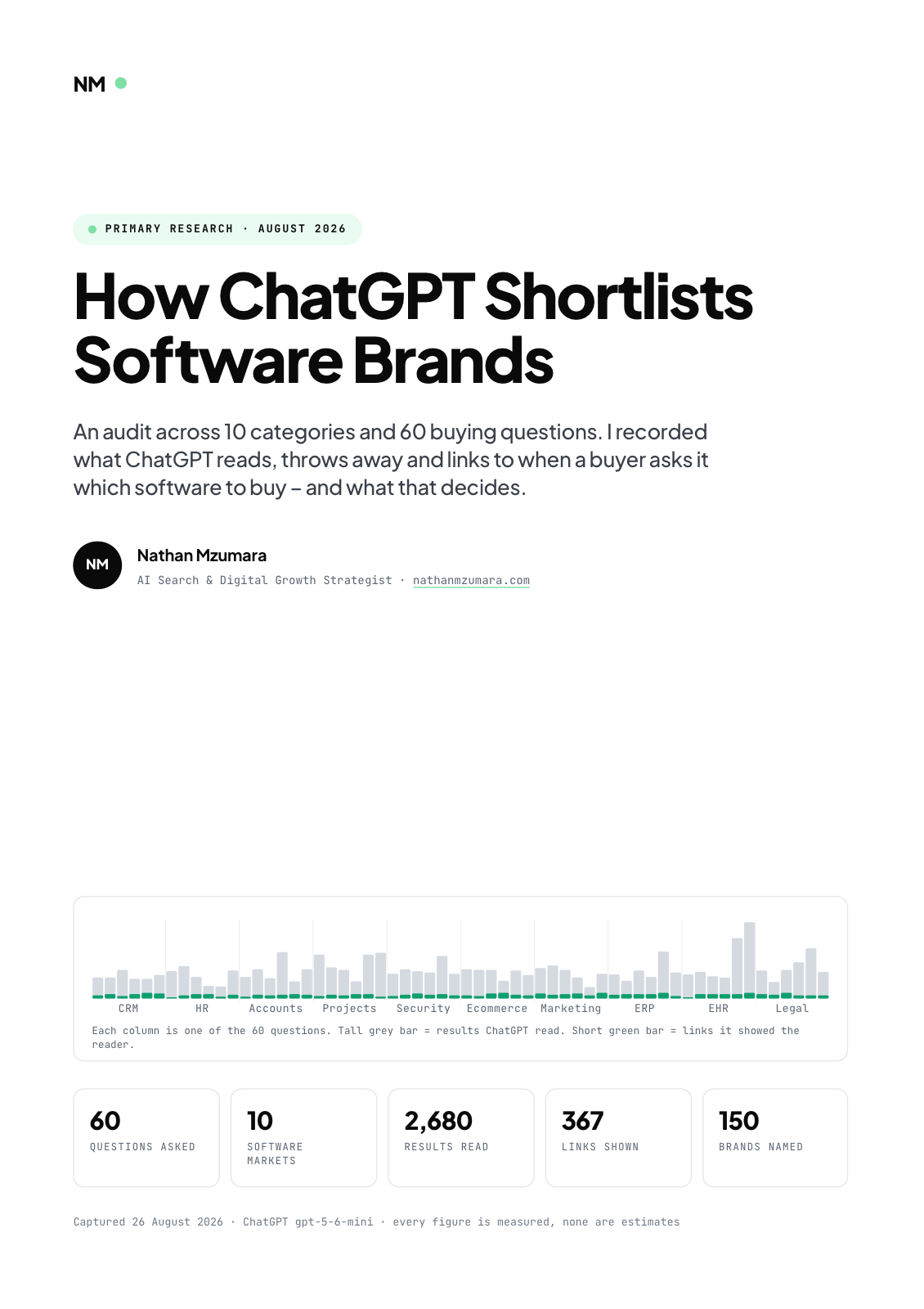
Primary research · August 2026
How ChatGPT Shortlists Software Brands
An audit across 10 categories and 60 buying questions. I recorded what ChatGPT reads, throws away and links to when a buyer asks it which software to buy, and what that decides.
- 60
- Questions asked
- 10
- Software markets
- 2,680
- Results read
- 367
- Links shown
Free download
Get the full report
35 pages · PDF · 536 KB. Enter your details and it downloads straight away.