AI Model & Product
LLM inference
Also known as: inference, model inference, large language model inference
LLM inference is the process of running a trained large language model to produce output from a prompt, as opposed to training the model in the first place. Each request is turned into tokens, processed by the model, and returned as generated text one token at a time. It is the step that happens every time someone asks an AI assistant a question.
What it is
Inference is the serving side of a language model: weights are already fixed, and the system spends compute turning an input prompt into an output sequence. It usually runs in two phases, a prefill phase that reads the prompt and a decode phase that generates tokens one after another. Anything the model is given at that moment, including retrieved web pages or documents, forms the context it reasons over.
Why it matters
AI answers about your brand are produced at inference time, which means the content pulled into the context window has a direct effect on what gets said. Inference also costs money and time per token, so assistants have practical limits on how many sources they read and how much of each page they keep. Understanding those limits explains why concise, well structured pages are quoted more often than long, unstructured ones.
How it works
Practitioners rarely run inference themselves, but they work with its constraints: keeping key facts high on the page, using clear headings and short passages that survive chunking, and making sure the retrieval layer can find a clean answer quickly. Engineering teams tune it with batching, caching of repeated prompts, quantised weights and smaller models for routine tasks. Where a business runs its own assistant, inference cost and latency become a budget line that shapes product decisions.
When it applies
It applies whenever a live model is generating an answer, including AI search results, chat assistants, support bots and content tools built on an API.
Examples
- A shopper asks an assistant to compare two broadband packages, and the model performs inference over retrieved pricing pages before writing a summary.
- An in-house support bot caches common prompts so repeat questions skip part of the inference cost.
- A content team notices answers get truncated for a long buying guide, and splits it into shorter pages so more of the useful text fits into the context passed at inference.
How it is measured
- Time to first token and total response latency for assistant answers
- Tokens consumed per request, input and output, as a cost driver
- Share of retrieved pages that actually appear in the generated answer
- Error and truncation rate for long or complex prompts
Related terms in AI Model & Product
- Agents APIAn Agents API is a programming interface for building applications where a model plans, calls tools and completes multi-step tasks rather than returning a single reply. The term is most often used for OpenAI's agent building interfaces, though other vendors offer equivalents. Teams use it to connect models to search, internal data and actions such as booking, updating records or generating reports.
- AI assistantAn AI assistant is a software product that uses a language model to hold a conversation, answer questions and carry out tasks on a user's behalf. It sits on top of one or more underlying models and adds an interface, memory, tools and safety controls. Examples include ChatGPT, Google Gemini, Microsoft Copilot, Claude and voice assistants such as Siri and Alexa.
- AI transcriptionAI transcription is the automatic conversion of spoken audio into written text using speech recognition models. Modern systems often add speaker labels, punctuation, timestamps and language detection, and can feed the output into summarisation or search. It is also called automatic speech recognition or ASR.
- BingBing is Microsooft's web search engine, available at bing.com and integrated into Microsoft Copilot and other Microsoft products. It maintains its own crawler, Bingbot, and its own index, and provides Bing Webmaster Tools for site owners. Its index and APIs have also supplied results to third-party search products and AI assistants.
- ChatGPT VoiceChatGPT Voice is the spoken conversation mode in OpenAI's ChatGPT apps, which lets you talk to the assistant and hear its replies read aloud. Advanced Voice Mode processes speech directly, so exchanges feel closer to a phone call and you can interrupt mid-answer. People use it hands free on mobile, and it is also available on desktop.
- Claude CodeClaude Code is Anthropic's agentic coding tool that works directly with a codebase, reading files, proposing and making edits, and running commands with permission. It runs in the terminal and in supported development environments, driven by natural language instructions rather than manual file by file editing. Marketing and growth teams use it for technical SEO, structured data and data tasks that would otherwise wait for engineering.
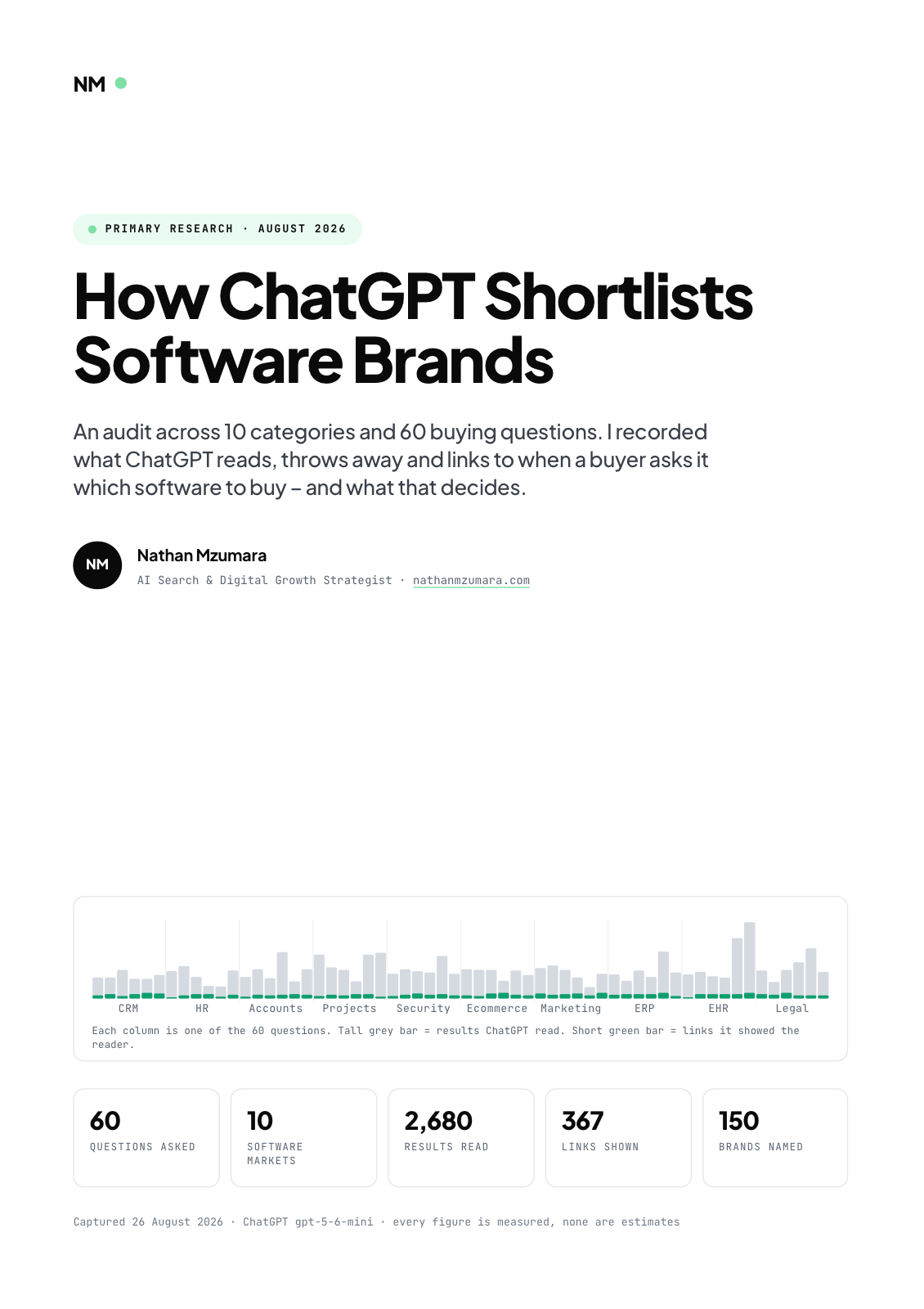
Primary research · August 2026
How ChatGPT Shortlists Software Brands
An audit across 10 categories and 60 buying questions. I recorded what ChatGPT reads, throws away and links to when a buyer asks it which software to buy, and what that decides.
- 60
- Questions asked
- 10
- Software markets
- 2,680
- Results read
- 367
- Links shown
Free download
Get the full report
35 pages · PDF · 536 KB. Enter your details and it downloads straight away.