AI Model & Product
Large language model
Also known as: LLM
A large language model is a neural network trained on very large amounts of text to predict the next token in a sequence, which lets it generate fluent language, follow instructions and summarise or reason over supplied material. LLMs sit behind chat assistants, AI answers in search results and most AI writing and research tools. They produce plausible text from patterns rather than looking facts up, so grounding and citation matter.
What it is
An LLM is a transformer based model with many parameters, trained first on broad text to learn language patterns and then tuned with instruction data and human feedback so it responds helpfully. It works in tokens, holds a limited context window, and can be extended with retrieval, tools and function calling. Different models vary in size, speed, cost and how well they follow instructions.
Why it matters
LLMs are the layer that now reads and rewrites your content before a person sees it, whether inside an AI answer, a chat assistant or a research agent. Visibility depends on whether a model can find your pages, parse them cleanly and quote them accurately, which is a different job from ranking a blue link. Understanding how the model handles context also explains common failure modes such as confident errors and outdated claims.
How it works
Practitioners use LLMs through APIs or interfaces, shaping behaviour with prompts, system instructions, examples and retrieval of trusted source documents. Marketing teams use them for drafting, clustering queries, classifying content, extracting entities and testing how assistants describe their brand. Content teams optimise for them by writing clear, extractable answers, keeping facts on the page and maintaining consistent entity information across the web.
When it applies
It applies any time content is consumed or produced through an AI assistant, AI search feature or automated content pipeline, which now covers most discovery and research journeys.
Examples
- A team prompts an LLM with a product page and asks what a buyer would still not know, then fills those gaps.
- A B2B brand tests several assistants monthly to see which competitors get named for its core category question.
- An agency uses an LLM to cluster twelve months of search queries into intent groups before rebuilding a content hub.
How it is measured
- Share of assistant answers that mention or cite your brand for target prompts
- Citation accuracy, measured as correctly attributed claims versus misquotes
- Crawl and fetch success rates for AI user agents on key pages
- Referral sessions and assisted conversions from AI assistant sources
Related terms in AI Model & Product
- Agents APIAn Agents API is a programming interface for building applications where a model plans, calls tools and completes multi-step tasks rather than returning a single reply. The term is most often used for OpenAI's agent building interfaces, though other vendors offer equivalents. Teams use it to connect models to search, internal data and actions such as booking, updating records or generating reports.
- AI assistantAn AI assistant is a software product that uses a language model to hold a conversation, answer questions and carry out tasks on a user's behalf. It sits on top of one or more underlying models and adds an interface, memory, tools and safety controls. Examples include ChatGPT, Google Gemini, Microsoft Copilot, Claude and voice assistants such as Siri and Alexa.
- AI transcriptionAI transcription is the automatic conversion of spoken audio into written text using speech recognition models. Modern systems often add speaker labels, punctuation, timestamps and language detection, and can feed the output into summarisation or search. It is also called automatic speech recognition or ASR.
- BingBing is Microsooft's web search engine, available at bing.com and integrated into Microsoft Copilot and other Microsoft products. It maintains its own crawler, Bingbot, and its own index, and provides Bing Webmaster Tools for site owners. Its index and APIs have also supplied results to third-party search products and AI assistants.
- ChatGPT VoiceChatGPT Voice is the spoken conversation mode in OpenAI's ChatGPT apps, which lets you talk to the assistant and hear its replies read aloud. Advanced Voice Mode processes speech directly, so exchanges feel closer to a phone call and you can interrupt mid-answer. People use it hands free on mobile, and it is also available on desktop.
- Claude CodeClaude Code is Anthropic's agentic coding tool that works directly with a codebase, reading files, proposing and making edits, and running commands with permission. It runs in the terminal and in supported development environments, driven by natural language instructions rather than manual file by file editing. Marketing and growth teams use it for technical SEO, structured data and data tasks that would otherwise wait for engineering.
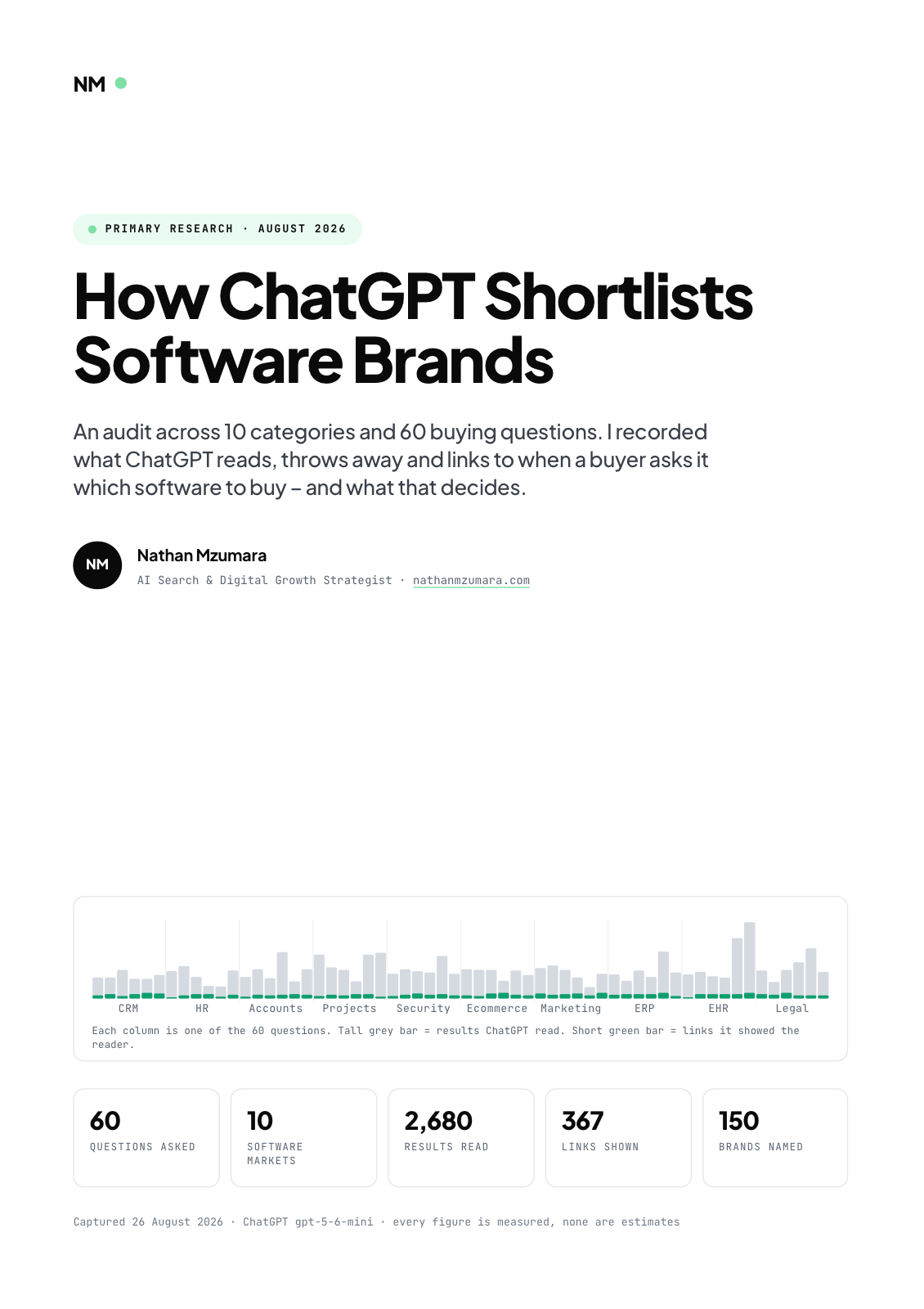
Primary research · August 2026
How ChatGPT Shortlists Software Brands
An audit across 10 categories and 60 buying questions. I recorded what ChatGPT reads, throws away and links to when a buyer asks it which software to buy, and what that decides.
- 60
- Questions asked
- 10
- Software markets
- 2,680
- Results read
- 367
- Links shown
Free download
Get the full report
35 pages · PDF · 536 KB. Enter your details and it downloads straight away.