AI Model & Product
Jalapeño
Jalapeño is a codename that has appeared in public model testing and community discussion as a label for an unannounced or in-testing AI model. Codenames like this are used so a model can be evaluated blind, without its vendor or final product name influencing testers. Any attribution of a codename to a specific company or release should be treated as unconfirmed until the vendor says so.
What it is
Jalapeño is an example of the food and codeword style labels that vendors and evaluation platforms use for pre-release model checkpoints. The name identifies a build during blind testing or staged rollouts and is not a shipping product name. Because these labels are deliberately opaque, the capabilities, ownership and eventual release of anything behind a codename are usually unclear while testing is under way.
Why it matters
Codename sightings are one of the earliest public signals that a new model is close, which matters if your visibility depends on how assistants retrieve and cite content. A new frontier model can change answer formats, citation behaviour and the volume of referral traffic from AI surfaces, so teams that track early signals can plan tests rather than react late. Equally, treating rumours as fact is a reputational risk, especially for publishers and analysts writing about vendors.
How it works
Practitioners watch blind comparison arenas, model listings, API string changes and developer communities for unfamiliar labels, then log sightings with dates and screenshots. They compare a codename's behaviour against known models, look for tell-tale formatting, refusal styles or knowledge cut-offs, and hold attribution as a hypothesis until an official announcement. Marketing teams use the lead time to prepare re-tests of their own brand and product queries once the model ships.
When it applies
It applies when you are monitoring the model release cycle, writing about unannounced products, or planning re-tests of AI answer visibility around a possible launch. It also applies when deciding how much weight to give unverified community reports in your own content.
Examples
- A stealth entrant labelled Jalapeño appears in a blind arena comparison and testers debate which lab it belongs to based on its output style.
- An AI newsletter notes several new codenames on a public leaderboard and frames them as signs that a release window is opening, without asserting ownership.
- A search team logs every codename sighting in a shared tracker, then re-runs its brand and category prompt set within days of any confirmed launch.
How it is measured
- Number of independent sightings of a codename, with dates and sources
- Elapsed time from first public sighting to an official vendor announcement
- Change in your brand's citation rate on a fixed prompt set before and after the related model ships
- Accuracy rate of your own attribution guesses, reviewed after each confirmed release
Insights on Jalapeño
Related terms in AI Model & Product
- Agents APIAn Agents API is a programming interface for building applications where a model plans, calls tools and completes multi-step tasks rather than returning a single reply. The term is most often used for OpenAI's agent building interfaces, though other vendors offer equivalents. Teams use it to connect models to search, internal data and actions such as booking, updating records or generating reports.
- AI assistantAn AI assistant is a software product that uses a language model to hold a conversation, answer questions and carry out tasks on a user's behalf. It sits on top of one or more underlying models and adds an interface, memory, tools and safety controls. Examples include ChatGPT, Google Gemini, Microsoft Copilot, Claude and voice assistants such as Siri and Alexa.
- AI transcriptionAI transcription is the automatic conversion of spoken audio into written text using speech recognition models. Modern systems often add speaker labels, punctuation, timestamps and language detection, and can feed the output into summarisation or search. It is also called automatic speech recognition or ASR.
- BingBing is Microsooft's web search engine, available at bing.com and integrated into Microsoft Copilot and other Microsoft products. It maintains its own crawler, Bingbot, and its own index, and provides Bing Webmaster Tools for site owners. Its index and APIs have also supplied results to third-party search products and AI assistants.
- ChatGPT VoiceChatGPT Voice is the spoken conversation mode in OpenAI's ChatGPT apps, which lets you talk to the assistant and hear its replies read aloud. Advanced Voice Mode processes speech directly, so exchanges feel closer to a phone call and you can interrupt mid-answer. People use it hands free on mobile, and it is also available on desktop.
- Claude CodeClaude Code is Anthropic's agentic coding tool that works directly with a codebase, reading files, proposing and making edits, and running commands with permission. It runs in the terminal and in supported development environments, driven by natural language instructions rather than manual file by file editing. Marketing and growth teams use it for technical SEO, structured data and data tasks that would otherwise wait for engineering.
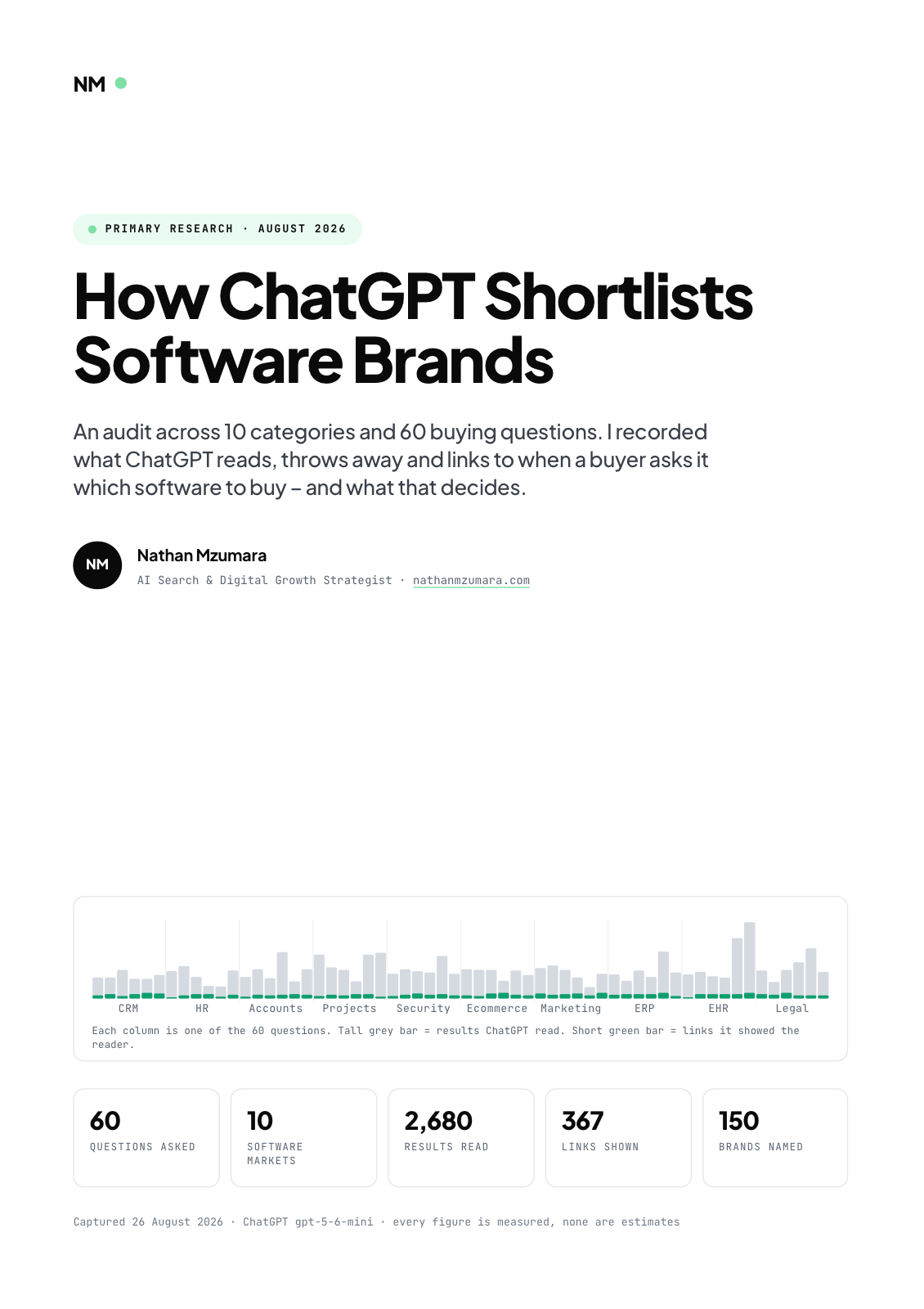
Primary research · August 2026
How ChatGPT Shortlists Software Brands
An audit across 10 categories and 60 buying questions. I recorded what ChatGPT reads, throws away and links to when a buyer asks it which software to buy, and what that decides.
- 60
- Questions asked
- 10
- Software markets
- 2,680
- Results read
- 367
- Links shown
Free download
Get the full report
35 pages · PDF · 536 KB. Enter your details and it downloads straight away.