AI Model & Product
GPT-5.5-Cyber
Also known as: OpenAI GPT-5.5-Cyber
GPT-5.5-Cyber is the name used for a cybersecurity-focused variant in OpenAI's GPT-5.5 line. Domain-specialised security models of this type are positioned for work such as vulnerability analysis, code review, threat intelligence and incident triage, usually with tighter access controls than general purpose models. Check the provider's own documentation for current availability, access terms and supported uses before planning around it.
What it is
A domain variant is a version of a frontier model tuned and evaluated for a particular field rather than general use. For security, that means stronger performance on tasks like reading unfamiliar codebases, reasoning about exploitability and drafting remediation, alongside guardrails intended to limit offensive misuse. Access to models in this category is commonly gated, with vetting or usage conditions applied.
Why it matters
Security work is a large, high-stakes use case where the cost of a wrong answer is measured in breaches rather than bad copy. For marketers and business owners the relevance is indirect but real: specialised model variants signal where vendors expect AI to be trusted with production decisions, and security teams increasingly set the rules for how AI tools are adopted across the business. Vendors selling into security will also need content that these models can read and cite correctly.
How it works
Security teams use models of this kind inside a controlled workflow: the model reviews code, logs or alerts, produces candidate findings with reasoning, and a human analyst validates before anything is actioned or disclosed. Outputs are logged for audit, and prompts are constrained so the model works on approved assets only. Adoption usually begins with a narrow pilot such as alert triage or dependency review, with measured false positive rates before scope widens.
When it applies
It applies when an organisation is evaluating AI assistance for defensive security work, or when governance policy needs to cover which models staff may use on sensitive code and infrastructure.
Examples
- A security team pilots the model on triaging a week of backlogged alerts and compares its judgements against the analyst queue.
- An engineering group runs AI-assisted review over third party dependencies before a major release, with every finding verified by a human.
- A CISO writes a policy stating that AI-generated vulnerability findings may not be disclosed externally without analyst confirmation.
How it is measured
- Proportion of AI-generated findings confirmed as genuine by a human analyst
- False positive rate on triage compared with the existing baseline process
- Mean time to triage and mean time to remediate, before and after adoption
- Coverage: share of repositories or alert classes included in AI-assisted review
Insights on GPT-5.5-Cyber
Related terms in AI Model & Product
- Agents APIAn Agents API is a programming interface for building applications where a model plans, calls tools and completes multi-step tasks rather than returning a single reply. The term is most often used for OpenAI's agent building interfaces, though other vendors offer equivalents. Teams use it to connect models to search, internal data and actions such as booking, updating records or generating reports.
- AI assistantAn AI assistant is a software product that uses a language model to hold a conversation, answer questions and carry out tasks on a user's behalf. It sits on top of one or more underlying models and adds an interface, memory, tools and safety controls. Examples include ChatGPT, Google Gemini, Microsoft Copilot, Claude and voice assistants such as Siri and Alexa.
- AI transcriptionAI transcription is the automatic conversion of spoken audio into written text using speech recognition models. Modern systems often add speaker labels, punctuation, timestamps and language detection, and can feed the output into summarisation or search. It is also called automatic speech recognition or ASR.
- BingBing is Microsooft's web search engine, available at bing.com and integrated into Microsoft Copilot and other Microsoft products. It maintains its own crawler, Bingbot, and its own index, and provides Bing Webmaster Tools for site owners. Its index and APIs have also supplied results to third-party search products and AI assistants.
- ChatGPT VoiceChatGPT Voice is the spoken conversation mode in OpenAI's ChatGPT apps, which lets you talk to the assistant and hear its replies read aloud. Advanced Voice Mode processes speech directly, so exchanges feel closer to a phone call and you can interrupt mid-answer. People use it hands free on mobile, and it is also available on desktop.
- Claude CodeClaude Code is Anthropic's agentic coding tool that works directly with a codebase, reading files, proposing and making edits, and running commands with permission. It runs in the terminal and in supported development environments, driven by natural language instructions rather than manual file by file editing. Marketing and growth teams use it for technical SEO, structured data and data tasks that would otherwise wait for engineering.
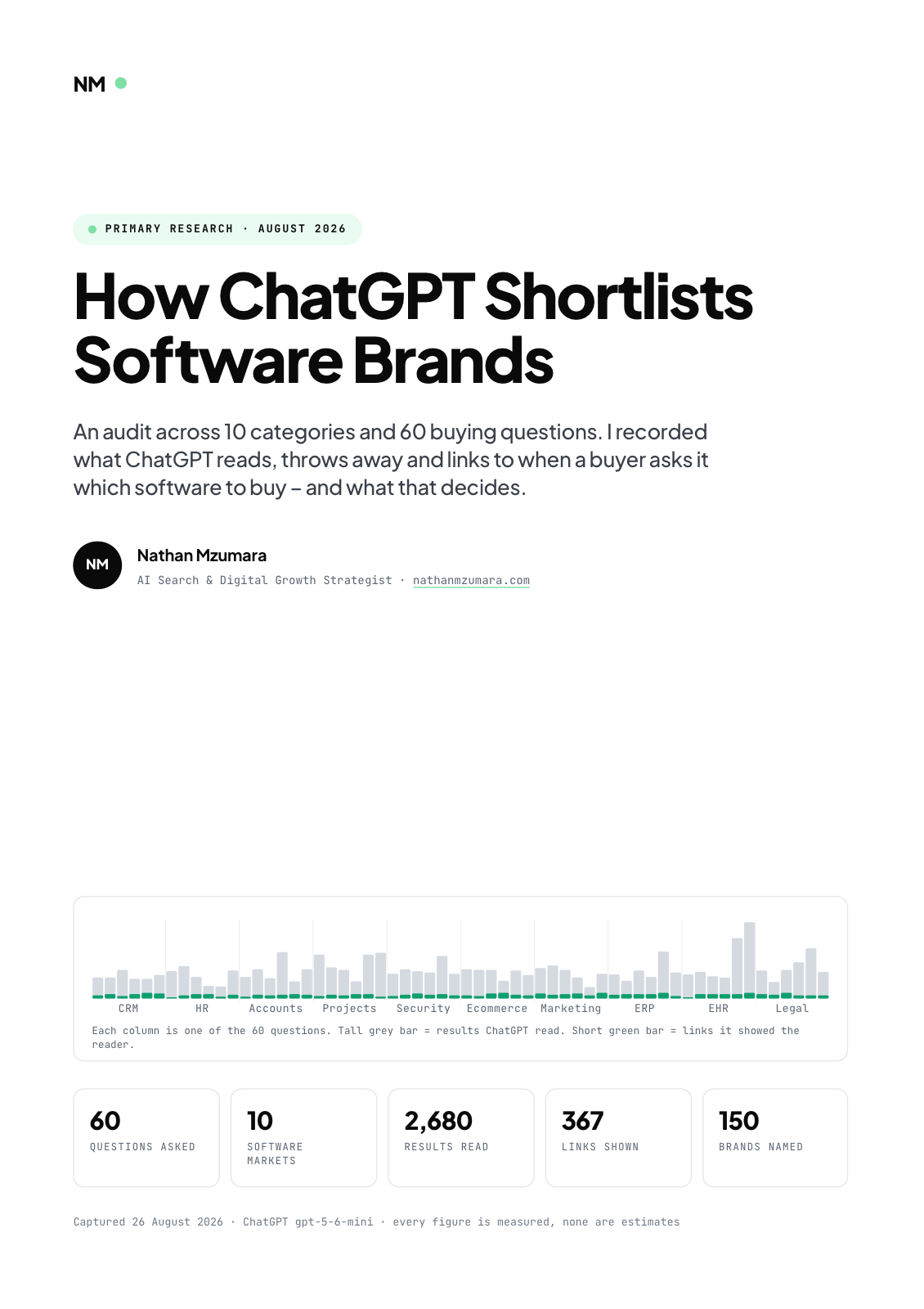
Primary research · August 2026
How ChatGPT Shortlists Software Brands
An audit across 10 categories and 60 buying questions. I recorded what ChatGPT reads, throws away and links to when a buyer asks it which software to buy, and what that decides.
- 60
- Questions asked
- 10
- Software markets
- 2,680
- Results read
- 367
- Links shown
Free download
Get the full report
35 pages · PDF · 536 KB. Enter your details and it downloads straight away.