Advertising & Paid Media
Google Ads
Also known as: AdWords, Google AdWords
Google Ads is Google's advertising platform, where businesses bid in an auction to show ads on Google Search, YouTube, Gmail, Google Maps and partner sites. Advertisers usually pay per click or per conversion, and ad placement depends on bid, expected click-through rate, ad relevance and landing page experience rather than bid alone. It was called Google AdWords until it was renamed in 2018.
What it is
Google Ads organises spend into campaigns by goal and network, with ad groups, keywords or audiences, creative assets and budgets underneath. Campaign types include Search, Shopping, Display, Video, Demand Gen and Performance Max, which spans several surfaces from one campaign. Bidding can be manual or automated towards a target cost per action or return on ad spend.
Why it matters
Paid search captures existing demand at the moment someone is looking, which makes it the fastest way to test messages, offers and landing pages. Its data is also useful beyond the channel: search terms reports show the exact language buyers use, which feeds organic content and product positioning. As AI answers absorb some informational queries, the balance between paid and organic demand capture is worth watching closely.
How it works
Practitioners set up conversion tracking first, then structure campaigns around commercial intent, write ads that match the query and the landing page, and use negative keywords to control waste. Ongoing work is mostly query mining, bid and budget allocation, creative testing and landing page improvement, with automated bidding given clean conversion data to learn from. Results are judged on profit or pipeline, not on clicks.
When it applies
Google Ads suits businesses with measurable conversions, sufficient search demand for their category and margins that support a paid acquisition cost. It is also useful for short-term needs such as launches, seasonal peaks or covering a gap while organic visibility is being built.
Examples
- A legal firm runs Search campaigns on high-intent service terms with call tracking and a tight negative keyword list.
- An online retailer uses Shopping and Performance Max driven by a well-structured product feed with accurate titles and stock data.
- A B2B software company bids on competitor comparison terms and sends traffic to a dedicated comparison page.
How it is measured
- Cost per acquisition and return on ad spend by campaign and product line
- Conversion rate by keyword, ad group and landing page
- Search impression share and share lost to budget or rank
- Incremental revenue from paid, tested against organic performance for the same terms
Insights on Google Ads
- Google Previews 'Ask Advisor'. Who Owns Ad Strategy Now?
- PMax Just Got a Theme Library. Your Asset Chaos Has an Off-Switch.
- The Shopify Sync Change That Could Wipe Your Product History
- Google Now Labels AI-Made Ads. Is Yours Ready?
- Google Just Cracked Open the PMAX Black Box With Channel Diagnostics
- Google Ads Just Replaced Its Overview Page With a Gemini Decision Engine
- Google's IP-Based Ad Measurement Hits the EEA on 3 August. Your Consent Mode Setup Is on the Clock.
- Google Ads Can Now Narrate Your Video With AI. Who Controls the Voice?
Related terms in Advertising & Paid Media
- AI-generated creativeAI-generated creative is ad and marketing creative produced or adapted using generative models, including images, video, voiceover, headlines and body copy. Teams use it to produce more variants, localise faster and test concepts that would be too costly to shoot. It still needs human direction, brand review and legal checks before it runs.
- Asset groupsAn asset group is the creative container inside a Google Performance Max or Demand Gen campaign, holding headlines, descriptions, images, logos, videos and audience signals. Google assembles ads from these assets and serves them across Search, Shopping, YouTube, Display, Discover, Gmail and Maps. Retail campaigns can tie an asset group to a specific set of products through listing groups.
- Brand safetyBrand safety is the practice of preventing advertising and brand content from appearing next to material that could damage reputation, such as violent, illegal or misleading content. Brand suitability is the related, narrower idea of matching placements to a specific brand's tolerance and values rather than a universal baseline. Both rely on exclusion lists, content classification and verification reporting.
- ChatGPT AdsChatGPT Ads refers to advertising placements inside OpenAI's ChatGPT. OpenAI has publicly signalled that advertising is part of its commercial plans and has been testing and building out ad capabilities, so the format details continue to change. For marketers it represents a possible new paid surface alongside organic visibility in AI assistants.
- ChatGPT Sponsored AgentsChatGPT Sponsored Agents is the name given to a paid placement format in which a brand's agent or assistant can be surfaced inside a ChatGPT conversation to help complete a task, such as booking, quoting or buying. It sits alongside other advertising formats OpenAI has discussed for ChatGPT, where commercial results are marked as sponsored rather than blended invisibly into answers. Availability, naming and mechanics are still moving, so treat any specification as provisional and check current OpenAI documentation before planning spend.
- Conversational advertisingConversational advertising is paid placement inside a dialogue, whether that is an AI assistant, a chatbot, a messaging app or a voice interface. Instead of a static creative next to content, the ad appears as a response, suggestion or handover at the point where the user has expressed intent. The defining features are turn-by-turn context, a disclosure label, and the option for the user to keep talking rather than click away.
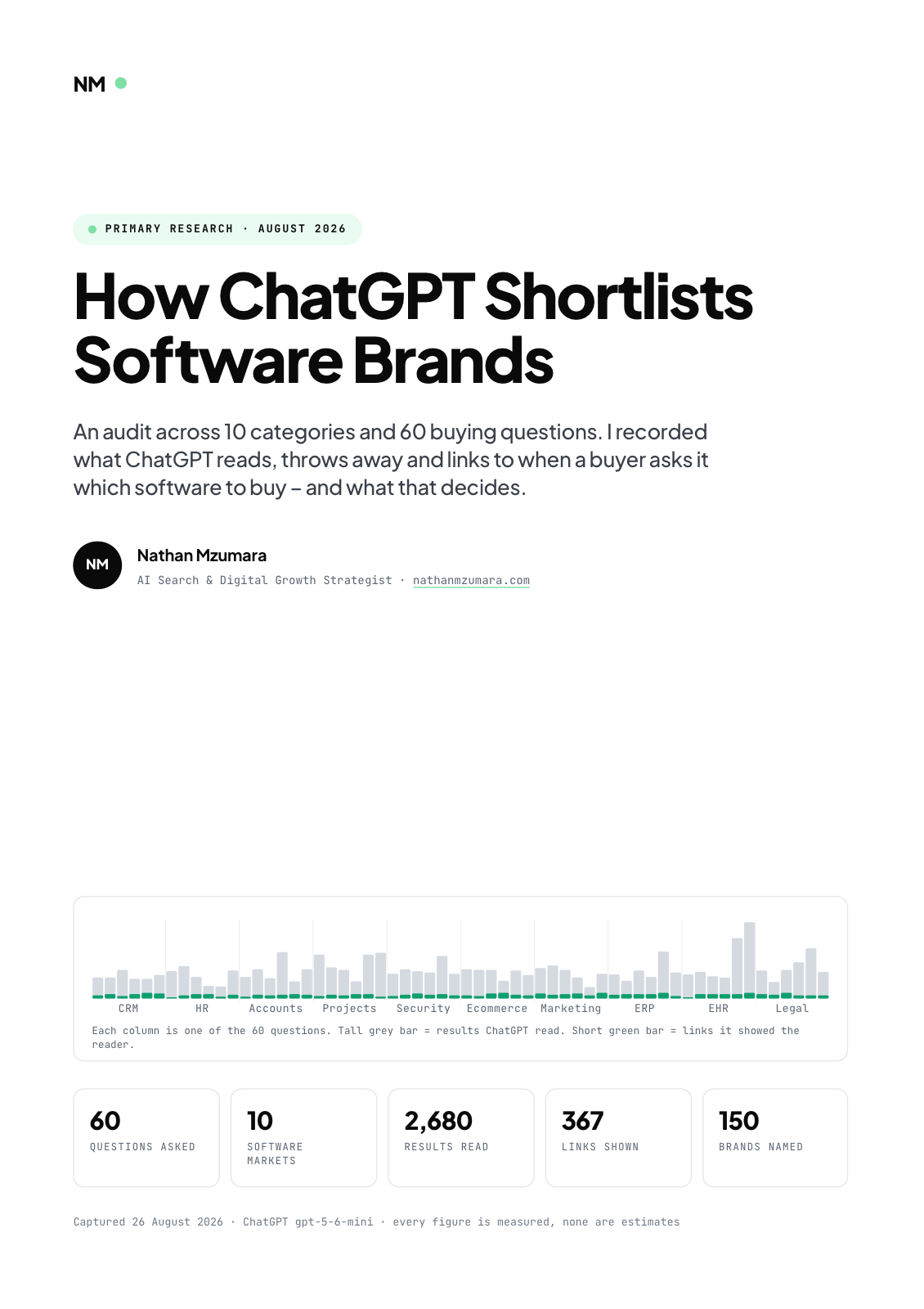
Primary research · August 2026
How ChatGPT Shortlists Software Brands
An audit across 10 categories and 60 buying questions. I recorded what ChatGPT reads, throws away and links to when a buyer asks it which software to buy, and what that decides.
- 60
- Questions asked
- 10
- Software markets
- 2,680
- Results read
- 367
- Links shown
Free download
Get the full report
35 pages · PDF · 536 KB. Enter your details and it downloads straight away.