Enterprise AI
ChatGPT Work
Also known as: ChatGPT for Work, ChatGPT Business
ChatGPT Work is the umbrella term for OpenAI's workplace plans, sold to organisations rather than individuals, and covering ChatGPT Business (previously Team) and ChatGPT Enterprise. These plans add a shared workspace, admin controls and administrative tools on top of the consumer product. OpenAI states that business workspace content is not used to train its models by default.
What it is
ChatGPT Work refers to the paid, organisation-level versions of ChatGPT rather than the free or personal Plus subscriptions. Buyers get a managed workspace with seats, roles, admin settings, shared custom GPTs and connectors to internal tools. Larger tiers add identity management, longer context, and more detailed compliance and analytics controls.
Why it matters
It matters for discovery because it changes where employees do their research. When staff ask a work-configured assistant instead of opening a search engine, brand visibility depends on whether your content is retrievable through the assistant's web search, connectors or the documents that a company has uploaded itself. For B2B marketers, it also shapes the buying committee: internal AI assistants increasingly summarise vendor shortlists before a human visits a site.
How it works
An administrator provisions the workspace, sets data and sharing policies, connects sources such as cloud storage or internal wikis, and rolls out shared GPTs for recurring tasks. Teams then use it for drafting, analysis, code and research, with browsing pulling in live web sources when the answer needs them. Marketers study which public pages get cited when relevant prompts are run inside such a workspace, and adjust content and structured data accordingly.
When it applies
It applies when you sell to organisations whose staff use managed AI assistants for research, or when your own team is standardising on a governed AI workspace instead of ad hoc personal accounts.
Examples
- A procurement team asks its company ChatGPT workspace to compare three shortlisted analytics vendors, and the assistant cites pricing and integration pages from each supplier's site.
- A marketing department builds a shared custom GPT loaded with brand tone rules so every campaign brief is drafted consistently.
- An IT admin connects the company knowledge base so support staff can answer policy questions without leaving the assistant.
How it is measured
- Share of relevant work-related prompts where your domain appears as a cited source
- Referral sessions attributed to chatgpt.com in analytics, segmented by landing page
- Seat adoption and weekly active users within your own workspace if you run one
- Accuracy of assistant answers about your products, scored by manual prompt testing
Insights on ChatGPT Work
- OpenAI Dots: Always-On Agents Land on Business Plans
- The ChatGPT Data Agent Removes the Query, Not the Responsibility
- Military Makes First Confirmed OpenAI Purchase: What It Means, and What Changed for Agents
- OpenAI Just Made AI the Default Operating Layer for Small Business
- ChatGPT Work Turns the Chatbot Into a Worker You Delegate To
- GPT-5.6 Is Live in Microsoft 365. Your Copilot Just Got an Autonomous Upgrade.
Related terms in Enterprise AI
- AI agentsAI agents are software systems that use a language model to plan and carry out multi-step tasks, rather than simply returning a block of text. They can call tools, query APIs, browse websites and write to other systems in pursuit of a goal, with varying degrees of human oversight. The term covers everything from a scripted assistant that books a meeting to a research agent that gathers sources and drafts a report.
- AI chipsAI chips are processors designed or optimised to run machine learning workloads, especially the large matrix operations behind training and inference. The category covers GPUs, tensor and neural processing units, and custom ASICs, usually paired with high-bandwidth memory and fast interconnects. They are also called AI accelerators or AI semiconductors.
- AI cost managementAI cost management is the practice of tracking, forecasting and controlling what an organisation spends on AI systems, including model API calls, inference compute, vector storage and the tooling around them. It applies familiar financial discipline to usage that is variable, token based and easy to scale without noticing. The goal is predictable spend at an acceptable level of quality and latency, rather than the lowest possible bill.
- AI drug discoveryAI drug discovery is the use of machine learning and computational models to support the early stages of finding and refining new medicines. Models are applied to tasks such as predicting protein structures, identifying candidate molecules, prioritising targets and estimating properties like toxicity or binding affinity. The aim is to narrow a very large search space before expensive laboratory and clinical work begins.
- AI infrastructureAI infrastructure is the stack of hardware, networking, storage and software needed to train, fine-tune and serve AI models at scale. It spans accelerators such as GPUs, the data centres and power that house them, and the orchestration and serving layers that turn raw compute into working model endpoints. For most marketing teams it is a cost and capacity constraint they consume through APIs rather than something they build.
- AI procurementAI procurement is the process of evaluating, buying and contracting artificial intelligence tools and services, from assistants and content platforms to models accessed through an application programming interface. It covers commercial terms alongside security, data protection, accuracy and integration questions that do not arise with ordinary software. Most organisations run it as a structured review with pilots, stakeholder sign off and defined exit conditions.
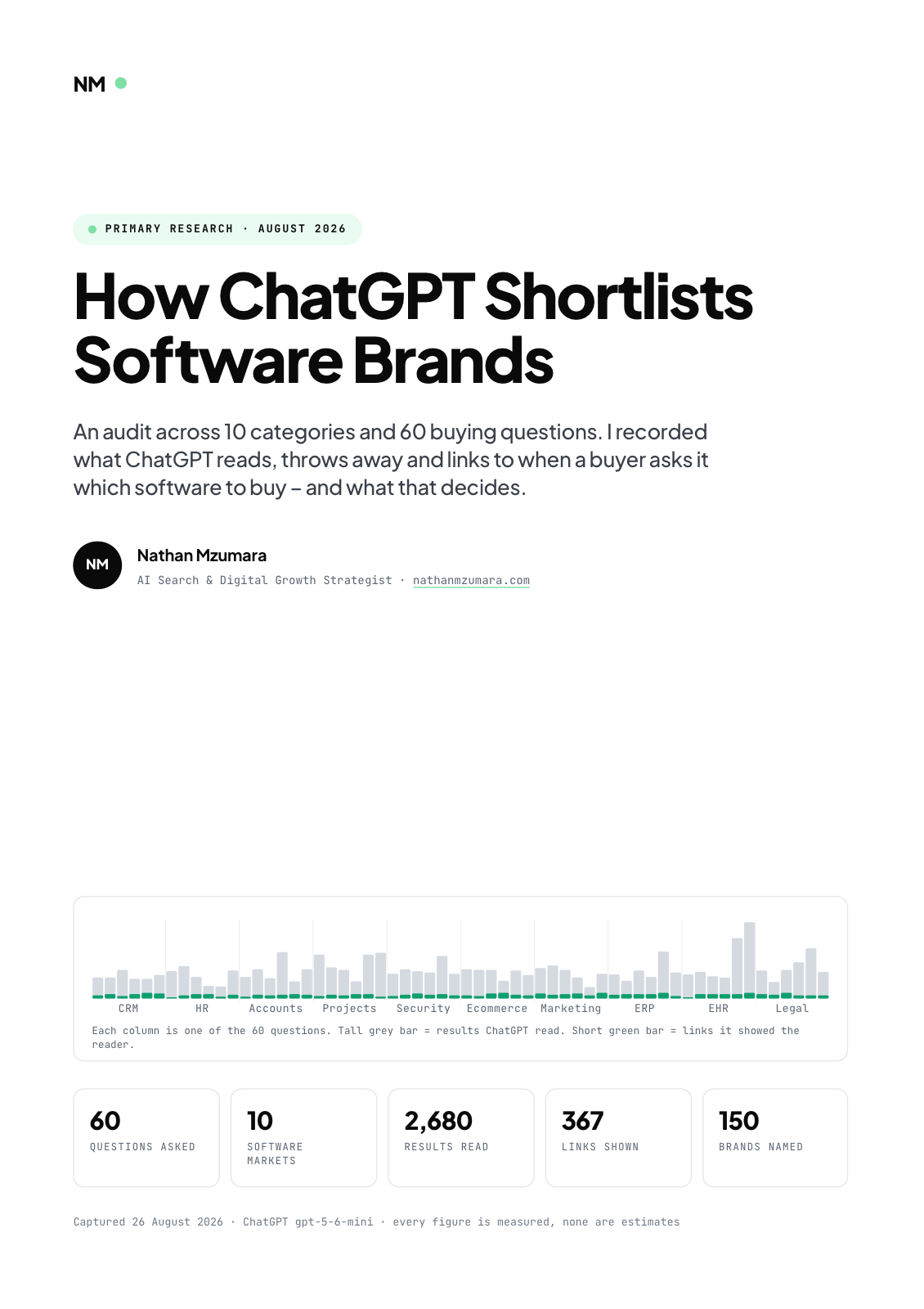
Primary research · August 2026
How ChatGPT Shortlists Software Brands
An audit across 10 categories and 60 buying questions. I recorded what ChatGPT reads, throws away and links to when a buyer asks it which software to buy, and what that decides.
- 60
- Questions asked
- 10
- Software markets
- 2,680
- Results read
- 367
- Links shown
Free download
Get the full report
35 pages · PDF · 536 KB. Enter your details and it downloads straight away.