Issue 15. the login wall fell and your site is now read by machines
TL;DR
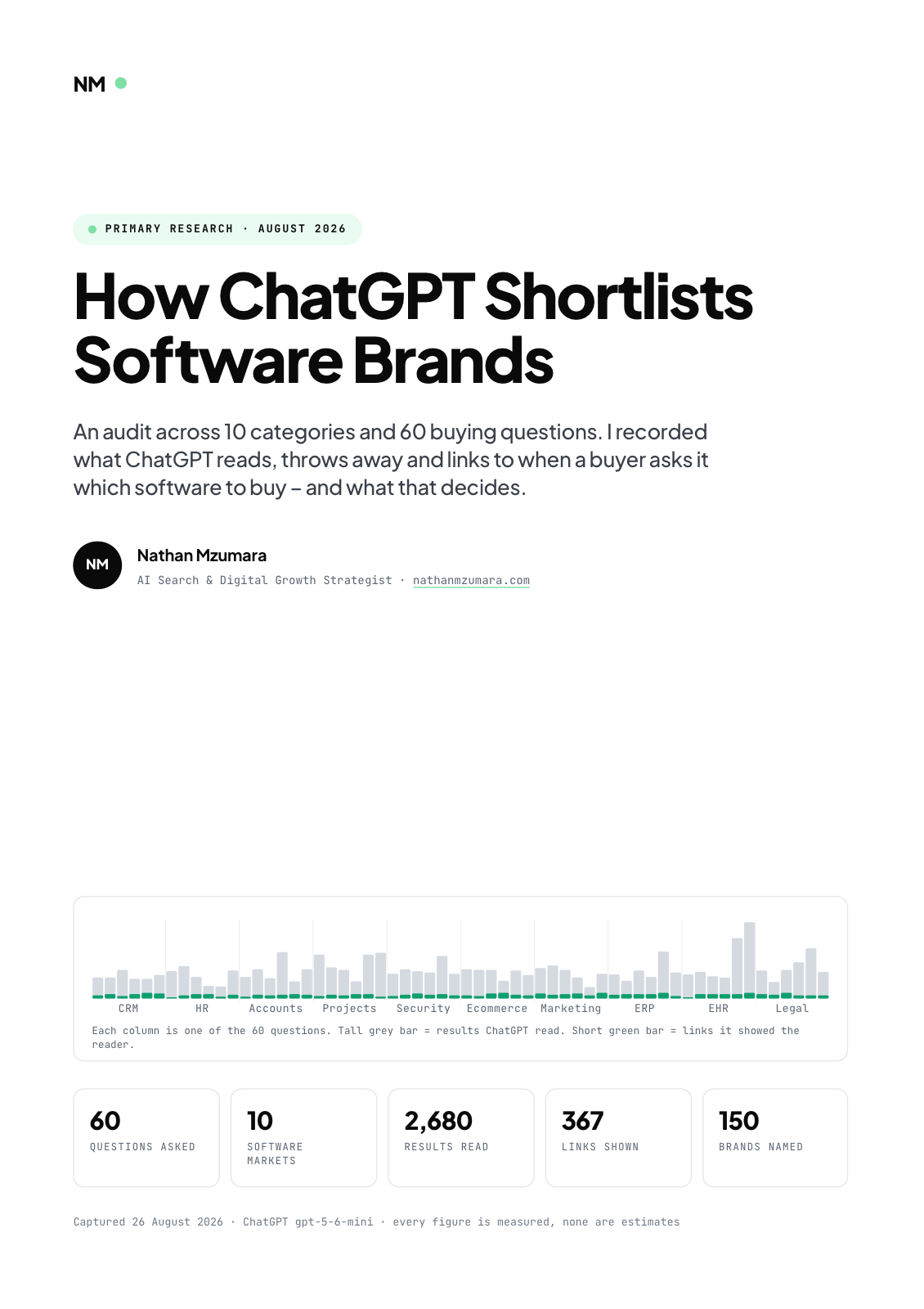
Two labs shipped agentic browsing in the same fortnight: ChatGPT Work can now sign in to sites on its own, and Claude reads pages and fills forms inside Cowork. GA4 is rebuilding its reporting workspace around a '+ Create' button, rolling out to all accounts now. And fresh primary research on 2,680 ChatGPT search results shows the discipline is measuring the wrong thing: only 11% of URLs the model reads ever become a citation.

1. ChatGPT Work can now sign in to your site on its own
- What
- OpenAI confirmed that ChatGPT Work can use its own computer and browser to log in to websites, on web and mobile, without ever seeing your username or password. The agent operates a real browser session inside a controlled environment, so it clicks, scrolls and submits like software, because it is software. OpenAI's own examples include booking DMV or passport appointments, checking insurance reimbursements, submitting invoices to accounting software and filling permit applications. Ignore the 'military makes first confirmed OpenAI purchase' searches doing the rounds: the confirmed news that matters here is agent sign-in.
- When
- 25 August 2026
- How it shifts discovery
- This breaks three things growth teams rely on. Form UX built for human eyes (tooltips, hover states, multi-step wizards) can trip an agent, so clear labels, stable selectors and honest error messages matter more. Bot detection built to block every non-human session may now quietly reject the traffic your own customers are sending on their behalf. And analytics that assume a human cannot separate an agentic session from a real one, so your conversion, attribution and personalisation data starts to blur. Audit your login and booking flows against a non-human visitor, review your CAPTCHA and rate-limiting rules, and start tagging agent sessions before they distort your funnel.
- Questions to ask
- Can an automated session complete our core login, form and booking flows without a human?
- Does our bot detection block agent traffic that a real customer has authorised?
- Can we separate agentic sessions from human ones in analytics today?
- Sources
2. GA4 rebuilds reporting around a '+ Create' button
- What
- Google Analytics is rolling out redesigned dashboards to all accounts, rebuilt around a central '+ Create' button with drag-and-drop card layouts and in-dashboard funnels. From one place you build, customise and organise your core performance views instead of jumping between fixed report templates and separate Explorations. The data model is unchanged: events, parameters, conversions, audiences and attribution all behave exactly as before. This is a presentation layer update, so historical data and existing definitions carry over untouched.
- When
- Announced 27 August 2026, rolling out to all accounts over the coming weeks
- How it shifts discovery
- For growth teams this changes where people live day to day and how fast they ship a shareable view. Drag-and-drop dashboards cut build time so reporting becomes a five-minute task, and a shared template means marketing, product and finance read the same funnel rather than three competing versions of the truth. Before your account switches, screenshot your current core reports and note where each metric lives, then reconcile your numbers before and after so you can prove nothing changed in the counting. The real win is standardisation: build every team off one canvas and you stop reconciling and start acting.
- Questions to ask
- Have we captured our current core reports before the redesign lands?
- Do our key metrics reconcile identically before and after the switch?
- Can we standardise on one shared dashboard template across teams?
- Sources
3. Claude gets a built-in browser that reads pages and fills forms
- What
- Anthropic has folded a native browser into Cowork, so Claude can open real pages, read their content, parse structure, extract prices and features, fill forms and complete tasks on its own. The person asking never visits your site; a machine reads it and reports back. This is the second big agentic-browsing launch in weeks, after ChatGPT Work, and the pattern is now clear: the human click is being replaced by a machine read. The rendering, the hero image and the animation stop mattering. What the agent can parse is what counts.
- When
- Shipped in stages, with the built-in Cowork browser the latest step (published on the site 27 August 2026)
- How it shifts discovery
- Your site now sits at step three of the flow: the read. If the agent cannot parse your page cleanly, you drop out of the answer before the user knows you existed. Ranking for a person is no longer the whole job; the battle is being crawled, parsed and cited by the agent. Teams that only measure human clicks will miss the moment their traffic moves behind the assistant. Make your pricing, comparison and product pages agent-readable: clean semantic structure, extractable claims in text (not images), stable markup and no reliance on hover or animation to convey meaning.
- Questions to ask
- Can an agent extract our prices and features from page text, not just images?
- Is our page structure clean enough to parse without rendering?
- How do we measure retrieval by agents, not just human clicks?
- Sources
4. In head-to-head prompts, your own site is the whole evidence base
- What
- When a buyer names the vendors, ChatGPT stops shopping and starts fact-checking against the vendors' own pages. Asked to compare CrowdStrike and SentinelOne, ChatGPT read 43 results from just three domains and sent all eight of its citations to the two vendors' own product and pricing pages. Across the study, head-to-head prompts took 91.0% of their citations from vendor-owned domains, named the fewest brands (a mean of 2.1) and produced the longest answers (a mean of 1,034 words). Cybersecurity took 66.7% of citations from vendor-owned pages, above the 65.9% corpus average.
- When
- Research captured 26 August 2026
- How it shifts discovery
- In every head-to-head your prospects run, the answer is built almost entirely from your website and your competitor's. There is no third party to blame and no analyst to hide behind. That means your product and pricing pages must carry clear, extractable, checkable claims on the exact dimensions a buyer compares (capabilities, response, rollback, workflows, price). Audit your comparison-relevant pages against your closest competitor and make sure every claim you want cited is stated plainly in text the model can bind a citation to.
- Questions to ask
- Do our product and pricing pages state checkable claims the model can cite?
- How do we compare, feature by feature, against the competitor we are named beside?
- Is any key differentiator locked behind gated pricing or an image?
- Sources
5. Your AI visibility tool is blind to 79% of what ChatGPT reads
- What
- Across 60 software buying answers ChatGPT pulled 564 distinct domains into context and cited only 118 of them, leaving 79.1% of the corpus it actually consulted invisible to citation-only tools. Domain survival (the odds a publisher, once read, is named anywhere) is 20.9%; URL survival is 11.09%. The retrieval set is available in the response stream but discarded before render, so tools working from the rendered page or an API response only ever see the final citations. If your dashboard says 'not cited', you cannot tell whether you were absent from the room or present and overruled.
- When
- Research captured 26 August 2026
- How it shifts discovery
- Citation-only monitoring reports two completely different problems as the same zero. A brand never retrieved has a discoverability problem (the query fan-out is not surfacing its pages); a brand retrieved but never cited has a conversion problem (its pages surface but lack extractable, checkable claims). Those need opposite fixes: one is content structure, the other is discoverability. Instrument the response stream to capture the retrieval set, then split your reporting into 'were we read' and 'were we cited' so you diagnose the right failure.
- Questions to ask
- Are we measuring retrieval, or only the citations we can see?
- When we are not cited, were we read and overruled, or never retrieved at all?
- Do our pages carry the extractable claims that citations bind to?
- Sources
6. The unknown comparison sites beating G2 in ChatGPT
- What
- A long tail of 43 small, independent software comparison sites earned 53 of ChatGPT's 367 citations, 14.4% of the total and 3.5 times what G2, Capterra, Software Advice, TrustRadius and TechnologyAdvice managed combined. Two of them, erpresearch.com and ciopages.com, rank fifth and sixth on the most-cited-domain list for the entire study, ahead of Salesforce, Microsoft, Asana and Gartner. Most have no brand recognition and, in some cases, no obvious business model beyond affiliate links. They win on structure, not authority: dated, titled, tabular comparisons of named products with prices, published fast.
- When
- Research captured 26 August 2026
- How it shifts discovery
- Comparison and 'versus' pages are the single largest identifiable retrieved content type at 525 results (19.6% of the corpus), ahead of best-of listicles at 371. Reviews, the format the aggregators are built on, account for just 17 results across the entire corpus (0.6%). The small sites are not out-writing anyone; they are out-formatting them. Publish your own dated, tabular comparison pages with named products and prices in clean HTML tables, and treat page shape as a first-class ranking factor for retrieval.
- Questions to ask
- Do we publish dated, tabular comparison pages the retrieval layer looks for?
- Are our prices and products in parseable tables rather than prose or images?
- Are we relying on aggregators that convert poorly for our category?
- Sources
7. HR software in ChatGPT: six prompts, six different winners
- What
- HR and payroll produced the least stable shortlist of any category in the study. Across six phrasings of the same buying question the top-ranked vendor was different every time: Rippling, Paylocity, Workday, ADP, BrightHR and Oracle HCM each led exactly once. Mean pairwise shortlist overlap was 0.185 against a corpus average of 0.338, and 19 distinct brands surfaced across the six prompts. The cause is category breadth: 'HR and payroll software' spans point payroll bureaux, mid-market HRIS, employer-of-record platforms and enterprise HCM, so six differently shaped questions address six different product classes.
- When
- Research captured 26 August 2026
- How it shifts discovery
- Any claim that 'we rank first in ChatGPT for HR software' is almost certainly true for one phrasing and false for the other five, and a competitor's identical claim is just as fragile. Stop measuring a single prompt and start tracking the spread across the phrasings that map to your actual product class. Target the segment-constrained questions where your product genuinely fits, rather than chasing the volatile unconstrained 'best HR software' slot.
- Questions to ask
- Which specific phrasings map to the product class we actually sell?
- Are we tracking shortlist volatility across prompts, not a single query?
- Do our pages state the segment we are best for, in extractable terms?
- Sources
8. Forty-five reads, six links: how ChatGPT actually cites brands
- What
- Across 60 purchase-intent software prompts, ChatGPT read a mean of 44.7 search results per answer and rendered 6.1 citations, with 88.91% of the 2,327 unique URLs pulled into context never shown to the user. A recommendation is assembled in five stages (route, fan out, read and discard, compose, attach citations), and the buyer sees only the last. All 60 turns resolved to gpt-5-6-mini and 100% triggered web retrieval; not one was answered from memory alone. Notably, 69.3% of the 358 brand recommendations carried no citation to that vendor anywhere in the answer.
- When
- Research captured 26 August 2026
- How it shifts discovery
- The compression between what the model reads and what it links is the single most important fact in AI search visibility, and it is measured at the network layer rather than by scraping the rendered page. Citations bind mostly to pricing, feature and capability statements (65.9% pointing at vendor-owned pages), so those are the claims worth making extractable. Instrument the response stream to see the full retrieval set, and write your pages so the specific claims you want cited are stated plainly and checkably.
- Questions to ask
- Which of our claims are structured to earn a citation pill?
- Are we instrumenting the stream, or only reading rendered citations?
- How often are we recommended without any link back to us?
- Sources
9. GA4's official rollout timeline and mechanics
- What
- Google Analytics confirmed the redesigned dashboards directly, calling it a 'streamlined command center' rolling out to all accounts over the next few weeks. The post confirms one-click dashboard creation, drag-and-drop cards and in-dashboard funnels as the core mechanics. This is the official source behind the workspace change, adding the rollout window and the vendor's own framing.
- When
- Posted 27 August 2026
- How it shifts discovery
- This gives you the timeline to plan against: the change is staged over several weeks, so most accounts have a short window before it lands. Use it to brief your team on the new build flow and to lock down your reporting baseline. Treat the '+ Create' canvas as the new starting point for every stakeholder view and standardise before people build ad hoc.
- Questions to ask
- When is our account scheduled to receive the redesign?
- Have we briefed stakeholders on the new build workflow?
- Is our baseline documented so we can prove numbers are unchanged?
- Sources
10. Claude's Cowork browser: a new non-human discovery surface
- What
- Anthropic is rolling out a built-in browser inside Cowork on desktop that opens sites, reads pages and completes forms on its own. This is distinct from Claude driving your own browser via computer use: it is a separate sandboxed browser inside Cowork with its own default settings. It is an emerging non-human discovery surface that SEO and GEO teams now have to account for alongside ChatGPT's agent.
- When
- Rolling out on desktop to all paid plans over the following week
- How it shifts discovery
- Every agentic browser that lands on your site is another reader that is software, not a person, and it will multiply the agent traffic hitting your forms and pages. Confirm your pages are parseable and your forms completable by an automated session, and add these surfaces to your monitoring so their sessions do not silently distort your analytics. Plan for a web where multiple assistants read on the user's behalf, not just one.
- Questions to ask
- Are we accounting for more than one agentic browser hitting our site?
- Can these sandboxed sessions complete our forms without a human?
- Do our analytics flag agent sessions from multiple assistants?
- Sources
Key takeaways
What to walk away with this week
- 01
Two agentic browsers now sign in and fill forms on their own: audit your login, booking and form flows against a non-human visitor.
- 02
Your bot detection may be blocking traffic your own customers authorised; review CAPTCHA and rate limiting now.
- 03
GA4's redesigned '+ Create' dashboards change the workflow, not the data model; screenshot reports and reconcile numbers before the switch.
- 04
Only 11% of URLs ChatGPT reads become citations, so measure retrieval, not just citations, and split 'were we read' from 'were we cited'.
- 05
Comparison and versus pages dominate what gets retrieved; dated, tabular, parseable pages beat authority alone.
- 06
In head-to-head prompts, 91% of citations come from vendor-owned pages, so your own site is the evidence base.