Google Ask Advisor Promises First Insight in Minutes

Google Analytics started publicly marketing Ask Advisor on 30 September 2026, with the claim that it cuts the time from raw data collection to first insight from hours to minutes. Google Ask Advisor is the natural-language layer inside Google Analytics. The post named no pricing, no markets, no plans and no rollout timing.
That absence matters more than the speed claim. If anyone in the business can ask a question in plain English and get a confident answer, the constraint stops being analyst capacity and becomes the quality of your data model.
What did Google Analytics say about Ask Advisor?
The post from the Google Analytics account on X was published at 18:54:53 UTC on 30 September 2026. It is short, and every detail in it is worth reading literally.
- The product: Ask Advisor is a feature in Google Analytics.
- The claim: Google Analytics states that Ask Advisor reduces the time from raw data collection to first insight from hours to minutes.
- The framing: the post describes the change as speeding up "your path from raw data to actionable insights".
- The proof point: the post says Ask Advisor is "helping teams transform how they work", and links to a Google blog post on Google Ads and Analytics AI updates for detail.
- The campaign: the link carries tracking parameters naming the campaign measurement_askadvisorcustomerquote2_093026, which tells you this is a scheduled marketing push built around a customer quote.
- The reception: at the time of capture the post had 5 likes and 1 retweet, and no top comments were returned.
Read on the material alone, this is a marketing claim about time saved, not a documented product change. There is no changelog, no eligibility note and no availability date. The detail sits in a separate Google blog post covering Google Ads and Analytics AI updates.
Why the bottleneck moves rather than disappears
Ask Advisor does not make your data correct. It makes your data faster to interrogate. Those are different things, and only one of them is a productivity win.
In most organisations the analyst was never just a query engine. The analyst was the filter that caught the broken event, the duplicated key event and the channel grouping that quietly dumps paid social into direct. Remove the filter and you keep the speed, but you lose the check.
Here is what a natural-language layer sits on top of, and what breaks first when non-analysts start asking questions unsupervised:
- Event naming: inconsistent event names across templates and platforms mean two questions about the same behaviour return two different numbers.
- Key event definitions: if three teams have each marked a different action as a key event, conversion answers will be internally contradictory and nobody will know which one is right.
- Channel groupings: custom groupings that nobody has reviewed in eighteen months will be summarised as fact, and budget conversations will follow them.
- Consent mode gaps: where consent rates vary by market, modelled and observed data sit side by side, and a plain-English answer rarely says which one it used.
- Conversion window settings: the change that pushed the Google Analytics conversion window out to 90 days shifts how credit lands across channels, as covered in our breakdown of the 90-day conversion window update.
A clean property gets faster. A messy property gets fast at being wrong, at scale, with no analyst in the loop to catch it.
What Ask Advisor changes for CMOs, VPs and growth leaders
For a CMO, the practical effect is that analytics answers stop being produced by a small trained group and start being produced on demand by anyone with property access. Volume of answers goes up. The variance in those answers goes up too.
For a VP of growth, the effect is on decision speed. A weekly reporting cycle that took hours to prepare becomes a question asked in a meeting. That is genuinely useful when the underlying model is trustworthy, and dangerous when it is not.
For a founder, the effect is cultural. Confident natural-language output reads as authoritative even when it is summarising a broken key event. People stop asking where the number came from.
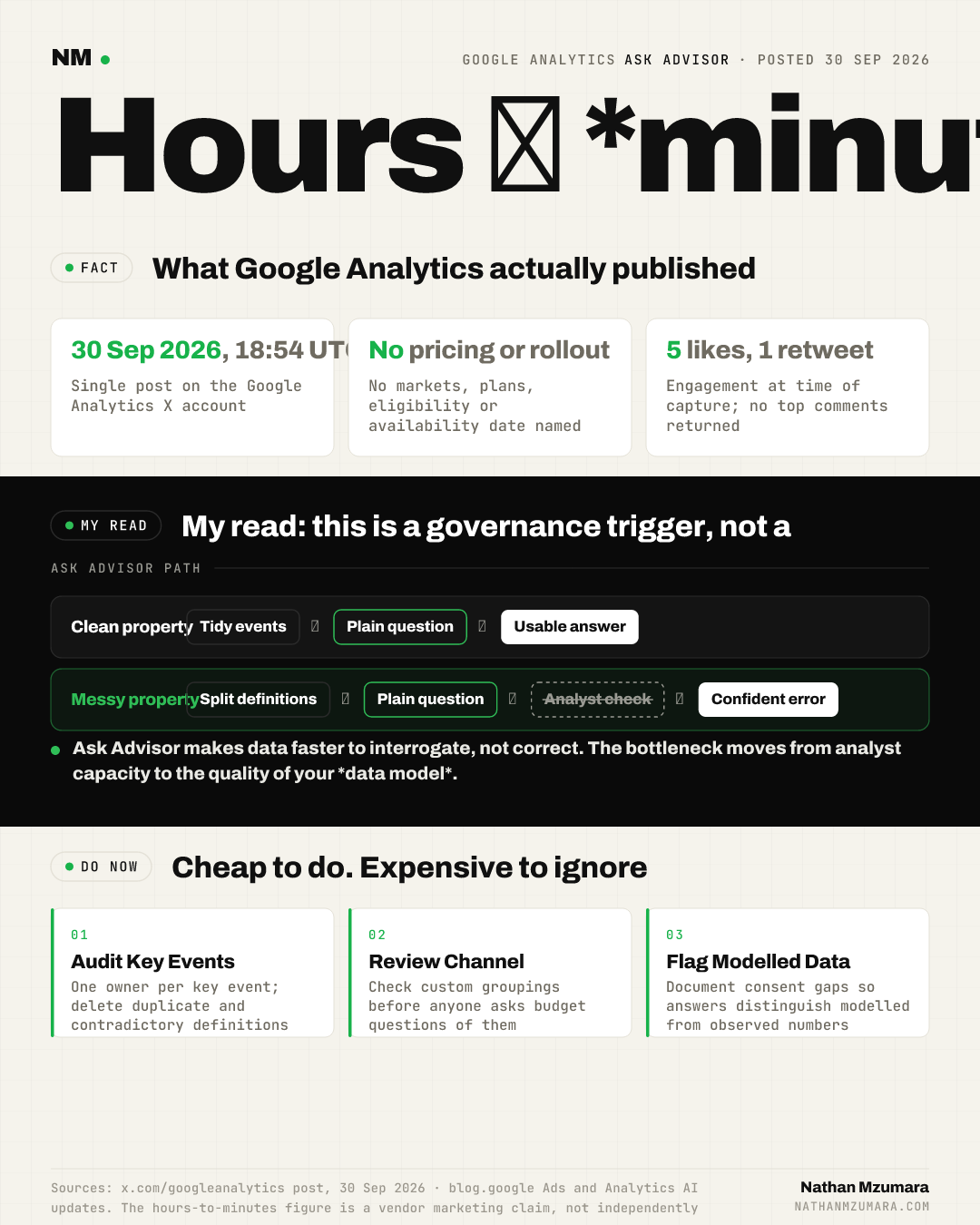
My read is simple: treat this as a governance trigger, not a productivity win. The cost of a wrong answer has not fallen. The speed at which wrong answers reach a budget meeting has risen.
The 2023 GA4 migration is the precedent worth remembering
The 2023 move to Google Analytics 4 is the closest comparison, and the lesson was not about the interface. Teams that had already fixed their tracking carried clean history forward. Teams that had not inherited years of data they could not use for anything serious.
The pattern repeats here, with one difference. In 2023 the damage was visible, because reports were obviously empty or obviously wrong. A natural-language answer does not look empty. It looks finished.
| Factor | GA4 migration, 2023 | Ask Advisor, 2026 |
|---|---|---|
| What changed | The data model and the reporting interface | Who can ask questions of the data |
| Who felt it first | Analysts and data engineers | Marketers, VPs and founders |
| Failure mode | Missing or unusable history | Confident answers from unreviewed definitions |
| How visible the failure is | Obvious | Hidden inside fluent prose |
Comparison of the 2023 Google Analytics 4 migration and the 2026 Ask Advisor push, based on the stated scope of each change.
The risk: losing two layers of raw signal at once
There is a second-order effect that deserves attention at board level. AI is now summarising demand on the way in, and summarising analytics on the way out.
Externally, AI search answers questions without sending a click, so query-level and referral signal thins. We covered how uneven that visibility is in our analysis of brand visibility in AI search. Internally, a natural-language layer narrates your own data back to you in prose.
Marketing leaders lose two layers of raw signal in the same period. That raises the value of the things that do not depend on either layer: first-party measurement, incrementality testing and marketing mix modelling. Dashboard narration is not a substitute for a holdout test.
The counter-view: governance usually follows adoption
The honest counter-argument is that nobody fixes an event taxonomy in the abstract. Teams fix data models when a bad answer embarrasses someone senior. Opening Ask Advisor to non-analysts might be the fastest way to surface every inconsistency that has been tolerated for years.
For that to hold true, two things have to be in place. Questions must be logged and reviewed, and someone must own the corrections. Without both, you get exposure without repair.
What to do this week before you open Google Ask Advisor to the business
- Audit your event taxonomy and key events. Name one owner per key event and remove duplicates.
- Write down which questions the tool is allowed to answer unsupervised, and which require an analyst.
- Check consent mode coverage by market, and record where modelled data is filling gaps.
- Review channel groupings and your conversion window settings before anyone asks an attribution question.
- Keep human sign-off on anything that moves budget. No exceptions in the first quarter.
Google Analytics has not published pricing, markets, plans or availability for Ask Advisor, so there is time to prepare before this lands across your accounts. Use it. Google Ask Advisor will make a well-governed property considerably faster, and it will make a neglected one confidently wrong in front of an audience that cannot tell the difference.
Tags
