GA Now Writes Your Data Story First. Who Edits It?

Google Analytics is adding AI Overviews to its homepage, so the moment you log in you see plain-language summaries of performance shifts and traffic trends before you touch a single report. Alongside it come mobile agentic experiences and anonymised industry benchmarks that compare you against peers automatically.
For growth leaders this is a quiet but real change in who interprets your data. The machine now writes the first draft of your data story, and the first draft usually sets the narrative everyone else inherits.
What actually changed
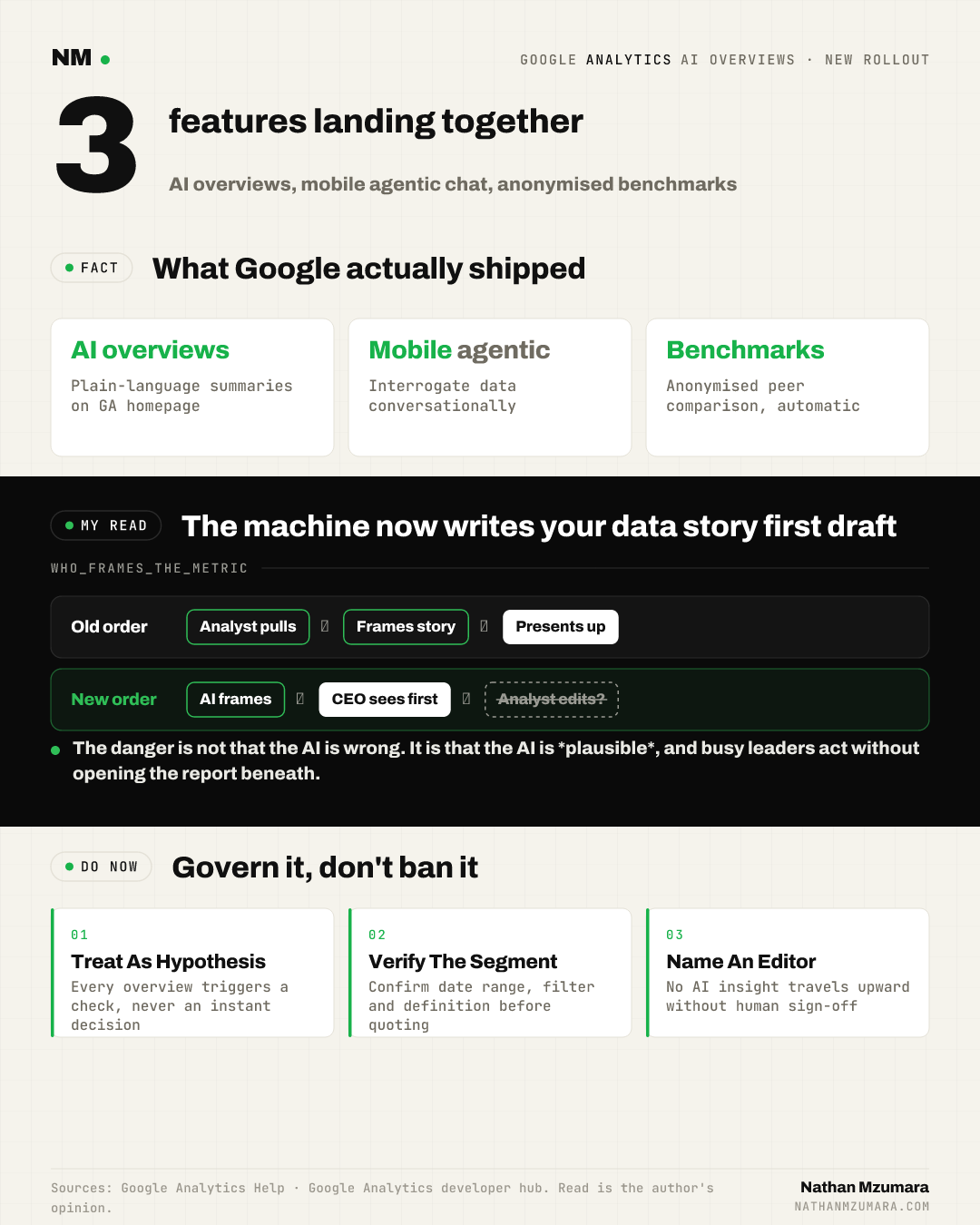
Three things landed together. First, AI-generated overviews now surface at the top of the GA homepage, calling out notable movements in traffic, conversions, and engagement without you asking. Second, agentic features on mobile let you interrogate the data conversationally. Third, anonymised benchmarks show how your metrics stack up against your industry.
Google has been building toward this for a while. You can track the direction of travel in the Google Analytics Help documentation and the ongoing feature notes on Google's Analytics developer hub.
Why it matters for CMOs and growth teams
The order of interpretation has flipped. Previously an analyst pulled the numbers, framed the story, and presented it up the chain. Now the summary greets everyone at login, including your CEO on their phone.
From my observation, whoever frames a metric first tends to own how it is understood. When a machine frames it, that framing feels neutral even though it is a choice about what to highlight and what to ignore.
The benchmark shift is the sharper edge
Anonymised industry benchmarks are genuinely useful for pressure-testing performance. If your conversion rate is up 8 percent but your sector is up 20, the AI Overview will surface that gap before you rationalise it away.
I think this is where the real value sits. Benchmarks strip out the comforting internal story and force an honest comparison, which is exactly the friction most reporting decks are designed to remove.
Where AI in marketing is heading
This fits a broader pattern. Ad platforms are pushing the same logic, as we covered in Google's Ask Advisor preview. The machine increasingly recommends, and the human increasingly approves. That is fine, until nobody remembers how to disagree with it.
How to govern AI-generated insight
Do not ban the overviews. Govern them. Here is a simple process my teams use.
- Treat the summary as a hypothesis, not a conclusion. Every AI overview should trigger a check, not a decision.
- Verify the underlying segment. Ask what date range, filter, and definition the summary used before you quote it in a board deck.
- Keep a human on the narrative. Assign one analyst to sign off on any AI insight before it travels upward.
- Use benchmarks to challenge, not to reassure. Look hardest at the metrics where you are winning, because that is where complacency hides.
The trap to avoid
The danger is not that the AI is wrong. It is that the AI is plausible. A confident, well-written summary invites trust it has not always earned, and busy leaders act on it without opening the report beneath.
In my opinion, the skill that appreciates in value here is not data pulling, it is data interpretation. This mirrors what we argued in why citation share is not the same as traffic: the headline number rarely means what it looks like at a glance.
The concrete action
Set an internal rule this week: no AI Overview reaches a decision-maker without a named human editor and a linked source segment. Use the benchmarks aggressively to interrogate your wins. Let the machine write the first draft, but never let it publish the final one.
Tags