Next Generation Networking and Internet: The EU's Rebuild
The European Commission is funding a rebuild of next generation networking and internet technology, and the policy page setting out that plan was last generated on 16 September 2026. The Next Generation Internet (NGI) initiative pays grass-root developers to build open-source components across every layer of the web, from open hardware to applications. Its stated mission is "to reimagine and re-engineer the Internet of tomorrow, reflecting fundamental human values".
That is not a product launch. It is a slow, funded attempt to change the defaults your marketing stack sits on.
What is next generation internet, in plain terms?
The Next Generation Internet initiative is a European Commission programme that funds the technical building blocks of a future internet built around openness, privacy and user control. The Commission describes the target as "an interoperable platform ecosystem that embodies the values that Europe holds dear: openness, inclusivity, transparency, privacy, cooperation, and protection of data".
The reasoning in the document is direct. The Commission states that the internet "is key to almost any social or economic activity" and that its role will keep increasing. It then names the problem: "concerns about personal data protection and transparency remain significant", alongside "a growing demand for the Internet to provide better services and greater user empowerment".
You can read the full policy text on the European Commission's Next Generation Internet initiative page, and the programme's own site sits at ngi.eu.
Which parts of the stack is NGI actually funding?
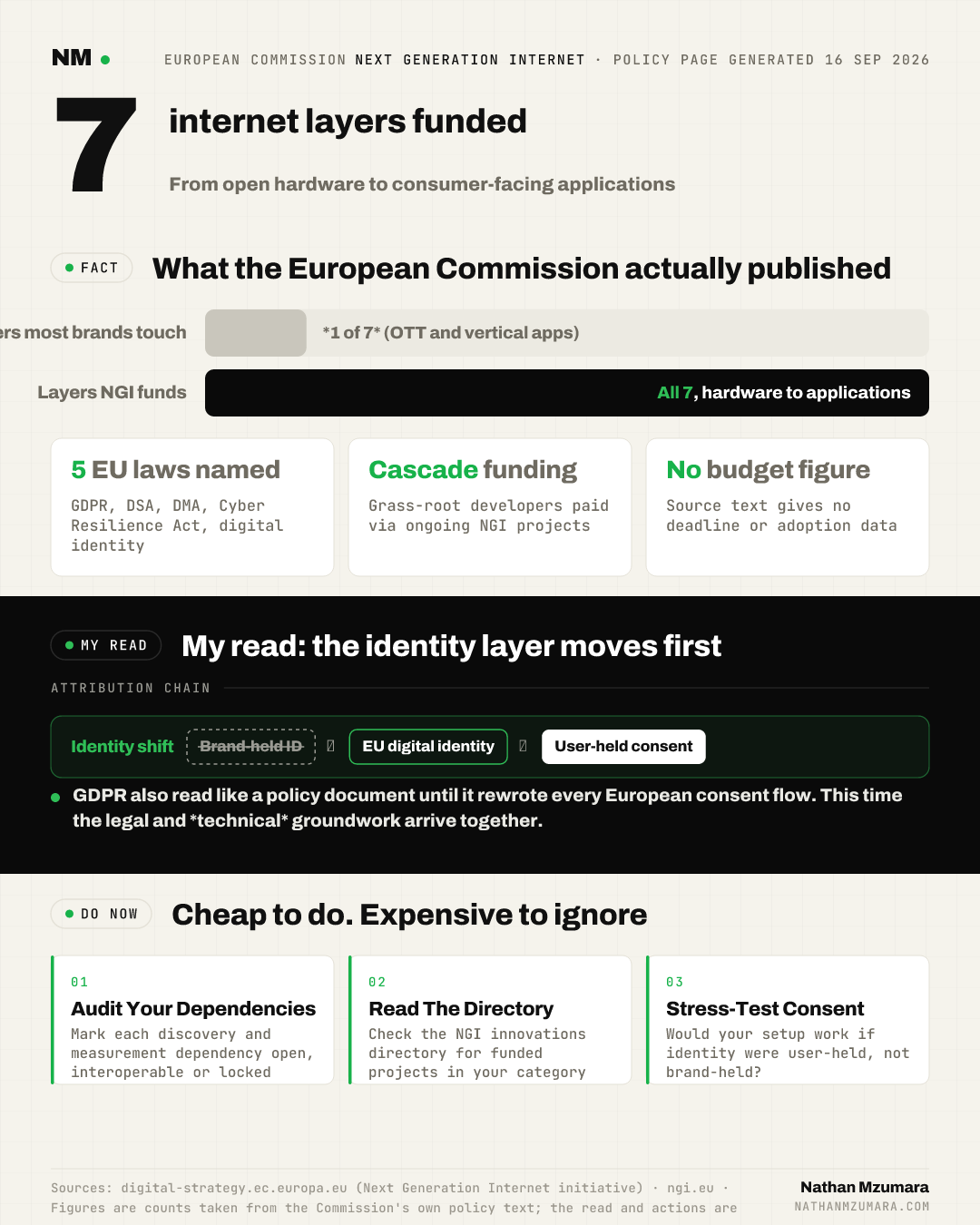
The Next Generation Internet initiative provides financial support to grass-root projects "covering all layers of the Internet". The Commission lists those layers explicitly, and the breadth is the point:
- Open hardware: the physical layer, funded rather than left to a handful of vendors.
- Networking and transport technologies: how data moves, which is the part most marketers never think about.
- Firmware, operating systems and virtualisation: the layer that decides what a device will and will not permit.
- Electronic identities and middleware: who a user is, and who gets to assert it.
- Decentralised ledgers: shared records without a single owner.
- Software productivity tools: the developer layer.
- Over-the-top (OTT) and vertical applications: the consumer-facing services, which is the only layer most brands currently touch.
The money reaches developers through what the Commission calls a "cascade funding mechanism", used across its ongoing NGI projects to fund "a large number of highly talented grass-root innovators". Funded work is catalogued in the NGI innovations directory.
How does NGI connect to EU law you already comply with?
The Commission is explicit that NGI projects "play a significant role in enabling a wide range of EU legislation". Five instruments are named in the document.
GDPR
The General Data Protection Regulation is singled out as the "strong focus" for compliance support. NGI-funded tooling is meant to make lawful data handling the default rather than a retrofit.
Digital Services Act and Digital Markets Act
The Digital Services Act and the Digital Markets Act govern platform behaviour and gatekeeper power. If you want a live example of how that regime reshapes a discovery surface, see my analysis of the ChatGPT DSA designation.
Cyber Resilience Act and EU digital identity
The Cyber Resilience Act and EU digital identity initiatives complete the list. The Commission frames the combined effect as "ensuring freedom of choice online and supporting the concept of digital commons".
Why should growth leaders care about a research programme?
Because the Commission is describing the defaults, not the apps. When identity, consent and transport are rebuilt around "privacy protection, user control and choice, inclusion, decentralisation", the measurement assumptions underneath your reporting change with them.
Three practical consequences follow from what the document says.
- Identity gets user-controlled: NGI funds electronic identities and middleware. Attribution models that assume a persistent, brand-held identifier are betting against the stated direction of European policy.
- Interoperability becomes a requirement, not a feature: the Commission's target is an "interoperable platform ecosystem". Content and data locked inside one platform loses value in that world.
- Open source becomes a sovereignty question: the document says NGI shapes "a sustainable, sovereign Open-Source technology landscape in Europe". Procurement teams in regulated sectors will start asking which parts of your stack are auditable.
My read is that the identity layer moves first, because the EU digital identity work already has a regulation attached and NGI is funding the middleware around it.
The counter-view
The honest objection is timing. The source document contains no budget figure, no deadline and no adoption number, so nobody can claim from this text that NGI has changed user behaviour yet. Grass-root funding produces components, not market share, and components can sit unused for years. A reasonable CMO could file this under "watch, do not act".
The reason I would not file it there is precedent. GDPR also looked like a policy document long before it rewrote consent flows, tag management and every European analytics deployment. Technical groundwork and legal groundwork are arriving together this time, which is the part worth noticing.
What to do about next generation networking and internet this quarter
Start with an audit, not a strategy deck. List every discovery and measurement dependency you own, then mark each one as open, interoperable or locked. Anything locked is a future migration cost.
Then read the NGI innovations directory for projects in your category, and check whether your consent architecture would still work if identity were user-held rather than brand-held. Pair that with a realistic view of how much traffic already never reaches you, which I covered in AI Overviews and the 68% problem.
The European Commission has put its position in writing: the next internet should be open, interoperable and built around the person using it. Teams that treat next generation networking and internet policy as an engineering footnote will spend the next two years reacting. Teams that read the source now will spend that time building.
Tags