Regulation & Policy
Digital sovereignty
Also known as: technological sovereignty, data sovereignty
Digital sovereignty is the principle that a country, region or organisation should retain control over the data, software and infrastructure it depends on. It covers where data is stored, which laws apply to it, and who can compel access to it. In practice it shapes procurement rules, cloud choices and AI vendor selection.
What it is
Digital sovereignty describes the ability of a state, public body or company to set and enforce its own rules over digital assets rather than inheriting them from foreign providers or jurisdictions. It spans data location, legal jurisdiction, supply chain dependency and the right to audit or exit a platform. The narrower term data sovereignty usually refers only to the data layer, while technological sovereignty extends to chips, models and hosting.
Why it matters
Search and AI discovery increasingly run through a small number of large platforms and model providers, so sovereignty questions decide which tools a regulated buyer is even allowed to use. Public sector, healthcare, financial services and defence buyers often screen vendors on hosting region and legal exposure before they consider features. For marketers selling into those sectors, sovereignty claims are part of the buying criteria and belong in published content, not just in security questionnaires.
How it works
Organisations act on it by choosing in-region hosting, sovereign or dedicated cloud tiers, self-hosted or open-weight models, and contracts that specify data residency, subprocessor lists and deletion rights. Procurement teams then verify these with documentation such as data processing agreements, certifications and architecture diagrams. Vendors respond by publishing trust pages and regional deployment options so buyers and AI assistants can find the answers without a sales call.
When it applies
It applies whenever you handle personal, confidential or nationally sensitive data, sell into the public sector or regulated industries, or operate across jurisdictions with conflicting access laws.
Examples
- A European health provider requires its AI transcription supplier to process and store all recordings in EU data centres with no transfer outside the region.
- A government department restricts a shortlist of AI assistants to those offering a sovereign cloud deployment and a named list of subprocessors.
- A SaaS vendor adds a regional hosting page setting out which countries its data centres sit in, so buyers and AI answer engines can cite it directly.
How it is measured
- Share of workloads or data sets hosted in the required jurisdiction
- Number of procurement or security questionnaires passed without an exception or waiver
- Deal cycles lost or delayed because of data residency objections
- Vendor and subprocessor inventory coverage, including documented exit and deletion routes
Insights on Digital sovereignty
Related terms in Regulation & Policy
- AI complianceAI compliance is the work of making sure AI systems meet the laws, regulations, standards and internal policies that apply to them. It spans data protection, transparency, risk classification, documentation, human oversight and record keeping across the life of a system. In practice it combines legal interpretation, engineering controls and ongoing evidence gathering.
- AI governanceAI governance is the set of policies, roles, controls and review processes an organisation uses to manage how AI systems are built, bought and used. It covers risk assessment, documentation, human oversight, data handling and accountability. It applies both to AI a company develops and to third-party AI tools used by staff.
- AI privacyAI privacy is the set of practices, rights and obligations that govern how personal data is collected, used, stored and exposed when building or using AI systems. It covers training data, prompts and outputs, retention by AI vendors, and the transparency and control offered to the people whose data is involved. For marketing teams it shapes what customer data can safely be put into AI tools and what must be disclosed.
- AI safetyAI safety is the practice of designing, testing and operating AI systems so they cause less harm, behave predictably and resist misuse. It covers alignment with intended behaviour, evaluation and red teaming, content guardrails, and monitoring once a system is live. For marketers it shapes what models will say, how assistants handle brands, and what compliance teams expect before AI tools go into production.
- AI transparencyAI transparency is the practice of making clear how an AI system works, what sits behind it, and when content or an interaction involves AI. It covers regulatory disclosure duties as well as voluntary explanations such as model cards, labels on synthetic media and citations in AI generated answers. For publishers and marketers it sets expectations about when AI involvement should be declared and how clearly.
- Competition and Markets AuthorityThe Competition and Markets Authority (CMA) is the United Kingdom's competition and consumer protection regulator. It investigates mergers, anti-competitive conduct and market practices, and it holds specific powers over large digital firms under the Digital Markets, Competition and Consumers Act 2024. Its decisions shape how search engines, app stores and AI assistants operate in the UK market.
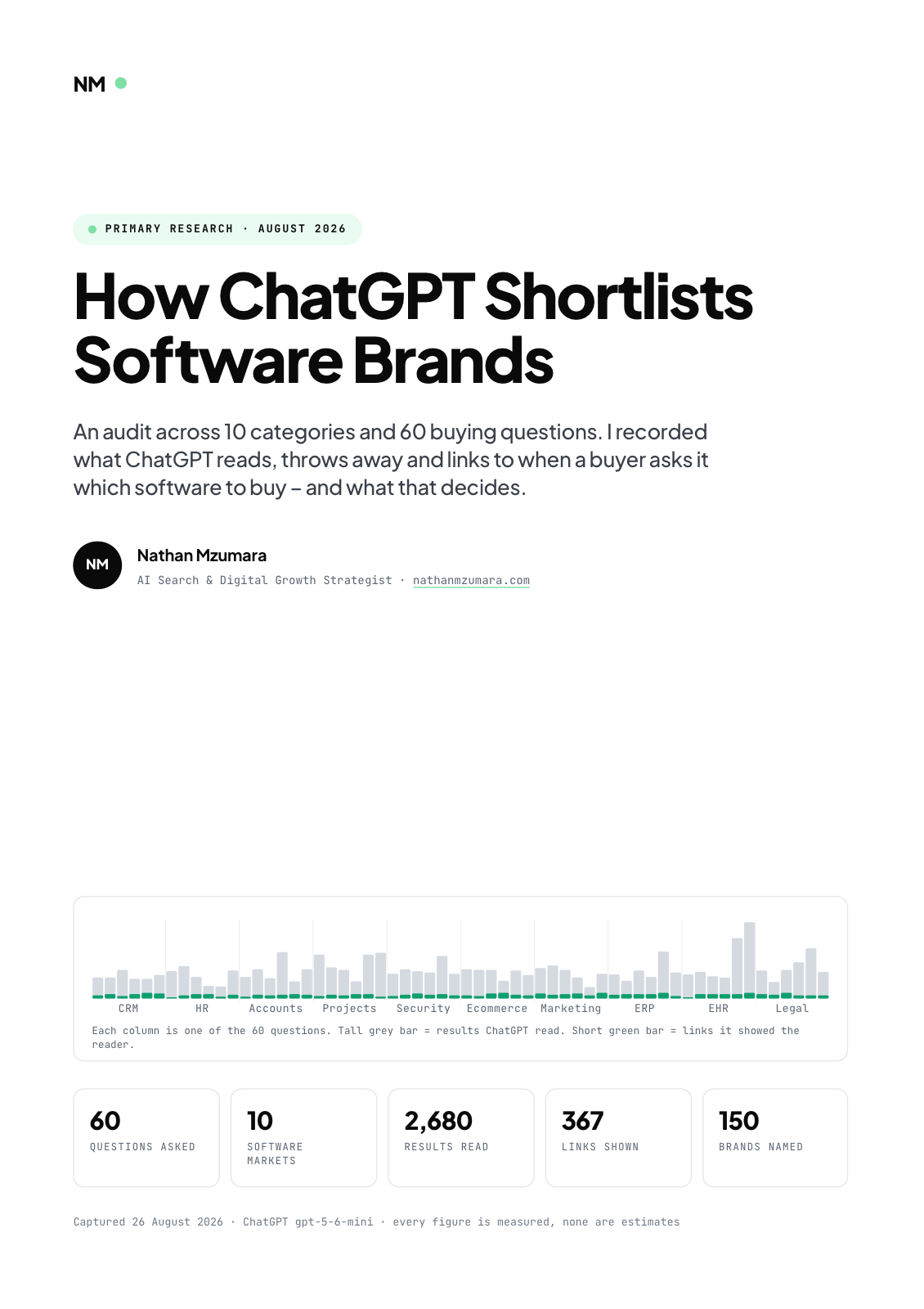
Primary research · August 2026
How ChatGPT Shortlists Software Brands
An audit across 10 categories and 60 buying questions. I recorded what ChatGPT reads, throws away and links to when a buyer asks it which software to buy, and what that decides.
- 60
- Questions asked
- 10
- Software markets
- 2,680
- Results read
- 367
- Links shown
Free download
Get the full report
35 pages · PDF · 536 KB. Enter your details and it downloads straight away.