Anthropic Puts $100m Behind Claude Frontier Academy

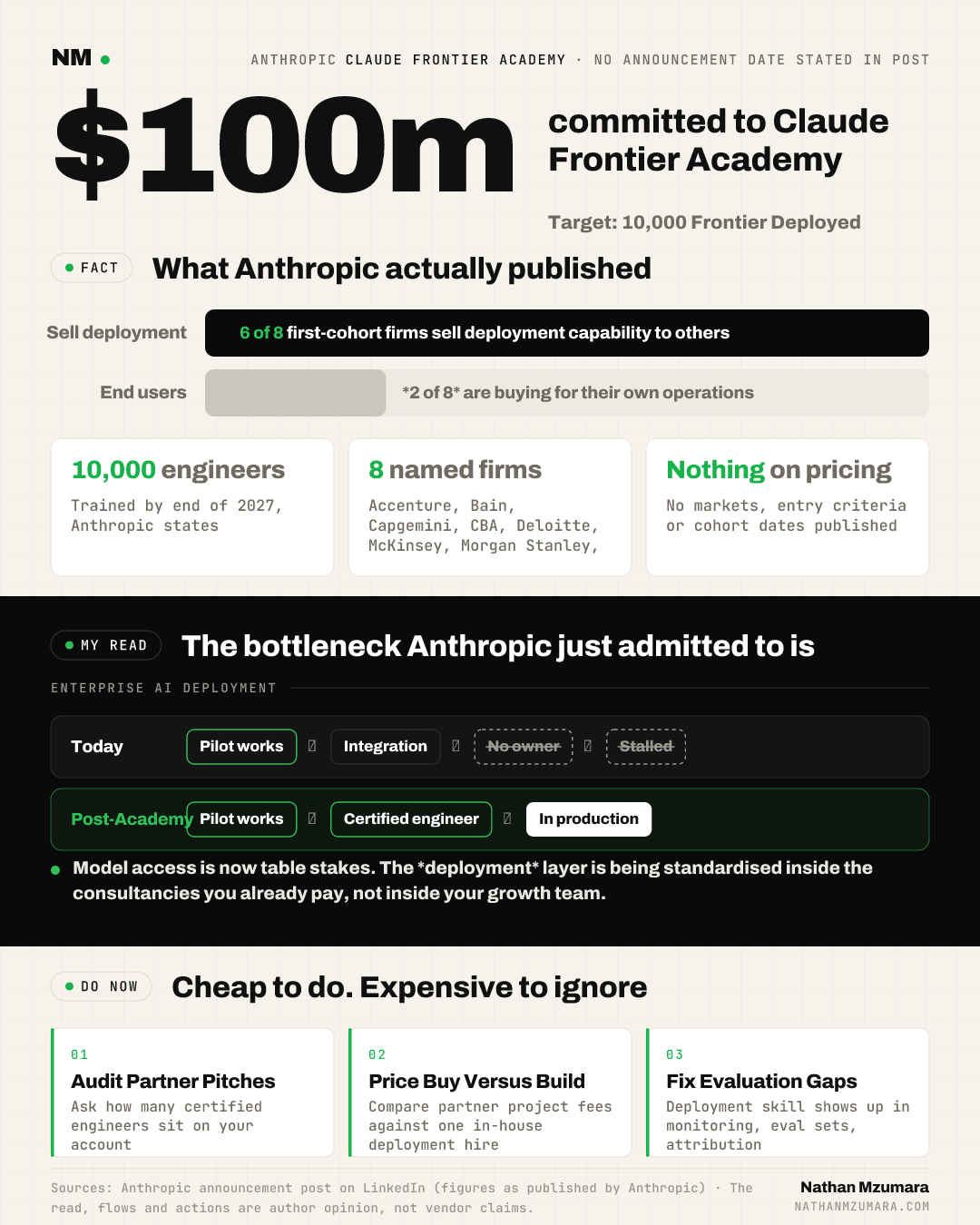
Anthropic has launched Claude Frontier Academy, a training programme backed by a $100 million commitment, with a plan to train 10,000 Frontier Deployed Engineers by the end of 2027. Engineers from Accenture, Bain, Capgemini, Commonwealth Bank of Australia, Deloitte, McKinsey, Morgan Stanley and Novo Nordisk are in the first cohorts. Anthropic did not state an announcement date in its post.
The interesting part is not the money. It is what Anthropic has quietly admitted about where the bottleneck sits. In its own words, the programme exists "to help with one of the hardest parts of deploying AI: finding people with the skills to do it". Not model quality. Not price. People.
What Anthropic announced about Claude Frontier Academy
Claude Frontier Academy is a training programme from Anthropic that produces a certified role called a Frontier Deployed Engineer. According to Anthropic's announcement post on LinkedIn, the commitment behind it is $100 million and the target is 10,000 trained engineers by the end of 2027.
Anthropic says the programme "is built on what we've learned deploying Claude inside large enterprises and the professional services firms that work with them". In other words, this is not generic AI literacy training. It is the codified version of what Anthropic's own deployment teams have had to do repeatedly inside big organisations.
No markets, pricing, entry criteria or cohort dates are stated in the material. Anthropic points to a longer write-up via a link in the announcement, and anything beyond the figures above is not yet confirmed.
Why is Anthropic funding training instead of selling more model access?
Because unsold capacity is a skills problem, not a demand problem. A model vendor can cut prices and ship better reasoning, and still watch enterprise projects stall at the point where someone has to wire the thing into real systems, real data and real governance.
Anthropic has been moving on commercial friction for a while, including dropping seat fees for prepaid usage in Claude for Government and holding pricing while cutting cost per task. Claude Frontier Academy attacks a different constraint. Cheaper tokens do not help if nobody in the building can turn them into a working deployment.
From my observation of enterprise AI programmes over the last two years, the stall almost always happens in the same place: the pilot works, and then nobody owns the integration, the evaluation set or the rollback plan. Funding 10,000 people who have done it before is a direct answer to that.
Who is in the first cohorts, and why that list matters
The eight named organisations in the first cohorts are not a random sample. Six of them sell deployment capability to other companies, which means Anthropic is seeding the supply chain rather than the end user.
Consultancies and systems integrators
Accenture, Bain, Capgemini, Deloitte and McKinsey are in the first cohorts. These are the firms your board already trusts for transformation work, and in many cases the firms your marketing organisation already pays for operating model reviews and martech implementation.
Financial services
Commonwealth Bank of Australia and Morgan Stanley are in the first cohorts. Both operate under heavy regulatory scrutiny, which makes them useful proof that the training holds up where compliance, auditability and data handling are non-negotiable.
Pharmaceuticals
Novo Nordisk is the one named cohort member from life sciences. Regulated commercial content, medical review and market access documentation are among the hardest AI use cases to get signed off, so it is a deliberate test case.
What does this mean for CMOs, growth leaders and founders?
Claude Frontier Academy changes where AI capability lives. The deployment layer for AI in marketing is being standardised inside the consultancies and integrators you already buy from, not inside your team. Here is what that does to your planning.
- Your partners get certified before you do: engineers at Accenture, Bain, Capgemini, Deloitte and McKinsey are in the first cohorts. Within the next budget cycle, those firms can walk into a pitch with vendor-trained deployment staff while your growth team is still refining prompts.
- The gap stops being about tools: every team has model access. Access is now table stakes. The difference in output will come from whether anyone on the project has deployed at scale before, inside messy data and real approval chains.
- Capability gets a price tag: once certified deployment engineers exist as a named role, agencies and integrators will bill for them as a premium line. That is a cost you can forecast, which also means it is a cost you can compare against hiring.
- Procurement language changes: expect "Frontier Deployed Engineer" to appear in RFP responses and statements of work. Ask how many are actually assigned to your account, not how many the firm employs globally.
- Measurement moves with it: deployment skill shows up in evaluation design, monitoring and attribution, which is where most marketing AI work currently has nothing at all.
Buy certified capability, or build it inside the growth team?
This is the decision the announcement forces, and it lands in the next budget cycle rather than next year. The honest answer depends on how much of your AI work is repeatable.
| Question | Buy through a certified partner | Build in-house |
|---|---|---|
| Speed to first deployment | Fastest, since the team has done it before | Slower, with a learning curve you pay for |
| Cost shape | Project fees, repeated each time | Salary plus training, amortised across all work |
| Where the knowledge sits | With the partner, and it leaves with them | With you, compounding each quarter |
| Best fit | One-off or highly technical builds | Continuous work: content, search, lifecycle, analytics |
Comparison based on the two routes available to marketing teams once vendor-certified deployment engineers exist as a named role. Source: author analysis of Anthropic's Claude Frontier Academy announcement.
My read is that most marketing organisations should do both, but asymmetrically. Buy the first build, insist on knowledge transfer in the contract, and fund one internal person to sit alongside it and absorb the method.
The risks in reading too much into this
Anthropic has not stated an announcement date, cohort sizes, geography, cost to participants or curriculum detail. The $100 million figure is a commitment, not reported spend, and 10,000 engineers by the end of 2027 is a plan rather than a result.
There is also a vendor lock-in question. A Frontier Deployed Engineer is trained on deploying Claude. If your stack is multi-model, certification depth on one vendor is useful but not sufficient, and you should ask partners what they do when the best model for a task is not Claude.
The counter-view: this may never reach your marketing budget
The reasonable objection is that 10,000 engineers spread across global consultancies, two banks and a pharmaceutical company is a small number. Those people will be pointed at core systems work, risk and operations, where billing rates are highest. Marketing may sit at the back of the queue for years.
That argument holds if your AI work is light. It fails if you are already running AI across content production, search visibility, lifecycle messaging and analytics, because that is exactly the kind of recurring workload where paying agency day rates forever becomes the expensive option.
What to do before Claude Frontier Academy scales
Three actions this week, in order.
- Ask your partners directly: email your agency and consultancy leads and ask whether anyone on your account is in a Claude Frontier Academy cohort, and what certification they expect to hold by the end of 2027.
- Count your own deployment hours: list every AI workflow your team runs and estimate how many hours a month go into building and maintaining them. If it exceeds roughly half a full-time role, hiring beats buying.
- Put one line in the budget: either a certified partner retainer or a deployment engineer inside the growth team. Decide which before procurement decides for you.
The signal in Claude Frontier Academy is simple. Anthropic has priced the skills gap at $100 million and named the firms it is backing to close it. Treat your next budget cycle as the moment you choose whether that capability arrives on an invoice or on your payroll.
Published and last updated: this analysis reflects Anthropic's Claude Frontier Academy announcement as published on LinkedIn. No announcement date was stated in the source.
Tags
