What Is Claude Cowork Now? It Just Merged Into Chat

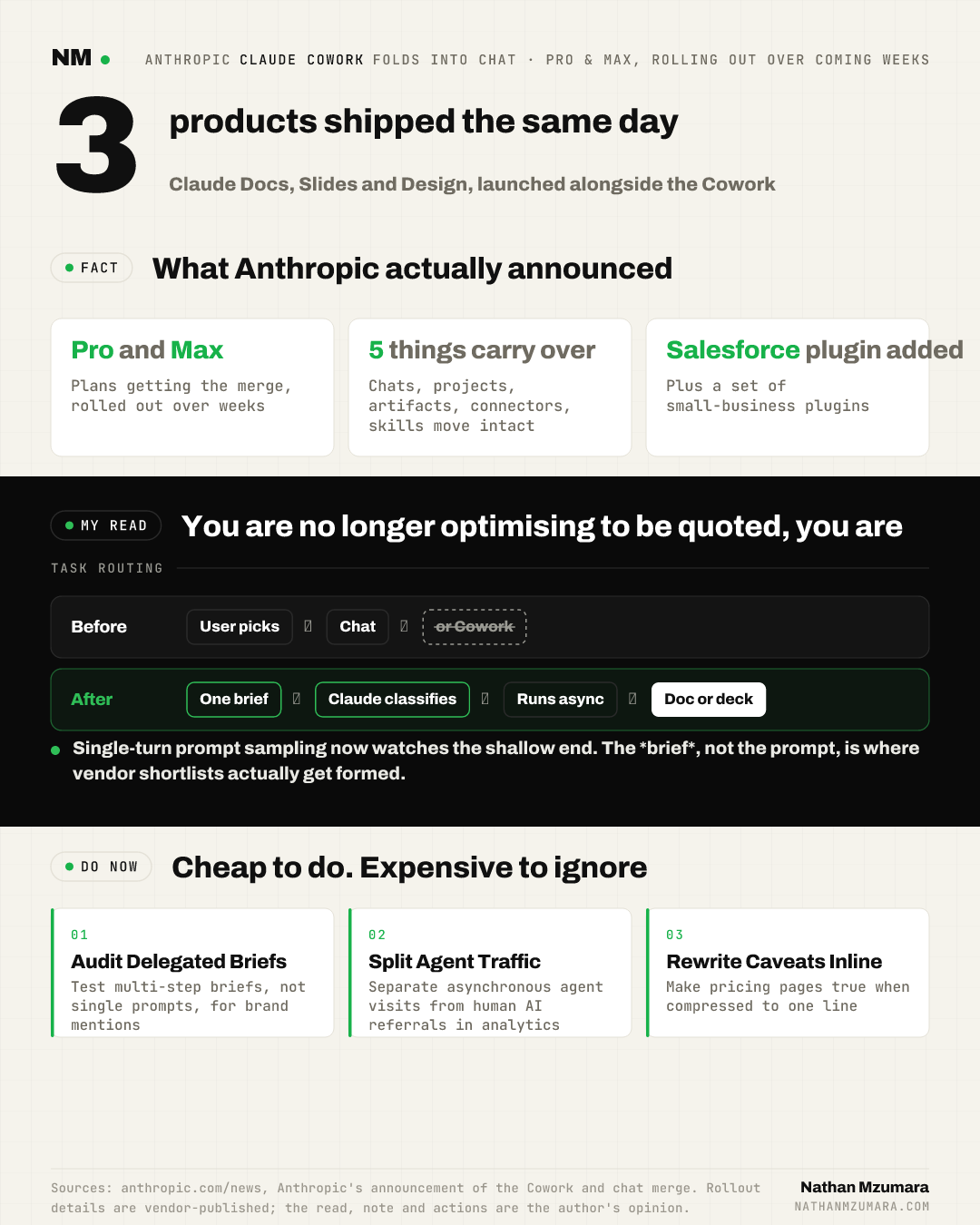
The short answer to what is Claude Cowork changed this week: it is no longer a separate place. Anthropic is folding Claude Cowork, its long-running agentic workspace, into ordinary Claude chat. The merge rolls out to Pro and Max plans over the coming weeks. Chats, projects, artifacts, connectors and skills carry over intact. Claude Docs, Slides and Design landed the same day, alongside new Salesforce and small-business plugins.
The interface tidy-up is the least interesting part of this. The consequential change is that the user no longer decides whether a task is a question or a job. Claude decides, and then acts accordingly.
What changed in Claude, and who gets it
Claude Cowork was Anthropic's separate surface for delegated work: you handed it a job rather than a question, and it worked through multi-step tasks on its own. That separation is going. There is now one Claude, and the agentic behaviour sits inside the normal chat window.
Here is what the Anthropic announcement of the Cowork and chat merge confirms:
- Who gets it: Pro and Max plan subscribers, with the rollout happening over the coming weeks rather than all at once.
- What carries over: chats, projects, artifacts, connectors and skills all move across intact. Nothing has to be rebuilt.
- What shipped alongside it: Claude Docs, Claude Slides and Claude Design, all on the same day.
- What connects to it: a Salesforce plugin and a set of small-business plugins.
So the answer to how to get Claude Cowork is now simply that you do not. If you are on Pro or Max, the capability arrives inside the assistant you already use, and how to use Claude Cowork is just how you use Claude: describe the job instead of asking the question, and let it classify.
Why the Claude Cowork merge is not a UI tidy-up
Three behaviours change when the two surfaces become one, and each of them alters how Claude touches your content.
Claude decides the task type
Before the merge, the user made the call. A quick question went to chat, a long research job went to Cowork. Now Claude reads the intent and picks. The same typed sentence can produce a one-paragraph reply or a multi-step run across many sources, and the person typing it does not choose which.
Work continues after the laptop closes
Claude now runs tasks asynchronously. The session does not need to stay open for the work to continue. That breaks the assumption behind almost every AI visibility tool on the market: that a model interaction is a request and a response, bounded in time.
Claude asks clarifying questions mid-task
Rather than failing silently on an ambiguous brief, Claude interrupts to ask. That makes long tasks more likely to finish usefully, which makes people delegate bigger ones. Behaviour follows reliability.
Claude chat vs Cowork: what the split used to decide
The old boundary was a user decision with measurement consequences. The table below shows what moved.
| Dimension | Before the merge | After the merge |
|---|---|---|
| Who classifies the task | The user, by choosing chat or Cowork | Claude, from the brief |
| Unit of work | A prompt, or a session in Cowork | A delegated brief |
| Session dependency | Work tied to an open session | Runs asynchronously after the laptop closes |
| Handling ambiguity | Weak output, or a restart | Claude asks clarifying questions mid-task |
| Typical output | An answer | A document, a deck, a design, a shortlist |
Table: how the Claude Cowork vs chat distinction collapses, based on Anthropic's announcement of the merge.
Anyone asking what Claude Cowork does now has a simpler answer: it does what Claude does, because it is Claude.
What the merge changes for growth leaders and CMOs
In plain English: your brand is now being assessed inside long jobs, not just short answers. Three things follow.
- The unit of AI work moves from prompt to brief: per-prompt visibility tracking loses its object. If your tooling samples single-turn answers, it cannot see the multi-step research runs where vendor shortlists actually get formed.
- Retrieval depth increases: background agents read more sources per task than chat ever did. The winners are the sites that survive repeat crawls and deep-link extraction, not only the ones that rank for a head query.
- The assistant becomes a deliverable engine: with Claude Docs, Slides and Design plus the Salesforce and small-business plugins, Claude now sits between your content and the buyer's actual artefact, which is the deck, the shortlist or the forecast.
That third point is the one I would take to a board. The measurement shift is uncomfortable, but the strategic shift is bigger: you are no longer optimising to be quoted, you are optimising to be reusable inside someone else's document.
In the AI visibility audits I run, sampling is almost always single-turn: a list of prompts, fired once, scored for brand mentions. My read is that this method is now measuring the shallow end of the pool. The deep end is a delegated brief that reads twenty pages and outputs a slide, and nothing in the standard toolkit observes it. That gap will persist longer than it should, because single-turn sampling is cheap and reports well.
This is the same measurement problem that shows up whenever a vendor removes a query step, and it is worth reading alongside what the citation data actually rewards in generative engine optimisation.
What could go wrong
Attribution gets worse before it gets better. An asynchronous agent that visits your site while the user is offline produces a session with no human intent behind it and, often, no clean referral signal. Mixing those sessions into your chat referral numbers will quietly inflate them.
There is also a content risk. Comparison and pricing pages written for a human reader tend to hold their meaning through layout, ordering and caveats. Compressed into one line of someone else's slide, the caveats go first. If your pricing page only makes sense with the footnotes, it will misrepresent you inside a deck you never see.
The counter-view
The honest case against panic is that merges like this are often slower in practice than in the announcement. The rollout is staged across Pro and Max over weeks, not instant, and plenty of users will keep treating Claude as a question box because that is the habit. If delegated briefs stay a minority behaviour, per-prompt tracking remains a reasonable proxy for a while longer.
I think the deliverable tools decide it. Docs, Slides and Design give the delegated brief somewhere to land, and people delegate more when the output is something they can send. For context on how much attention Anthropic actually commands, the Claude versus ChatGPT traffic share data is the right sense check before you re-plan a quarter around this.
What to do this week
- Run a delegated-brief audit. This is also the fastest way to learn how to use Claude Cowork in its merged form: instead of asking Claude a question about your category, hand it a job, such as build a shortlist, draft a comparison deck, model a vendor decision. Check whether you appear, and how you are described.
- Split your analytics. Instrument agent-referred and asynchronous sessions separately from live chat referrals. One number covering both is now misleading.
- Stress-test compression. Take your pricing and comparison pages and ask an assistant to summarise each into a single slide. If the result is wrong, the page is the problem, not the model.
- Make repeat crawling cheap. Stable URLs, clean headings, figures stated in text rather than only in images, and claims that survive being lifted out of order.
- Check your connectors story. With a Salesforce plugin live, ask whether your own product or content is reachable inside the systems your buyers already work in.
What is Claude Cowork now that it lives inside chat?
Claude Cowork is no longer a place you go. It is a mode Claude enters on its own, inside the chat window, for Pro and Max subscribers as the rollout lands over the coming weeks. Your chats, projects, artifacts, connectors and skills come with it, so there is nothing to migrate and no separate product to learn.
The practical instruction is short. When a colleague asks you what is Claude Cowork, the useful answer is a behaviour rather than a product: stop asking whether your brand shows up in a single prompt, and start checking whether it survives a long job. Claude Cowork merging into chat means the interesting evaluation of your content now happens while nobody is watching, and the output is a deliverable rather than an answer.
Published 2 March 2026. Last updated 2 March 2026.