Anthropic Claude Fable 5.1: Cheaper Caching Beats the Benchmarks

Anthropic Claude Fable 5.1, released alongside Claude Mythos 5.1, is now the vendor's top model for coding and knowledge work. For growth and search teams, the headline is not the benchmark score. It is a 25% cut to typical costs, driven by cheaper cache reads, plus new terms on price, data retention and safeguards. That changes what always-on AI can cost you.
What Anthropic changed with Claude Fable 5.1
Anthropic introduced Claude Fable 5.1 and Claude Mythos 5.1 as the same underlying model with different safeguard levels. Fable 5.1 is generally available. Mythos 5.1 is limited to trusted access programs for cybersecurity and life sciences work.
Anthropic states Fable 5.1 costs an estimated 25% less than Fable 5 for typical token-billed workloads. For highly agentic work, the saving rises to about 45%. The cut comes from lower pricing on cache reads, where the model reads inputs it has already processed and stored.
Why cheaper caching matters more than the score
Cache reads are the repeated context an AI agent pulls in on every step: system prompts, brand rules, product data, prior outputs. In long agentic runs, cache reads dominate the bill. Cutting their price cuts the cost of always-on work, not one-off queries.
This is why the claude fable 5 anthropic model matters to marketing operations. If you run Claude for GEO monitoring, rank tracking or large-scale content generation, your spend is mostly repeated context. A 45% saving on agentic work moves the break-even point for running these systems continuously.
How to recalculate your agent running costs
Start with your current monthly Claude token bill. Split it into fresh input, cache reads and output. Apply the estimated 25% typical cut, or up to 45% for your most agentic pipelines. The workloads with heavy repeated context, such as visibility tracking and content ops, benefit most.
The data retention change: Enterprise Frontier Safeguards
Anthropic's new Enterprise Frontier Safeguards (EFS) give customers complete privacy, matching a zero data retention policy, while still preventing adversarial use. EFS stores data in cloud infrastructure the customer controls, not Anthropic. It rolls out to enterprise customers in phases beginning later this autumn.
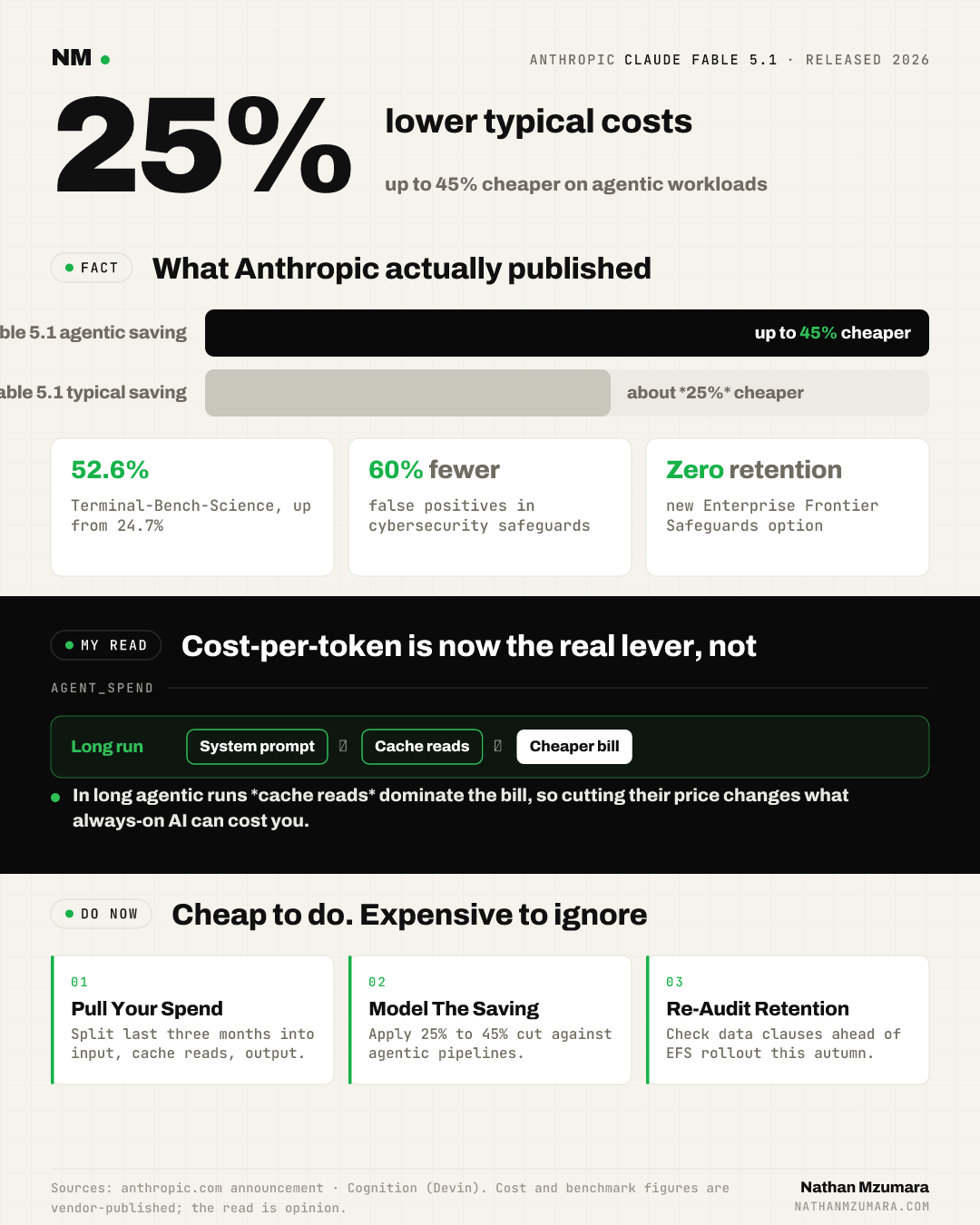
Until EFS is available, eligible customers can use Fable 5.1 with zero data retention. For any CMO or VP running brand and customer data through an AI pipeline, this is a reason to re-audit your data retention clauses now, not after your next renewal.
Safeguards: fewer false positives
Anthropic improved its safeguards to reduce false positives, where the system flags harmless content. In cybersecurity, the newest safeguards block 60% fewer false positives than before. For teams that hit blocked outputs on legitimate technical content, that means less friction in production.
How the anthropic claude fable 5 mythos 5 line compares on benchmarks and cost
The official figures from the claude fable anthropic launch show clear gains over Fable 5. Below are selected scores from Anthropic's own reporting.
| Benchmark | Fable 5.1 | Fable 5 | Opus 5 |
|---|---|---|---|
| Agentic scientific research (Terminal-Bench-Science 0.1) | 52.6% | 24.7% | 29.0% |
| Agentic coding (Terminal-Bench 4.0) | 55.8% | 42.0% | 52.3% |
| Business workflows (AutomationBench) | 31.4% | 17.1% | 26.9% |
| Agentic coding (CursorBench 3.2.0) | 73.4% | 70.5% | 70.0% |
Anthropic reports that at Low or Medium effort, Fable 5.1 matches or beats Fable 5 at a much lower cost. Cognition confirmed it: the firm said it moved Opus 5 traffic in Devin to Fable 5.1 on launch day, and that the new cache read pricing finally made a Fable-class model economical for code review.
The counter-view: quality still varies by task
My read is that model quality is now table stakes and cost-per-token is the real lever between Claude, GPT and Gemini. But that does not mean quality is settled. Anthropic notes its production safeguards scored some benchmarks at zero where they intervened, which lowers reported performance. Test on your own workloads before you switch everything across.
You should also weigh single-provider risk. Concentrating agentic pipelines on one vendor exposes you to sudden access or pricing changes, a pattern covered in our piece on single-provider risk.
What to do this week with the anthropic claude fable 5 official update
Read the official Anthropic announcement for Claude Fable 5.1 and Mythos 5.1 and pull your last three months of token spend. Model the 25% to 45% saving against your agentic workloads. This claude fable 5 anthropic june 2026 release resets the pricing baseline, so re-audit your data retention clauses ahead of EFS, and pressure-test whether cheaper caching now makes always-on visibility tracking affordable. For context on how governance shifts with autonomous agents, see our note on Claude Code auto mode. The anthropic claude fable 5 ai model has reset the maths, so it is worth running the numbers.