Algorithm
Spam penalty
Also known as: manual action, Google penalty, search spam penalty
A spam penalty is a loss of search visibility imposed on a site for breaching a search engine's spam policies. The term covers two distinct things: manual actions, applied by human reviewers and reported in Google Search Console, and algorithmic demotions applied automatically by spam detection systems. Manual actions can be appealed with a reconsideration request once the issue is fixed, while algorithmic demotions lift only when the systems reassess the site.
What it is
Marketers use "penalty" loosely, but the two mechanisms behave differently. A manual action is a documented decision by a reviewer against a specific issue such as unnatural links, thin content, cloaking, hacked content or pure spam, and it appears in the Manual Actions report. An algorithmic demotion has no notification and no appeal route, so it has to be inferred from traffic patterns and the timing of known ranking or spam system updates.
Why it matters
Penalties remove pages or whole domains from the results that feed both classic search and the AI surfaces built on top of it, so revenue can fall sharply and without warning. Confusing an algorithmic demotion with a manual action wastes weeks, because the recovery work is different in each case. Clean policy compliance is also a precondition for being treated as a credible source by systems that summarise and cite the web.
How it works
Start by checking the Manual Actions and Security Issues reports in Search Console, then compare the drop date against known update timelines and segment traffic by page type, query type and country to find what actually fell. For a manual action, remove or fix the offending behaviour across the whole site, document the work, and file a reconsideration request explaining what happened and what changed. For algorithmic demotions there is no form to submit, so the route back is substantive improvement and patience through the next reassessment.
When it applies
The concept applies after any sudden, steep and unexplained drop in organic visibility, and during due diligence on a domain you are about to buy, migrate or rebuild.
Examples
- A Search Console notice reports an unnatural links manual action affecting the whole site after years of bought placements.
- A recipe site loses most of its visibility overnight with no Search Console notice, tracking a documented spam or ranking system update.
- An expired domain is bought and repurposed to publish unrelated commercial content, and is later demoted under the site reputation and expired domain abuse policies.
How it is measured
- Manual action count and status in Google Search Console, and time to resolution
- Organic clicks and impressions before, during and after the drop, segmented by page type
- Number of indexed URLs and their trend during the affected period
- Reconsideration request outcome and the number of submissions needed
Insights on Spam penalty
Related terms in Algorithm
- Core updateA broad Google algorithm update affecting search rankings sitewide rather than a single feature. Recent core updates (e.g. May 2026) have increasingly favoured intent-aligned content over keyword-optimised content.
- EEATGoogle's quality framework: Experience, Expertise, Authoritativeness, Trustworthiness. EEAT signals are increasingly weighted in both classical ranking and AI Overview source selection.
- Entity salienceEntity salience is a measure of how central an entity is to a piece of content, as opposed to merely being mentioned in it. Natural language processing systems assign a salience score based on signals such as position, frequency, grammatical role and surrounding context. It helps a system decide what a document is actually about.
- Google Search algorithmThe Google Search algorithm is the collection of ranking and retrieval systems Google uses to find, order and present results for a query. It is not a single formula but many interacting systems that assess content, links, query intent, context and user signals. Google updates these systems continuously, with larger changes announced as core updates.
- Google Spam UpdateA Google Spam Update is a rollout of changes to the systems Google uses to detect and demote content that breaks its spam policies. These updates target things like scaled content abuse, cloaking, hacked pages, link schemes and site reputation abuse rather than general content quality. Sites hit by a spam update usually need to remove the offending practices before they can recover.
- Helpful Content UpdateGoogle's quality-focused update class targeting low-value, AI-generated, or thin content. Successive HCUs have favoured first-hand experience and named expertise over comprehensive but shallow coverage.
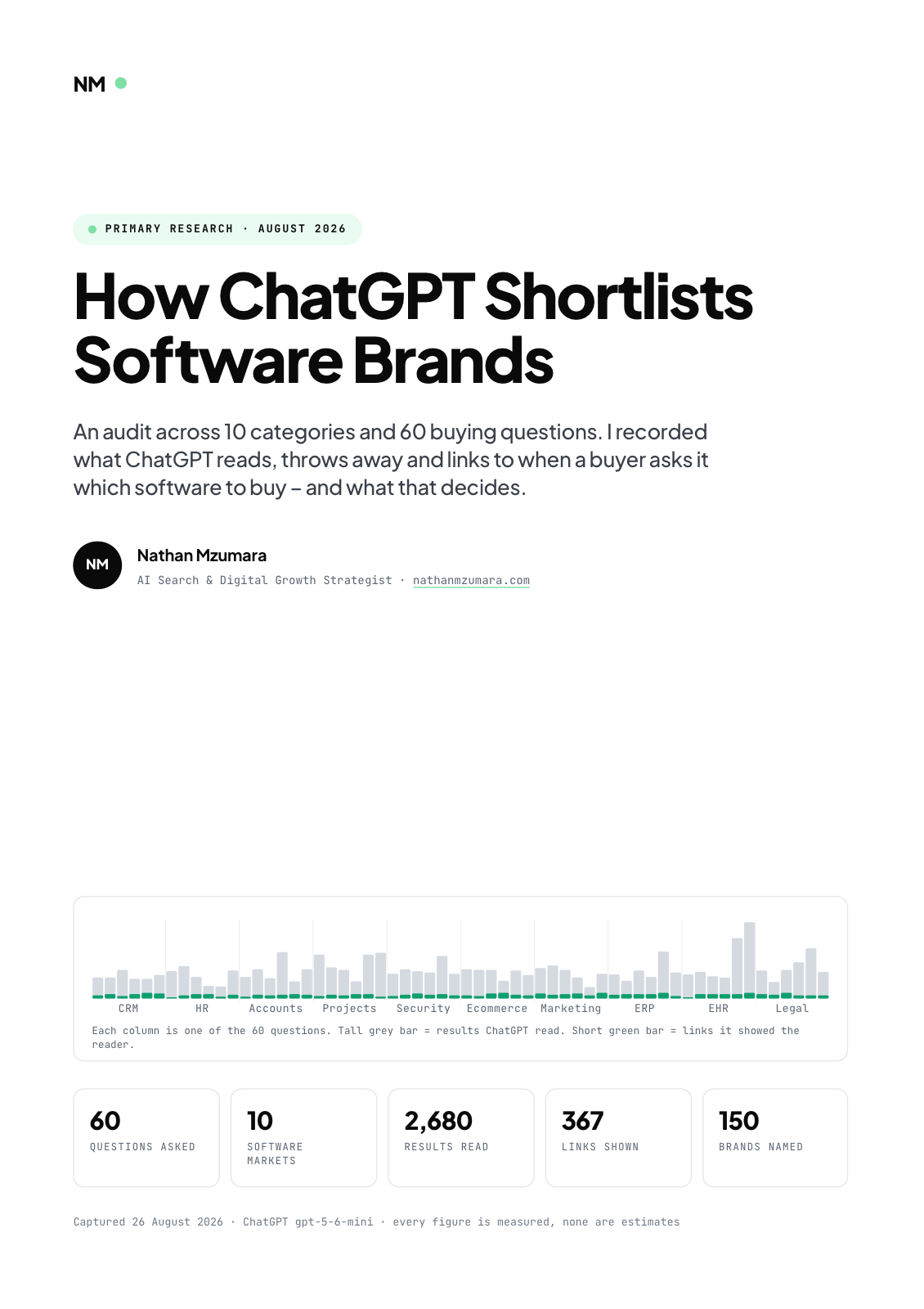
Primary research · August 2026
How ChatGPT Shortlists Software Brands
An audit across 10 categories and 60 buying questions. I recorded what ChatGPT reads, throws away and links to when a buyer asks it which software to buy, and what that decides.
- 60
- Questions asked
- 10
- Software markets
- 2,680
- Results read
- 367
- Links shown
Free download
Get the full report
35 pages · PDF · 536 KB. Enter your details and it downloads straight away.