Consumer Behaviour
Social search
Also known as: social media search, searching on social platforms
Social search is the practice of using social platforms such as TikTok, Instagram, YouTube, Reddit or LinkedIn as search engines rather than as feeds. People type a query into the platform's search bar and browse posts, videos and comment threads for answers, recommendations and reviews. It sits alongside web search and AI assistants as a route to discovery, and often influences the final decision.
What it is
Social search describes query-led behaviour inside social apps: someone searches "best running shoes for flat feet" or "is this CRM worth it" on TikTok or Reddit and treats the results as a research tool. The results are ranked by the platform's own relevance and engagement signals, not by a web index. Comment sections frequently act as a second layer of results, where viewers verify or contradict the original post.
Why it matters
For many audiences, especially younger ones, social platforms are the first stop for recommendations, local discovery and product research, so brands absent from those results are absent from the decision. Social content also feeds AI answer engines and appears in web search results, so a post that ranks inside TikTok or Reddit can surface in several places. Unbranded queries on social are where category demand is captured before anyone visits your site.
How it works
Practitioners research the phrases people actually type into each platform's search bar, then create content that answers those phrases directly in the first few seconds and in on-screen text. They add searchable text signals such as spoken keywords, captions, on-screen titles, alt text and topical hashtags, and they build up creator and community coverage so third-party posts also rank. Many teams monitor branded and category searches on each platform and treat comment questions as a content brief.
When it applies
It applies whenever an audience researches products, services, places or how-to questions inside social apps, which is common in beauty, food, travel, fitness, consumer tech and increasingly B2B software.
Examples
- A skincare brand titles a TikTok "retinol vs retinal for beginners" so it matches a common in-app search phrase.
- A B2B SaaS team answers Reddit threads asking "alternatives to [competitor]" with a factual comparison rather than a pitch.
- A restaurant group keeps Instagram location tags and menu photos current because diners search neighbourhood names in the app.
How it is measured
- Share of platform views or impressions attributed to search within each app's native analytics
- Rankings for target phrases when searched manually inside each platform
- Volume of branded and category searches recorded in platform search insights tools
- Assisted conversions and self-reported attribution naming social platforms as the discovery source
Insights on Social search
Related terms in Consumer Behaviour
- Agentic browserA browser (or browsing layer) that uses an LLM agent to interpret pages, summarise content, and take actions on behalf of the user. Arc Search, Perplexity Comet, Browser Company's Dia, Dia browser, and similar.
- Brand demandSearch volume for branded terms. In an AI-search world, brand demand is the single strongest moat, generic queries are absorbed by AI Overviews and ChatGPT, while branded queries route users directly to brand properties.
- Brand discoveryBrand discovery is the process by which someone encounters a brand for the first time, or becomes newly aware it can solve their problem. It happens across search results, AI assistants, social feeds, communities, creators, reviews, marketplaces and word of mouth. Marketers study it to work out which surfaces introduce them to future customers.
- Consumer behaviour signalObservable patterns in how users phrase queries, refine searches, and choose answers, used by both ranking systems and generative models to infer intent and quality.
- Conversational searchConversational search is the pattern of finding information through a back and forth dialogue rather than a single keyword query, with each follow-up interpreted in the context of what came before. Users ask broad questions, then narrow with refinements such as cheaper, nearby or without the subscription. It shifts discovery from ranked link lists towards answers that must survive several rounds of questioning.
- Facebook SearchFacebook Search is the search function inside Facebook that lets people find posts, people, Pages, Groups, events, videos and Marketplace listings. It is a platform search experience rather than a general web search engine, so results are shaped by what is published on Facebook and by the searcher's connections and activity. For businesses it affects whether a Page, Group or listing is found by people already inside the app.
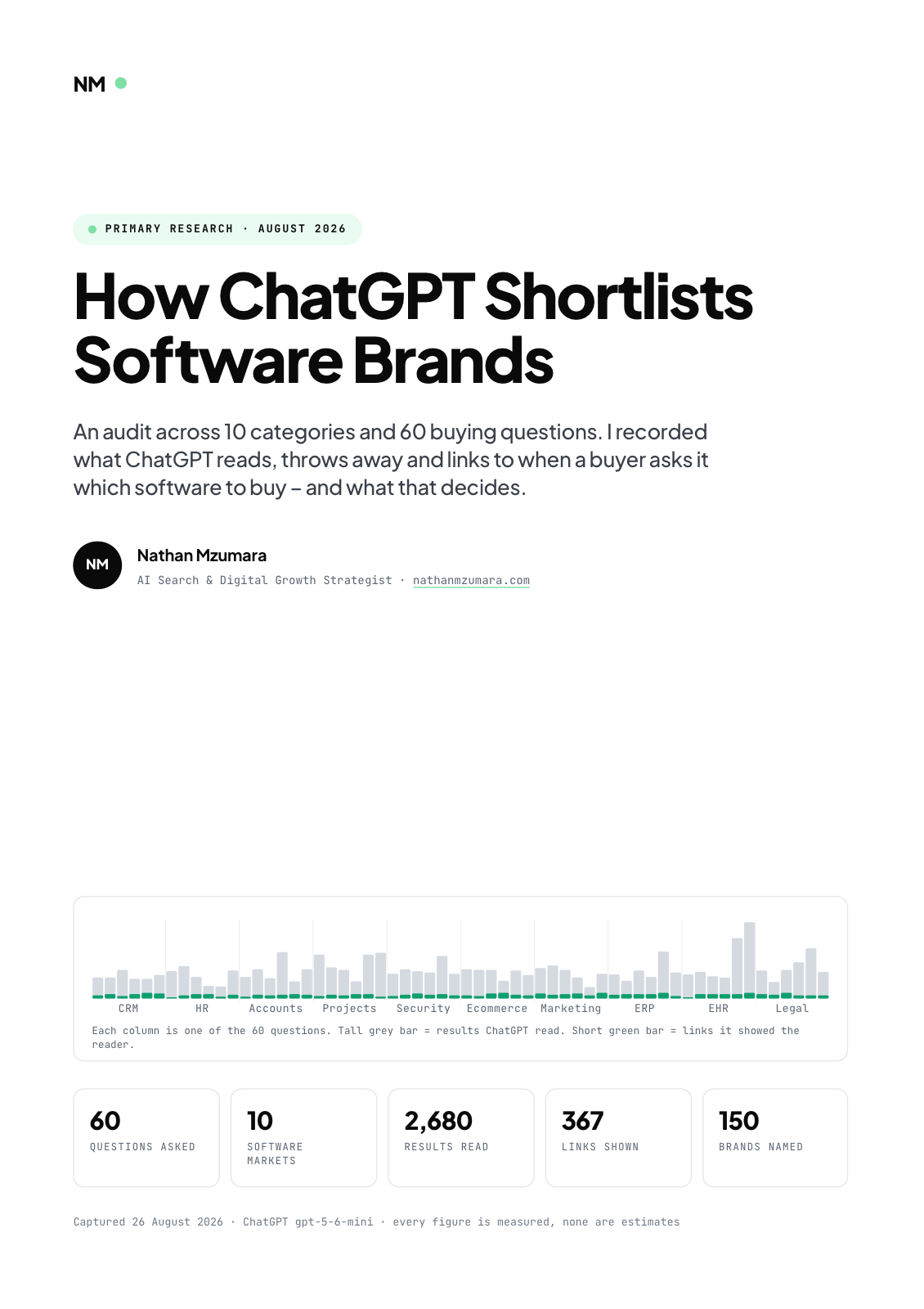
Primary research · August 2026
How ChatGPT Shortlists Software Brands
An audit across 10 categories and 60 buying questions. I recorded what ChatGPT reads, throws away and links to when a buyer asks it which software to buy, and what that decides.
- 60
- Questions asked
- 10
- Software markets
- 2,680
- Results read
- 367
- Links shown
Free download
Get the full report
35 pages · PDF · 536 KB. Enter your details and it downloads straight away.