Advertising & Paid Media
Performance Max
Also known as: PMax, Google Performance Max
Performance Max is a goal based Google Ads campaign type that runs across Google's inventory, including Search, Shopping, YouTube, Display, Discover, Gmail and Maps, from a single campaign. Advertisers supply conversion goals, budget, assets and audience signals, and Google's automation handles targeting, bidding and creative assembly. Retailers commonly run it with a Merchant Center product feed.
What it is
Performance Max, often shortened to PMax, replaces manual placement and keyword control with a machine learning system that serves across Google surfaces. You build asset groups containing headlines, descriptions, images, logos and videos, optionally attach a product feed, and define listing groups, audience signals and search themes. The system then decides which combinations to show, where and to whom, optimising towards the conversion goals and values you set.
Why it matters
It concentrates a large share of Google spend into a campaign type where the advertiser controls inputs rather than placements, so input quality becomes the main lever. For discovery, it broadens reach into browsing and video surfaces that keyword campaigns do not cover, which can surface products to people who were not searching. It also changes measurement practice, because reporting is less granular than Search or Shopping campaigns and needs deliberate structure to interpret.
How it works
Practitioners feed the campaign strong conversion data, usually with values or offline conversion imports, so bidding optimises to profit rather than raw volume. Structure choices do the heavy lifting: splitting asset groups or campaigns by product category, margin or brand, using custom labels from the feed, adding brand exclusions and account level negatives, and supplying search themes and first party audience signals. Creative is refreshed based on asset performance labels, and results are read alongside brand and non brand Search to check incrementality rather than in isolation.
When it applies
It applies when an advertiser wants broad coverage across Google surfaces with automated bidding and has enough conversion volume for learning, particularly in ecommerce and lead generation. It is less suitable when strict placement control, tight keyword governance or very low conversion volumes make automation hard to steer.
Examples
- A retailer splits Performance Max into three campaigns by margin band using custom labels, then sets different target ROAS values for each.
- A lead generation business imports qualified lead and closed sale values from its CRM so bidding favours enquiries that convert offline.
- A brand applies a brand exclusion list and account level brand negatives to stop Performance Max absorbing cheap brand traffic and inflating reported ROAS.
How it is measured
- Conversions, conversion value and ROAS or cost per acquisition by campaign and asset group
- Incrementality of new customer acquisition, for example new customer share or lift tests against brand and non brand Search
- Asset performance ratings and coverage, plus share of spend going to Shopping versus other surfaces where reporting allows
- Search term and search category insights reviewed for waste, alongside brand versus non brand spend split
Related terms in Advertising & Paid Media
- AI-generated creativeAI-generated creative is ad and marketing creative produced or adapted using generative models, including images, video, voiceover, headlines and body copy. Teams use it to produce more variants, localise faster and test concepts that would be too costly to shoot. It still needs human direction, brand review and legal checks before it runs.
- Asset groupsAn asset group is the creative container inside a Google Performance Max or Demand Gen campaign, holding headlines, descriptions, images, logos, videos and audience signals. Google assembles ads from these assets and serves them across Search, Shopping, YouTube, Display, Discover, Gmail and Maps. Retail campaigns can tie an asset group to a specific set of products through listing groups.
- Brand safetyBrand safety is the practice of preventing advertising and brand content from appearing next to material that could damage reputation, such as violent, illegal or misleading content. Brand suitability is the related, narrower idea of matching placements to a specific brand's tolerance and values rather than a universal baseline. Both rely on exclusion lists, content classification and verification reporting.
- ChatGPT AdsChatGPT Ads refers to advertising placements inside OpenAI's ChatGPT. OpenAI has publicly signalled that advertising is part of its commercial plans and has been testing and building out ad capabilities, so the format details continue to change. For marketers it represents a possible new paid surface alongside organic visibility in AI assistants.
- ChatGPT Sponsored AgentsChatGPT Sponsored Agents is the name given to a paid placement format in which a brand's agent or assistant can be surfaced inside a ChatGPT conversation to help complete a task, such as booking, quoting or buying. It sits alongside other advertising formats OpenAI has discussed for ChatGPT, where commercial results are marked as sponsored rather than blended invisibly into answers. Availability, naming and mechanics are still moving, so treat any specification as provisional and check current OpenAI documentation before planning spend.
- Conversational advertisingConversational advertising is paid placement inside a dialogue, whether that is an AI assistant, a chatbot, a messaging app or a voice interface. Instead of a static creative next to content, the ad appears as a response, suggestion or handover at the point where the user has expressed intent. The defining features are turn-by-turn context, a disclosure label, and the option for the user to keep talking rather than click away.
Primary research · August 2026
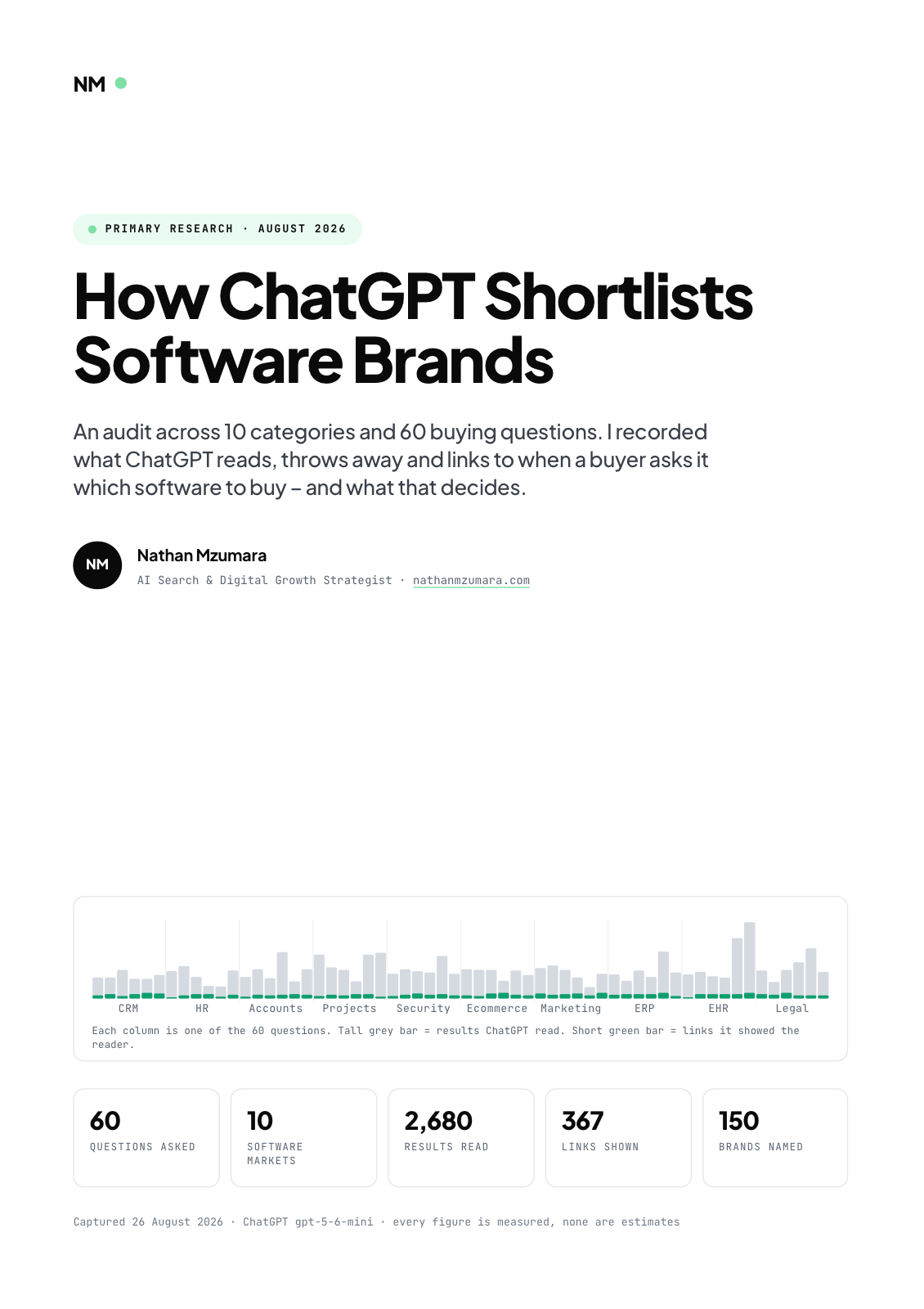
How ChatGPT Shortlists Software Brands
An audit across 10 categories and 60 buying questions. I recorded what ChatGPT reads, throws away and links to when a buyer asks it which software to buy, and what that decides.
- 60
- Questions asked
- 10
- Software markets
- 2,680
- Results read
- 367
- Links shown
Free download
Get the full report
35 pages · PDF · 536 KB. Enter your details and it downloads straight away.