Tooling
Merchant API
Also known as: Google Merchant API, Content API for Shopping
Merchant API is Google's programmatic interface for managing product and retail data in Merchant Center, including product listings, price and availability, promotions, business information and performance reporting. It is the successor to the Content API for Shopping and is structured as a set of modular sub-APIs. Retailers and their developers use it to keep large catalogues accurate without manual feed uploads.
What it is
Merchant API is a family of REST endpoints that let a retailer or an agency create, update and read the data Google holds about their products and merchant account. It covers areas such as product inputs and data sources, local and online inventory, promotions, account settings, and reporting. It replaces the older Content API for Shopping, which Google has been phasing out in favour of this modular design.
Why it matters
Product data quality decides whether items are eligible to appear in Shopping surfaces, free product listings and shopping-related answers in AI assistants. Feeds that go stale on price or stock create disapprovals and mismatched results, which costs visibility and trust. An API connection lets stock and pricing changes reach Google in near real time rather than waiting for the next scheduled crawl or file upload.
How it works
Practitioners authenticate against a Merchant Center account, register a data source, then push product inputs and inventory updates from the commerce platform or a middleware layer. Teams typically combine a primary data source for core attributes with supplemental updates for volatile fields such as price and availability, and pull reporting endpoints to monitor disapprovals and product-level performance. Migration work usually means mapping existing Content API calls and feed logic to the newer sub-API structure.
When it applies
It applies to any retailer running Shopping ads or free product listings at a scale where manual feeds and spreadsheets break down, and to anyone still on the Content API for Shopping who needs to migrate.
Examples
- A fashion retailer pushes size-level availability updates through the inventory endpoints each time a warehouse order is picked, so sold-out variants stop being advertised.
- An agency pulls product-level reporting nightly into a warehouse to flag which SKUs are disapproved and which are losing impression share on price.
- A multi-country store uses account and data source endpoints to manage separate feeds per market with local currency and shipping settings.
How it is measured
- Share of catalogue active and approved in Merchant Center, and disapproval reasons by count
- Latency between a price or stock change in the commerce platform and the update being live in Merchant Center
- Impressions and clicks from free product listings and Shopping ads at SKU level
- Rate of price and availability mismatch warnings over time
Insights on Merchant API
Related terms in Tooling
- Ahrefs Brand RadarAhrefs' AI-visibility module tracking brand mentions and impressions inside AI answers. Surfaces shifts in how brands appear across ChatGPT, Gemini, and other LLM surfaces.
- AI content detectionAI content detection is the use of software to estimate whether a piece of text, image, audio or video was generated by an AI model. Detectors return a probability or classification rather than proof, and accuracy varies with length, language, editing and model used. Because of that uncertainty, results are treated as a signal for review, not a verdict.
- AI watermarkingAI watermarking is the practice of embedding a signal into AI generated text, images, audio or video so the output can later be identified as machine produced. The signal is usually designed to be imperceptible to people but detectable by software that holds the matching key or detector. It is one of several provenance approaches used alongside metadata standards and content credentials.
- Bot detectionBot detection is the practice of identifying automated traffic to a website or API and separating it from human visitors. It distinguishes wanted automation, such as search engine and AI crawlers, from unwanted activity like scraping, credential stuffing and click fraud. Detection results feed decisions about what to allow, challenge, rate limit or block.
- Brave BrowserBrave is a Chromium based web browser from Brave Software that blocks third party trackers and most ads by default. It bundles privacy controls, Brave Search as the default engine, and an AI assistant called Leo. Because it strips tracking scripts, visits from Brave users are often harder to attribute in analytics.
- Brave SearchBrave Search is a search engine from Brave Software that serves results from its own web index rather than reselling another engine's results. It is the default engine in the Brave browser, offers AI generated answer summaries, and is sold to developers as the Brave Search API. That API makes it a grounding source for other search and AI products.
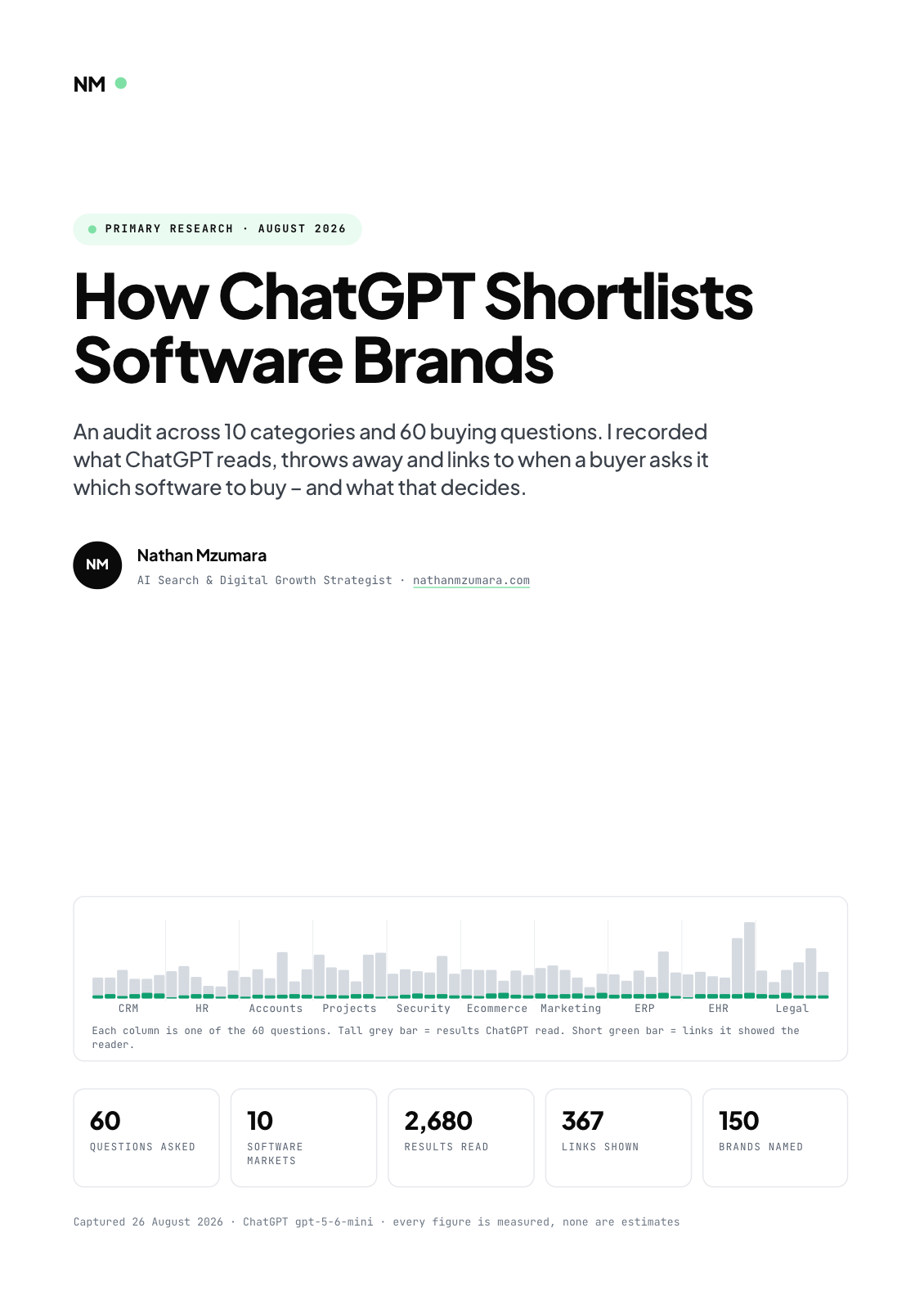
Primary research · August 2026
How ChatGPT Shortlists Software Brands
An audit across 10 categories and 60 buying questions. I recorded what ChatGPT reads, throws away and links to when a buyer asks it which software to buy, and what that decides.
- 60
- Questions asked
- 10
- Software markets
- 2,680
- Results read
- 367
- Links shown
Free download
Get the full report
35 pages · PDF · 536 KB. Enter your details and it downloads straight away.