Search Tactic
Instagram SEO
Also known as: Instagram search optimisation
Instagram SEO is the practice of optimising Instagram accounts and content so they rank in Instagram's own search results for keywords, and appear in relevant suggestions and Explore. It uses the name field, username, bio, captions, alt text, on screen text and hashtags as matching signals. The goal is to be discoverable to people searching inside the app.
What it is
Instagram SEO works on the fact that Instagram search returns accounts, audio, hashtags, Reels and posts for typed keywords, not just exact account names. Practitioners treat the searchable fields, especially the profile name field and captions, as places to state clearly what the account is about in plain language. It is a subset of social SEO focused on one platform's retrieval behaviour.
Why it matters
Many people now look for local businesses, products and creators in Instagram rather than a search engine, checking recent posts and comments before they buy. If a profile name reads only as a brand name and captions carry no descriptive language, the account is hard to match to those searches. Optimised profiles also make the account easier for Instagram to recommend to people with related interests.
How it works
Teams put a category descriptor in the name field alongside the brand, write bios that name the service and location, and use captions that state the topic in full words rather than relying on hashtags alone. They add alt text to images, put readable text on the first frame of Reels, say the key phrase out loud in video, and keep hashtags few and specific. Results are checked by searching the target terms in the app and reviewing insights for reach from search and Explore.
When it applies
It applies to any account where people could plausibly search a category, product or place, particularly local businesses, hospitality, retail, fitness, beauty and creators. It matters most for accounts that rely on new audience discovery rather than existing followers.
Examples
- A coffee shop changes its Instagram name field from "Vale & Co" to "Vale & Co | Coffee Roasters Bristol" and starts appearing in searches for Bristol coffee.
- A wedding photographer writes captions naming the venue and county, so posts surface when couples search that venue.
- A supplement brand adds alt text describing the product and its use to each carousel image instead of leaving it auto generated.
How it is measured
- Reach and profile visits attributed to search and Explore in Instagram insights
- Position of the account and its posts for target keywords searched in app
- Follower growth from non follower reach
- Link clicks or saved posts from search sourced impressions
Insights on Instagram SEO
Related terms in Search Tactic
- Agentic researchAgentic research is the use of an AI system that plans and carries out a multi-step research task on its own, running many searches, opening and reading sources, then writing a synthesised answer or report with citations. It differs from a single search query because the model decides what to look up next based on what it has already found. Vendors often market this capability as deep research.
- Answer Engine OptimisationThe practice of structuring content so it can be lifted directly into AI answers. Close cousin of GEO; emphasises clean, parseable facts and unambiguous attribution.
- Citation-worthy contentContent with the qualities LLMs select for when synthesising an answer: a single, defensible claim per paragraph; named entities; first-hand evidence; and a clear authority signal.
- Content auditA content audit is a structured review of every page or asset in a content set, scored against performance, quality, accuracy and search intent. The output is a decision for each item: keep, improve, consolidate, redirect or remove. It turns a large and uneven content library into a prioritised action plan.
- Crawler policyA crawler policy is the set of rules a site publishes and enforces to decide which automated agents may access its content, how often, and for what purpose. It typically combines robots.txt directives, server side rules and terms of use, and increasingly distinguishes search crawlers from AI training and assistant crawlers. The policy defines both what is allowed and what happens when a bot ignores it.
- Digital discoveryThe full set of channels through which people find brands, products, and answers, search engines, AI assistants, social platforms, marketplaces, and agentic browsers. Replaces the narrower frame of just “SEO”.
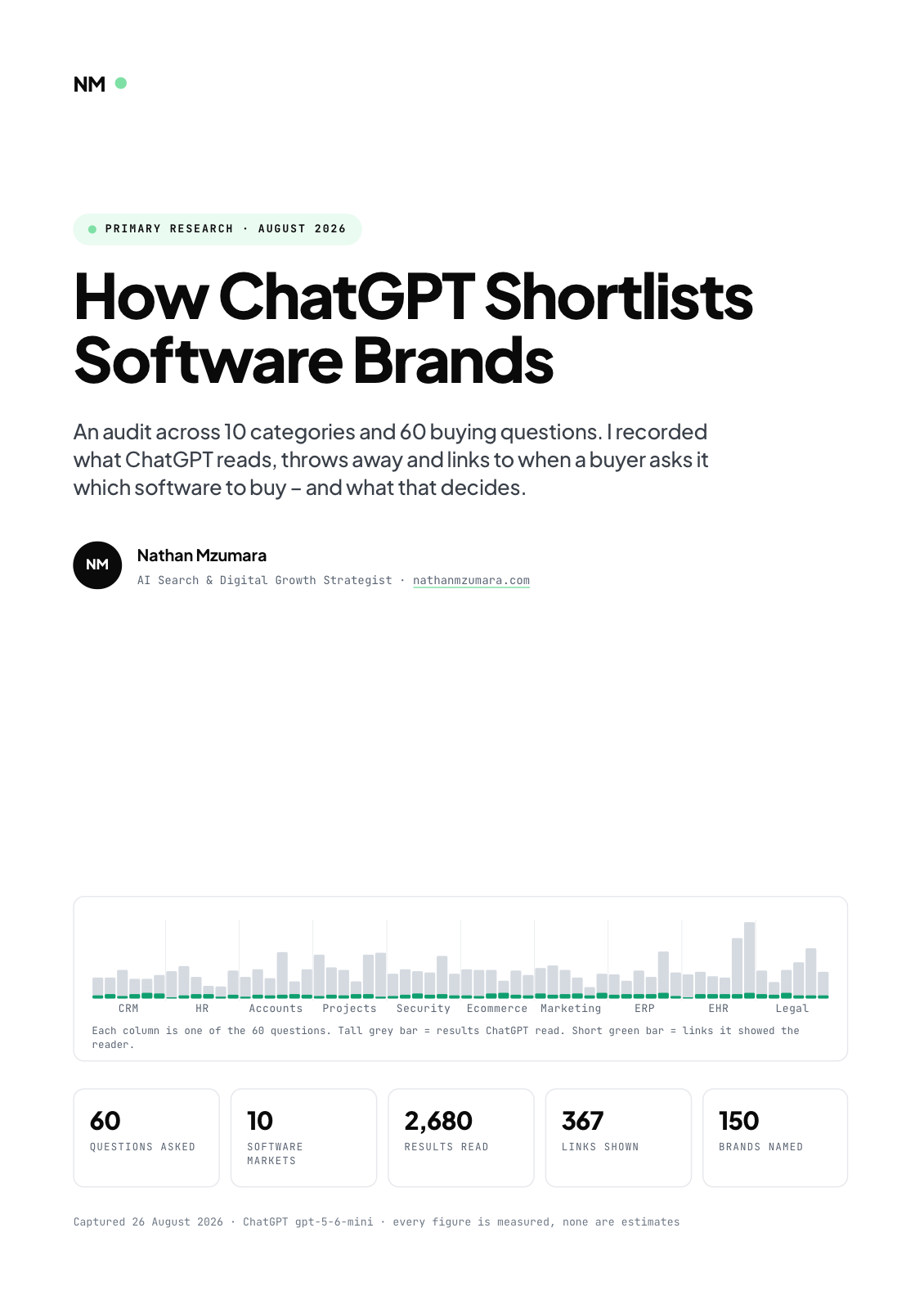
Primary research · August 2026
How ChatGPT Shortlists Software Brands
An audit across 10 categories and 60 buying questions. I recorded what ChatGPT reads, throws away and links to when a buyer asks it which software to buy, and what that decides.
- 60
- Questions asked
- 10
- Software markets
- 2,680
- Results read
- 367
- Links shown
Free download
Get the full report
35 pages · PDF · 536 KB. Enter your details and it downloads straight away.