Google Surface
Google Trends
Also known as: trends.google.com, Google Trends Explore
Google Trends is a free Google tool that shows the relative popularity of search terms over time, by location and by related query. It reports interest on a normalised 0 to 100 scale rather than absolute search volumes. Marketers use it to spot seasonality, compare terms and check whether a topic is rising or fading.
What it is
Google Trends is a public interface onto a sample of Google search data, available at trends.google.com. Instead of giving you a monthly search count, it indexes interest for a term against its own peak within the period and region you select, where 100 is the highest point. It also surfaces related queries, breakout terms, regional breakdowns and comparisons between up to five terms.
Why it matters
Search demand moves before revenue does, so Trends gives an early read on whether a category, product or narrative is growing. It is one of the few free sources that covers the present week rather than a lagging keyword database, which makes it useful for planning campaigns, content calendars and stock. It also helps settle internal arguments about whether a topic is genuinely emerging or just noisy on social media.
How it works
Practitioners compare a shortlist of terms over one to five years to see shape and seasonality, then narrow the region and category to reduce ambiguity between homonyms. Topic view is often preferred to search term view because it groups related phrasings and languages. Trends is then paired with a volume source such as Google Keyword Planner or a third party tool so that a rising line can be sized in absolute terms.
When it applies
Use it at the planning stage for annual and quarterly demand, when validating a new product or content bet, and when you need to explain a sudden traffic change.
Examples
- A retailer charts "paddling pool" over five years, sees demand peak in the first warm week rather than a fixed date, and moves paid budget to a weather triggered trigger.
- A B2B SaaS team compares "AI search optimisation" with "SEO" in the UK to judge whether the newer term deserves its own landing page yet.
- An agency checks Trends after a client's organic traffic drops 30 per cent and finds category demand fell by a similar amount, ruling out a ranking problem.
How it is measured
- Relative interest index for your core terms, tracked month on month and year on year
- Year on year change in category demand, used as a baseline when reporting traffic movement
- Share of interest for your brand term versus named competitors
- Number of rising or breakout related queries adopted into the content or keyword plan
Insights on Google Trends
Related terms in Google Surface
- AI ModeGoogle's standalone AI-first search experience inside Search itself, a conversational, multi-step interface for complex queries. Different ranking and citation logic from classical SERP.
- AI OverviewsGoogle's generative answer shown at the top of the SERP for eligible queries. Sourced from the open web, cites multiple pages, and increasingly replaces the traditional snippet for informational intent. Successor to the SGE experiment.
- AndroidAndroid is Google's mobile operating system, used on phones, tablets, televisions and other devices from many manufacturers. For marketers it is a discovery surface as well as a platform, because it ships with Chrome, the Google app, Google Play and Google's assistant features. Being visible on Android means being findable through those entry points, not only through a browser.
- Circle to SearchCircle to Search is an Android feature that lets people search whatever is on their screen by circling, highlighting or tapping it, without leaving the app they are in. It sends the selected content, image or text, to Google as a query and shows results in an overlay. It was introduced on selected Android devices in 2024.
- DiscoverGoogle's personalised feed in the Google app and on Android. Algorithmically curated, no query needed, driven by topical interest signals and freshness. Material traffic source for publishers.
- Google Business ProfileGoogle Business Profile is the free Google tool that lets a business manage how it appears in Google Search, Google Maps and local results. It holds core details such as name, address, phone number, opening hours, categories, photos, products, services and reviews. Formerly called Google My Business, it is the main control panel for a business's local presence on Google.
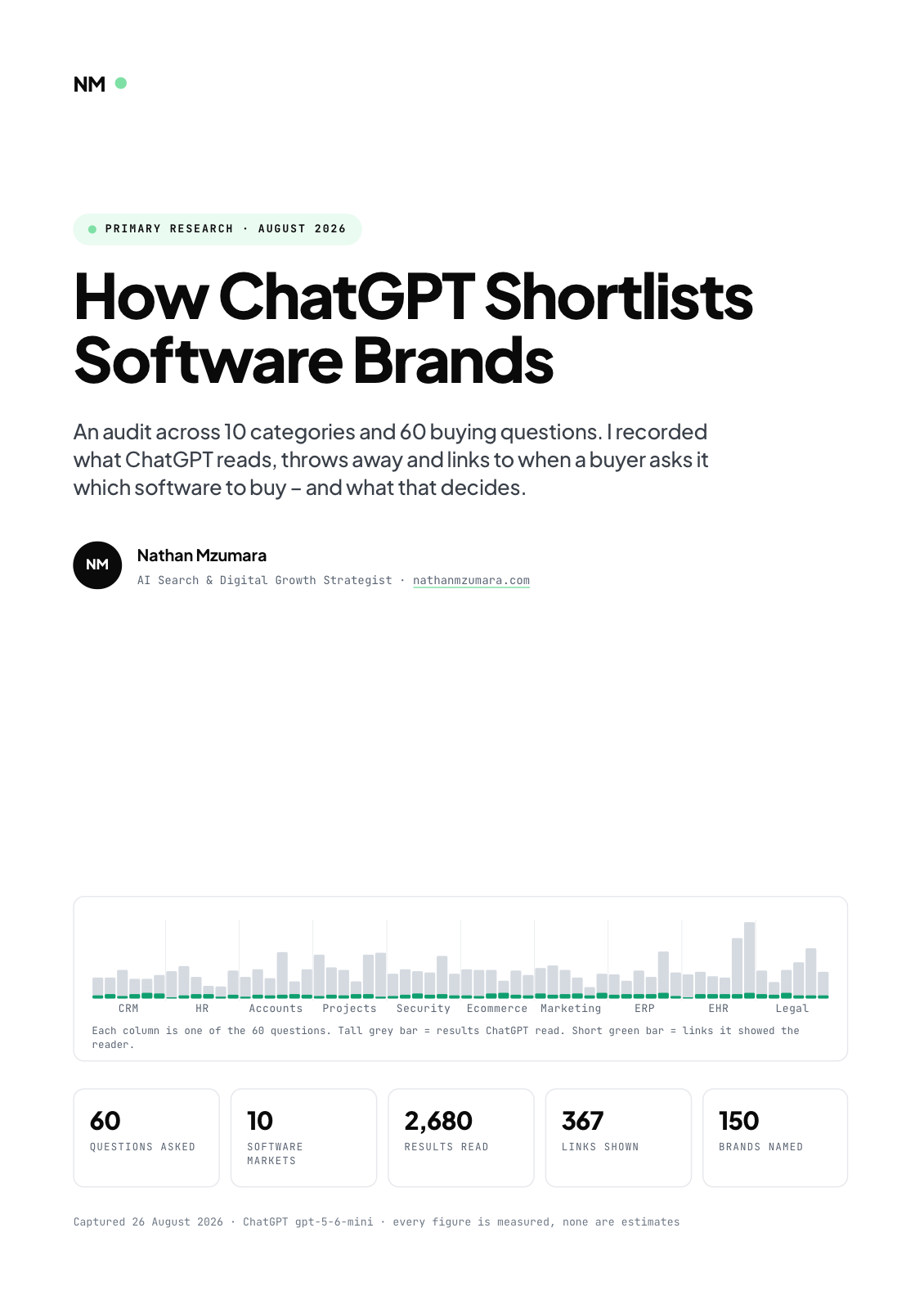
Primary research · August 2026
How ChatGPT Shortlists Software Brands
An audit across 10 categories and 60 buying questions. I recorded what ChatGPT reads, throws away and links to when a buyer asks it which software to buy, and what that decides.
- 60
- Questions asked
- 10
- Software markets
- 2,680
- Results read
- 367
- Links shown
Free download
Get the full report
35 pages · PDF · 536 KB. Enter your details and it downloads straight away.