Advertising & Paid Media
Google Search Partner Network
Also known as: Partner Network, Search Partners, Google Partner Network
The Google Search Partner Network is a group of non-Google websites, apps and search boxes that can show Google search and shopping ads alongside or instead of results on Google itself. Advertisers opt in or out of it at campaign level in Search and Shopping campaigns. Performance usually differs from Google Search, so it is normally reported and judged separately.
What it is
It is an inventory setting rather than a separate product. When enabled, ads from eligible campaigns can appear on partner sites that run Google-powered search, on site search results pages, in directories and price comparison pages, and in some browser and app search boxes. Google does not publish a full public list of participating properties, so the exact set of placements is not fully visible to advertisers.
Why it matters
Search partners expand reach beyond Google's own results pages and can add cheap incremental volume, but the traffic often behaves differently because the query intent, page layout and audience are not the same. Without separating it out, partner traffic can flatter or distort blended cost per acquisition and make Search performance look better or worse than it is. It also matters for brand safety, because you have less control over where ads render than you do on Google Search.
How it works
Practitioners segment reporting by network to compare Google Search against search partners on cost, conversion rate and cost per acquisition, then decide whether to keep the setting on. Because bidding and budget are shared across the whole campaign, many teams either accept the blended result, split traffic into separate campaigns for cleaner control, or simply untick the setting where partner performance is weak. Exclusions and placement visibility are more limited than on the Display Network, so the main lever is usually on or off.
When it applies
It applies whenever you are setting up or auditing Google Search and Shopping campaigns, and when diagnosing sudden shifts in volume, click quality or cost per acquisition. It is also relevant in automated campaign types where partner inventory is included by default.
Examples
- A lead generation account segments by network and finds search partners deliver 18 per cent of clicks but a much higher cost per qualified lead, so the setting is switched off
- A retailer keeps search partners on for Shopping campaigns because price comparison placements return a workable return on ad spend
- An agency splits one brand campaign into two, one with partners on and one off, to get a clean read before recommending a change
How it is measured
- Clicks, cost and conversions segmented by network (Google Search versus search partners)
- Cost per acquisition and return on ad spend for partner traffic compared with Google Search
- Click-through rate and conversion rate gap between the two networks
- Share of total campaign spend going to search partners
Related terms in Advertising & Paid Media
- AI-generated creativeAI-generated creative is ad and marketing creative produced or adapted using generative models, including images, video, voiceover, headlines and body copy. Teams use it to produce more variants, localise faster and test concepts that would be too costly to shoot. It still needs human direction, brand review and legal checks before it runs.
- Asset groupsAn asset group is the creative container inside a Google Performance Max or Demand Gen campaign, holding headlines, descriptions, images, logos, videos and audience signals. Google assembles ads from these assets and serves them across Search, Shopping, YouTube, Display, Discover, Gmail and Maps. Retail campaigns can tie an asset group to a specific set of products through listing groups.
- Brand safetyBrand safety is the practice of preventing advertising and brand content from appearing next to material that could damage reputation, such as violent, illegal or misleading content. Brand suitability is the related, narrower idea of matching placements to a specific brand's tolerance and values rather than a universal baseline. Both rely on exclusion lists, content classification and verification reporting.
- ChatGPT AdsChatGPT Ads refers to advertising placements inside OpenAI's ChatGPT. OpenAI has publicly signalled that advertising is part of its commercial plans and has been testing and building out ad capabilities, so the format details continue to change. For marketers it represents a possible new paid surface alongside organic visibility in AI assistants.
- ChatGPT Sponsored AgentsChatGPT Sponsored Agents is the name given to a paid placement format in which a brand's agent or assistant can be surfaced inside a ChatGPT conversation to help complete a task, such as booking, quoting or buying. It sits alongside other advertising formats OpenAI has discussed for ChatGPT, where commercial results are marked as sponsored rather than blended invisibly into answers. Availability, naming and mechanics are still moving, so treat any specification as provisional and check current OpenAI documentation before planning spend.
- Conversational advertisingConversational advertising is paid placement inside a dialogue, whether that is an AI assistant, a chatbot, a messaging app or a voice interface. Instead of a static creative next to content, the ad appears as a response, suggestion or handover at the point where the user has expressed intent. The defining features are turn-by-turn context, a disclosure label, and the option for the user to keep talking rather than click away.
Primary research · August 2026
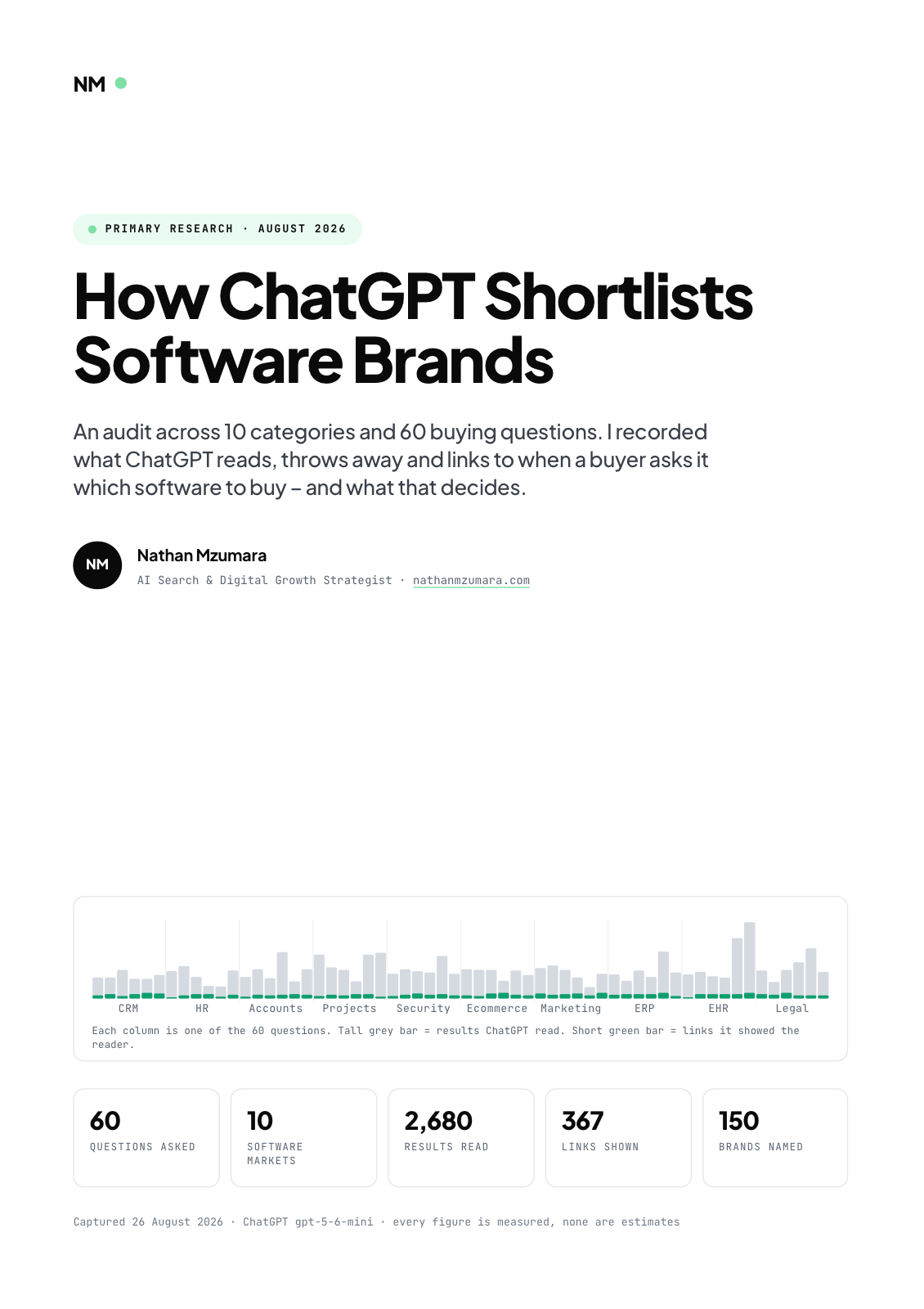
How ChatGPT Shortlists Software Brands
An audit across 10 categories and 60 buying questions. I recorded what ChatGPT reads, throws away and links to when a buyer asks it which software to buy, and what that decides.
- 60
- Questions asked
- 10
- Software markets
- 2,680
- Results read
- 367
- Links shown
Free download
Get the full report
35 pages · PDF · 536 KB. Enter your details and it downloads straight away.