Consumer Behaviour
Facebook Search
Also known as: Facebook search engine, search on Facebook
Facebook Search is the search function inside Facebook that lets people find posts, people, Pages, Groups, events, videos and Marketplace listings. It is a platform search experience rather than a general web search engine, so results are shaped by what is published on Facebook and by the searcher's connections and activity. For businesses it affects whether a Page, Group or listing is found by people already inside the app.
What it is
Search on Facebook queries content held within the platform, with filters and tabs for different content types. Results reflect signals such as relevance to the query, engagement, recency, location and the searcher's own network and history, so two people searching the same phrase can see different results. Meta has also placed its AI assistant in the search experience in some markets, which means some queries can return a generated response alongside platform results.
Why it matters
A meaningful share of consumer discovery happens inside apps rather than on the open web, particularly for local services, secondhand goods, events and community recommendations. If your Page name, category, location and posts are unclear, people searching for your business inside Facebook may not find you. It also matters for reputation, because recommendation threads inside Groups surface in search and are the kind of user discussion that AI systems draw on.
How it works
Practitioners make Pages findable by using the name people actually search for, completing category, location and contact fields, and posting consistently so there is recent content to match queries. For Marketplace and local services they write listing titles in the words buyers use and add clear location detail. Teams also monitor searches for their brand and category inside Facebook to see which Groups, posts and competitors appear.
When it applies
It applies to any business with a local audience, community presence, event programme or Marketplace activity, and to social teams tracking where brand conversations happen.
Examples
- A plumber names their Page with the service and town so it matches searches such as "plumber Stirling".
- A furniture seller titles Marketplace listings with the item, condition and area rather than a vague phrase.
- A venue keeps its events published on Facebook so they appear when people search the event name or category locally.
How it is measured
- Page and Group reach or visits attributed to search within platform insights
- Marketplace listing views and enquiry rate per listing
- Brand and category query checks: manual review of what appears for your key search terms
- Follower or member growth from non-referral, in-app discovery
Insights on Facebook Search
Related terms in Consumer Behaviour
- Agentic browserA browser (or browsing layer) that uses an LLM agent to interpret pages, summarise content, and take actions on behalf of the user. Arc Search, Perplexity Comet, Browser Company's Dia, Dia browser, and similar.
- Brand demandSearch volume for branded terms. In an AI-search world, brand demand is the single strongest moat, generic queries are absorbed by AI Overviews and ChatGPT, while branded queries route users directly to brand properties.
- Brand discoveryBrand discovery is the process by which someone encounters a brand for the first time, or becomes newly aware it can solve their problem. It happens across search results, AI assistants, social feeds, communities, creators, reviews, marketplaces and word of mouth. Marketers study it to work out which surfaces introduce them to future customers.
- Consumer behaviour signalObservable patterns in how users phrase queries, refine searches, and choose answers, used by both ranking systems and generative models to infer intent and quality.
- Conversational searchConversational search is the pattern of finding information through a back and forth dialogue rather than a single keyword query, with each follow-up interpreted in the context of what came before. Users ask broad questions, then narrow with refinements such as cheaper, nearby or without the subscription. It shifts discovery from ranked link lists towards answers that must survive several rounds of questioning.
- Job-to-be-done (search)The functional outcome a searcher is trying to achieve when they issue a query. Distinct from the literal query text. The unit of analysis for intent-aligned content strategy.
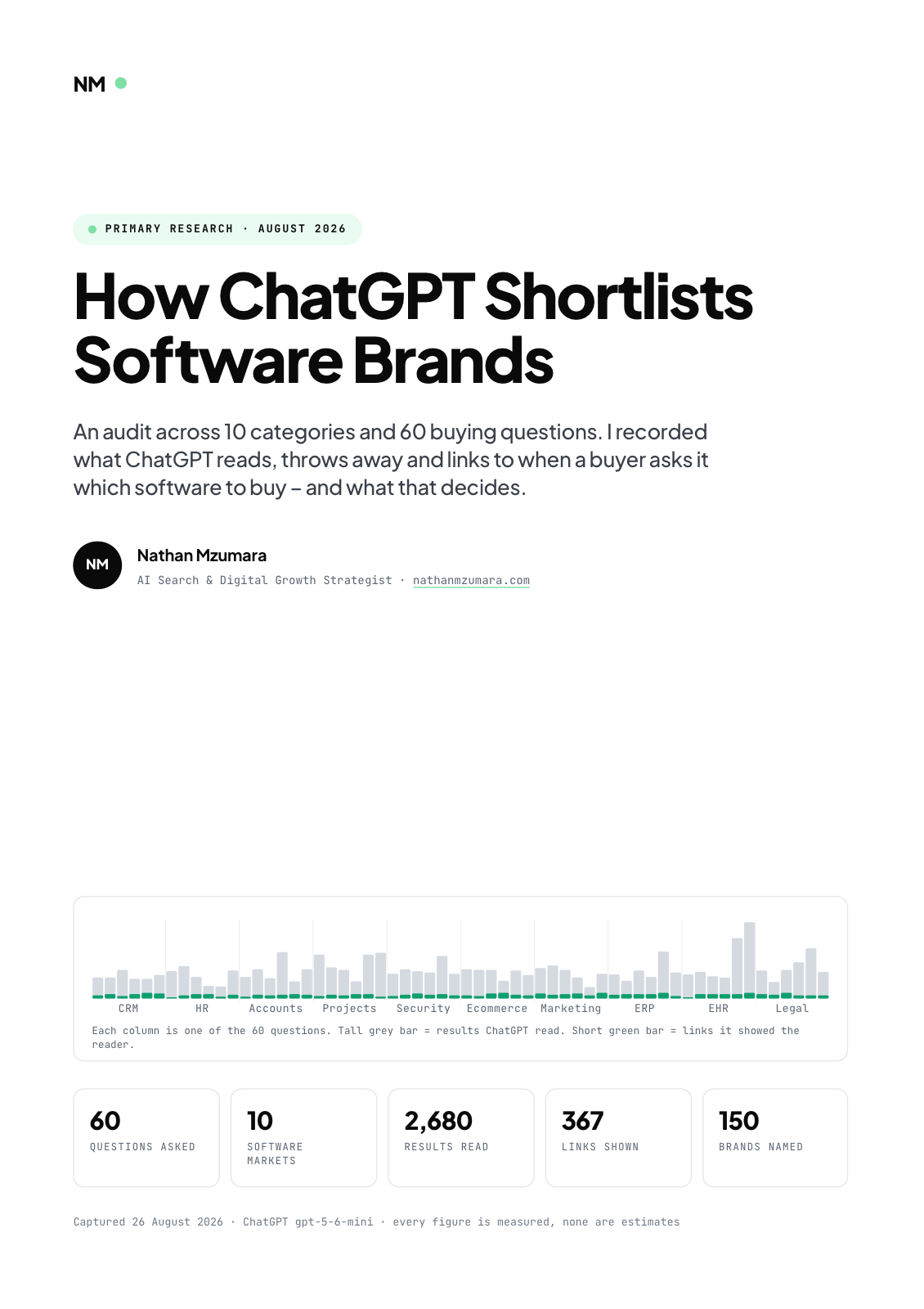
Primary research · August 2026
How ChatGPT Shortlists Software Brands
An audit across 10 categories and 60 buying questions. I recorded what ChatGPT reads, throws away and links to when a buyer asks it which software to buy, and what that decides.
- 60
- Questions asked
- 10
- Software markets
- 2,680
- Results read
- 367
- Links shown
Free download
Get the full report
35 pages · PDF · 536 KB. Enter your details and it downloads straight away.