Regulation & Policy
Data Protection Officer
Also known as: DPO, data protection officer role
A Data Protection Officer is a designated role responsible for advising an organisation on data protection law, monitoring its compliance and acting as a contact point for regulators and individuals. Under UK and EU GDPR, appointing one is mandatory for public authorities and for organisations carrying out large scale monitoring or processing of special category data. Other organisations may appoint one voluntarily.
What it is
The DPO is an independent advisory and oversight role, not simply an operational owner of privacy tasks. Core duties set out in the GDPR include informing and advising staff on obligations, monitoring compliance, advising on data protection impact assessments, cooperating with the supervisory authority such as the Information Commissioner's Office in the UK, and acting as the contact point for data subjects. The role can be filled internally or contracted externally, and must report to the highest level of management.
Why it matters
Marketing and growth teams handle much of an organisation's personal data through analytics, tags, advertising audiences, CRM and lead generation, so the DPO is often the person who signs off on new tracking or data sharing. Involving them early shortens approval cycles and reduces the risk of having to unpick consent mechanisms, measurement setups or customer data platforms after launch. Their assessment also shapes what first party data you can legally collect and use for personalisation and audience building.
How it works
Practitioners work with the DPO on records of processing, lawful basis decisions, consent and cookie configuration, data sharing agreements with ad and analytics vendors, retention periods and data protection impact assessments for higher risk projects. In practice this means bringing the DPO into the brief for new tools and campaigns rather than at sign off, and documenting decisions so they can be defended later. The DPO must be given genuine independence and cannot be instructed on how to carry out their tasks, which is why they advise rather than simply approve.
When it applies
The appointment requirement applies where the GDPR conditions are met, and the role is relevant to any project involving personal data, including new martech deployments, audience matching, profiling or transfers to third parties. Requirements differ by jurisdiction, so check current guidance from the relevant regulator.
Examples
- A local authority appoints a DPO as required for public bodies and routes all new analytics tools through them for review.
- A subscription business asks its DPO to complete a data protection impact assessment before launching behavioural profiling for email personalisation.
- A mid sized retailer with no mandatory obligation retains an external DPO on a part time contract to oversee consent management and vendor contracts.
How it is measured
- Share of new marketing tools and campaigns reviewed by the DPO before launch
- Number of data protection impact assessments completed and outstanding actions closed
- Time to respond to data subject access, deletion and objection requests
- Volume and resolution time of privacy incidents or complaints logged
Insights on Data Protection Officer
Related terms in Regulation & Policy
- AI complianceAI compliance is the work of making sure AI systems meet the laws, regulations, standards and internal policies that apply to them. It spans data protection, transparency, risk classification, documentation, human oversight and record keeping across the life of a system. In practice it combines legal interpretation, engineering controls and ongoing evidence gathering.
- AI governanceAI governance is the set of policies, roles, controls and review processes an organisation uses to manage how AI systems are built, bought and used. It covers risk assessment, documentation, human oversight, data handling and accountability. It applies both to AI a company develops and to third-party AI tools used by staff.
- AI privacyAI privacy is the set of practices, rights and obligations that govern how personal data is collected, used, stored and exposed when building or using AI systems. It covers training data, prompts and outputs, retention by AI vendors, and the transparency and control offered to the people whose data is involved. For marketing teams it shapes what customer data can safely be put into AI tools and what must be disclosed.
- AI safetyAI safety is the practice of designing, testing and operating AI systems so they cause less harm, behave predictably and resist misuse. It covers alignment with intended behaviour, evaluation and red teaming, content guardrails, and monitoring once a system is live. For marketers it shapes what models will say, how assistants handle brands, and what compliance teams expect before AI tools go into production.
- AI transparencyAI transparency is the practice of making clear how an AI system works, what sits behind it, and when content or an interaction involves AI. It covers regulatory disclosure duties as well as voluntary explanations such as model cards, labels on synthetic media and citations in AI generated answers. For publishers and marketers it sets expectations about when AI involvement should be declared and how clearly.
- Competition and Markets AuthorityThe Competition and Markets Authority (CMA) is the United Kingdom's competition and consumer protection regulator. It investigates mergers, anti-competitive conduct and market practices, and it holds specific powers over large digital firms under the Digital Markets, Competition and Consumers Act 2024. Its decisions shape how search engines, app stores and AI assistants operate in the UK market.
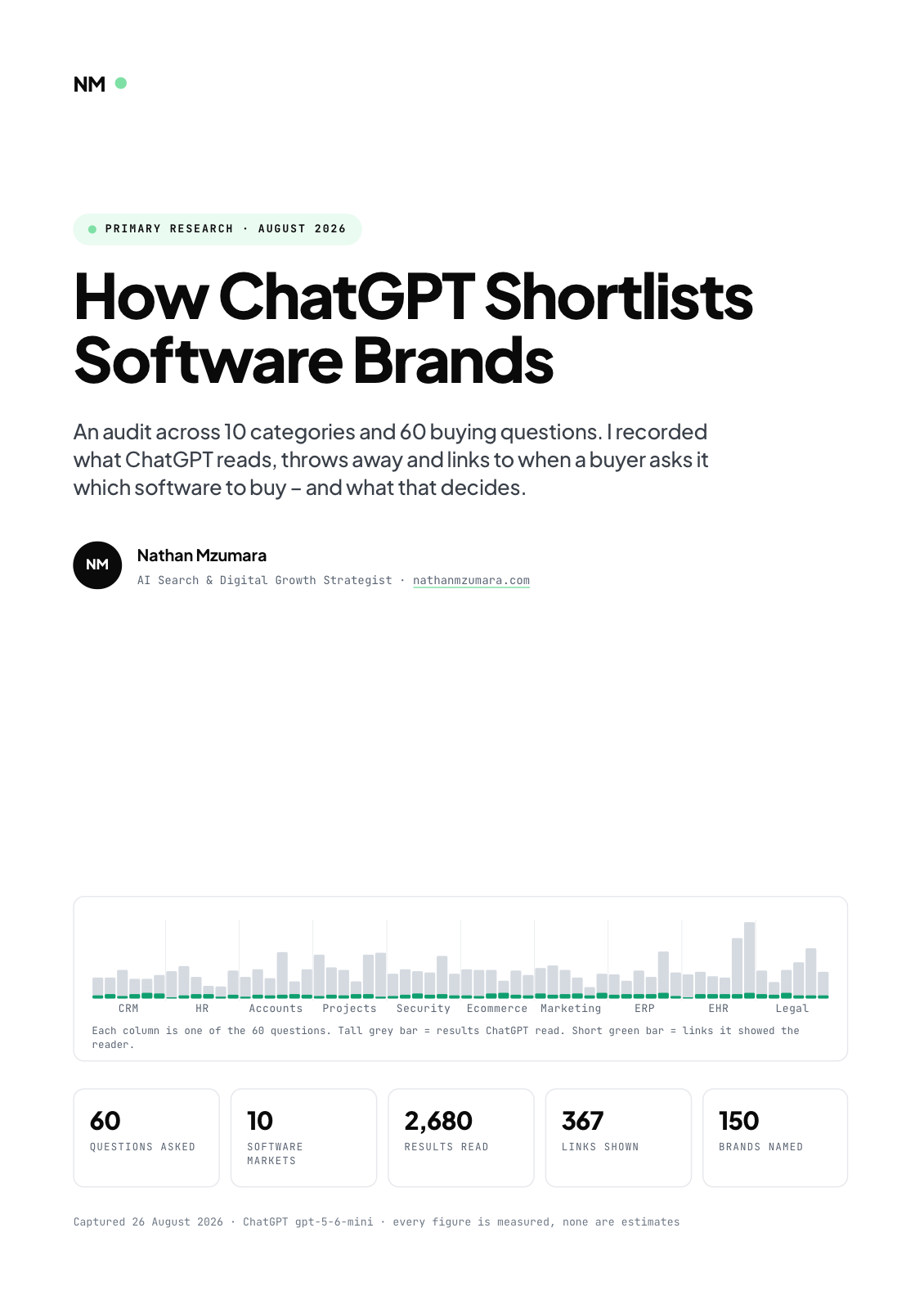
Primary research · August 2026
How ChatGPT Shortlists Software Brands
An audit across 10 categories and 60 buying questions. I recorded what ChatGPT reads, throws away and links to when a buyer asks it which software to buy, and what that decides.
- 60
- Questions asked
- 10
- Software markets
- 2,680
- Results read
- 367
- Links shown
Free download
Get the full report
35 pages · PDF · 536 KB. Enter your details and it downloads straight away.