How to Disect the AI 2040 Plan A Scenario for Marketers

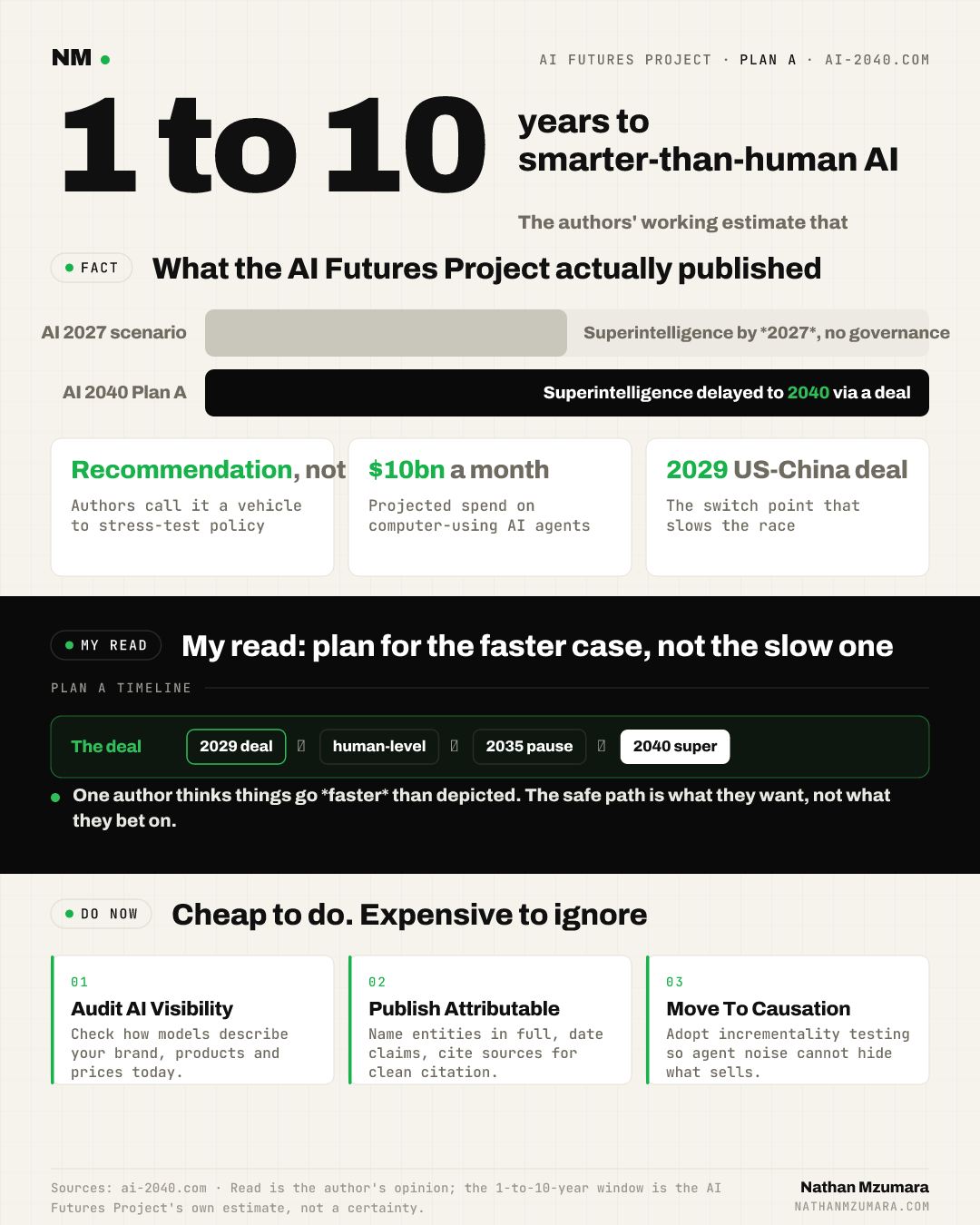
Let me disect the AI 2040 Plan A scenario in plain terms. The AI Futures Project published Plan A at ai-2040.com as a positive vision for avoiding AI-driven catastrophe. It imagines humanity delaying superintelligence until 2040 through an international deal, total research transparency, and what the authors call mutually assured compute destruction. It is a recommendation, not a forecast.
What is Plan A in one sentence?
Plan A is the AI Futures Project's proposal for how humanity can avoid an existential catastrophe from superintelligent AI and reach a flourishing future. The plan calls for an international deal that slows the race to superintelligence, with dozens of companies across multiple countries scaling together, openly and safely, rather than racing in secret.
The authors are clear that Plan A is "primarily a recommendation, not a prediction." It is not their best guess about what will actually happen. It is a vehicle to communicate and stress-test policy ideas.
The timeline you need to know
The scenario sets out a concrete sequence of dates. These matter because they frame how much runway businesses may have.
- 2029: The US and China agree to avoid a reckless race to superintelligence.
- 2030: AI R&D would have been fully automated, leading to superintelligence by year end. The deal prevents this.
- 2030 to 2035: AI scales within the human range, to systems roughly as capable as top human experts.
- 2035: Development pauses at top-human-expert level to keep humans in control.
- 2040: The pause lifts and AI scales to superintelligence. Hence the title.
In the earlier AI 2027 scenario, AI fully automated the building of smarter AI in 2027, causing an intelligence explosion within the year. The two changes here are a default timeline of 2030 and superhuman AI first appearing in 2040 because of governance.
Why disect a scenario at all rather than a forecast?
The team uses scenarios because most AI policy proposals, in their words, "fall apart under scenario scrutiny." That means if you write down a detailed, plausible story where a policy succeeds, you often find it is weaker than it looked. Writing the scenario surfaces the hard choices.
To disect switch points like these is useful even under deep uncertainty. The authors compare the exercise to the US military gaming out Taiwan, and to scenario work by intelligence agencies, climate bodies and pandemic-preparedness offices. Eisenhower's line frames it: "Plans are worthless, but planning is everything."
The core claim marketers should not ignore
The scenario states that "AI companies will probably succeed at their stated goal of building smarter-than-human AI systems within the next 1 to 10 years." That is the single sentence with the largest bearing on any long-range business plan. Whether or not you accept it, it defines the range you are planning inside.
What the 2027 picture already shows for business
The scenario's 2027 chapter describes two workforces in America. The first is 165 million people. The second is AI agents, "millions of copies spun up and shut down every hour," working at superhuman speed. Most of the output is described as slop, but enough is good that people pay ten billion dollars a month for AIs that can, in theory, do anything on a computer an employee can.
For growth leaders, that is the marketing shift in miniature. Agents that can operate software will research, buy, browse and transact. The move to agent-driven work reshapes how your brand gets discovered, chosen and measured. I have written about the practical side of this in how agents navigate websites, logins and bookings.
What Plan A means for the future of marketing
Plan A hinges on transparency. The authors call for "total research transparency" so nations can understand what is happening and enforce guardrails. The most important transparency step named is limiting the gap between internal and external deployment, because the internally deployed AIs carry most of the takeover risk.
Marketing does not sit at the centre of this, but the second-order effects reach every growth team. Consider three.
- Discovery moves to models: If agents do the work of employees, they also do the work of buyers. Being visible inside AI answers becomes as important as ranking in classic search.
- Provenance becomes a trust signal: A transparency regime rewards verifiable, sourced content. Brands that publish clear, attributable material are easier for models to cite correctly.
- Measurement gets harder before it gets clearer: Agent traffic muddies analytics. You need causal methods, not just correlation, to know what works. See my breakdown of Google Meridian and geo incrementality.
The prediction versus the recommendation
Read carefully and the distinction is the whole point. The implementation of Plan A is a recommendation and not what the team expects. The subsequent effects it depicts are their predictions. Daniel, one of the authors, "currently thinks things will probably go somewhat faster than depicted in this scenario."
So the honest reading is this: the safe, slow path is what the authors want, not what they bet on. The 1 to 10 year window for smarter-than-human AI is their working estimate. Plan for the faster case and be pleasantly surprised if the deal holds.
Concrete actions to take now
You cannot influence an international AI deal from a marketing seat. You can prepare your business for either path.
- Audit AI visibility: Check how models describe your brand, products and prices today. Fix wrong or missing facts at the source.
- Publish attributable content: Name entities in full, date your claims and cite sources. This helps models quote you correctly under any transparency regime.
- Build agent-ready journeys: Make sure an agent can find, understand and complete key tasks on your site.
- Move measurement toward causation: Adopt incrementality testing so agent noise does not hide what drives sales.
- Set a review cadence: Given a 1 to 10 year window, revisit your assumptions every quarter, not every year.
How to disect any big AI scenario for your own plan
When you disect the AI 2040 Plan A material, separate three things and act on the last one. First, the recommendation, which is what the authors wish for. Second, the timeline, which is a device, not a promise. Third, the predicted effects, which are their real forecast. Build your marketing plan around the effects and the window, review it every quarter, and you will be ready whichever path the world takes.
Tags