Search Tactic
SEO audit
Also known as: technical SEO audit, site audit
An SEO audit is a structured review of a website to find the technical, content and authority issues holding back its visibility in search and AI answers. It produces a prioritised list of problems, their likely impact and the fixes needed. Audits are usually run as a baseline before a project and repeated periodically.
What it is
An SEO audit, sometimes called a technical SEO audit or site audit, is a diagnostic exercise rather than a strategy document. It typically covers crawling and indexing, site architecture, page speed and rendering, on-page elements, structured data, internal linking, content quality and duplication, and the external link profile. The output is a findings report with evidence, severity and recommended actions.
Why it matters
Audits matter because visibility problems are often caused by mechanics rather than by a lack of content: pages that cannot be crawled, rendered or understood will not be retrieved or cited. A good audit stops teams from spending budget on new content while basic barriers remain in place. It also creates a shared, evidence-based view of priorities across marketing, product and engineering.
How it works
Practitioners combine a crawl of the site with data from Search Console, analytics, log files and manual inspection of key templates, then compare findings against how important pages actually perform. Issues are grouped by theme and ranked by expected impact and effort, so the report becomes a backlog rather than a long undifferentiated list. Findings are usually re-checked after implementation to confirm the fix worked.
When it applies
Run an audit before a redesign or migration, when organic traffic or AI citations drop without an obvious cause, when taking over an unfamiliar site, and on a regular cycle for large or fast-changing sites.
Examples
- A crawl finds faceted navigation generating thousands of near-duplicate URLs, so canonical and crawl rules are added.
- Search Console shows key service pages marked as discovered but not indexed, tracing back to thin content and no internal links.
- A JavaScript-rendered pricing table is invisible in the raw HTML, so the content is server-rendered to make it available to crawlers and AI retrievers.
How it is measured
- Number of open issues by severity, and the proportion closed after each sprint
- Indexed pages versus intended indexable pages, tracked in Search Console
- Core Web Vitals and crawl error trends before and after fixes
- Organic impressions, clicks and AI citations for the templates and page groups the audit targeted
Related terms in Search Tactic
- Answer Engine OptimisationThe practice of structuring content so it can be lifted directly into AI answers. Close cousin of GEO; emphasises clean, parseable facts and unambiguous attribution.
- Citation-worthy contentContent with the qualities LLMs select for when synthesising an answer: a single, defensible claim per paragraph; named entities; first-hand evidence; and a clear authority signal.
- Content auditA content audit is a structured review of every page or asset in a content set, scored against performance, quality, accuracy and search intent. The output is a decision for each item: keep, improve, consolidate, redirect or remove. It turns a large and uneven content library into a prioritised action plan.
- Crawler policyA crawler policy is the set of rules a site publishes and enforces to decide which automated agents may access its content, how often, and for what purpose. It typically combines robots.txt directives, server side rules and terms of use, and increasingly distinguishes search crawlers from AI training and assistant crawlers. The policy defines both what is allowed and what happens when a bot ignores it.
- Digital discoveryThe full set of channels through which people find brands, products, and answers, search engines, AI assistants, social platforms, marketplaces, and agentic browsers. Replaces the narrower frame of just “SEO”.
- Ecommerce SEOEcommerce SEO is the practice of making an online store's category, product, brand and editorial pages discoverable in organic search. It combines technical work on crawling, indexing and site structure with commercial decisions about which queries each page should serve. The goal is qualified non-paid traffic that converts into orders.
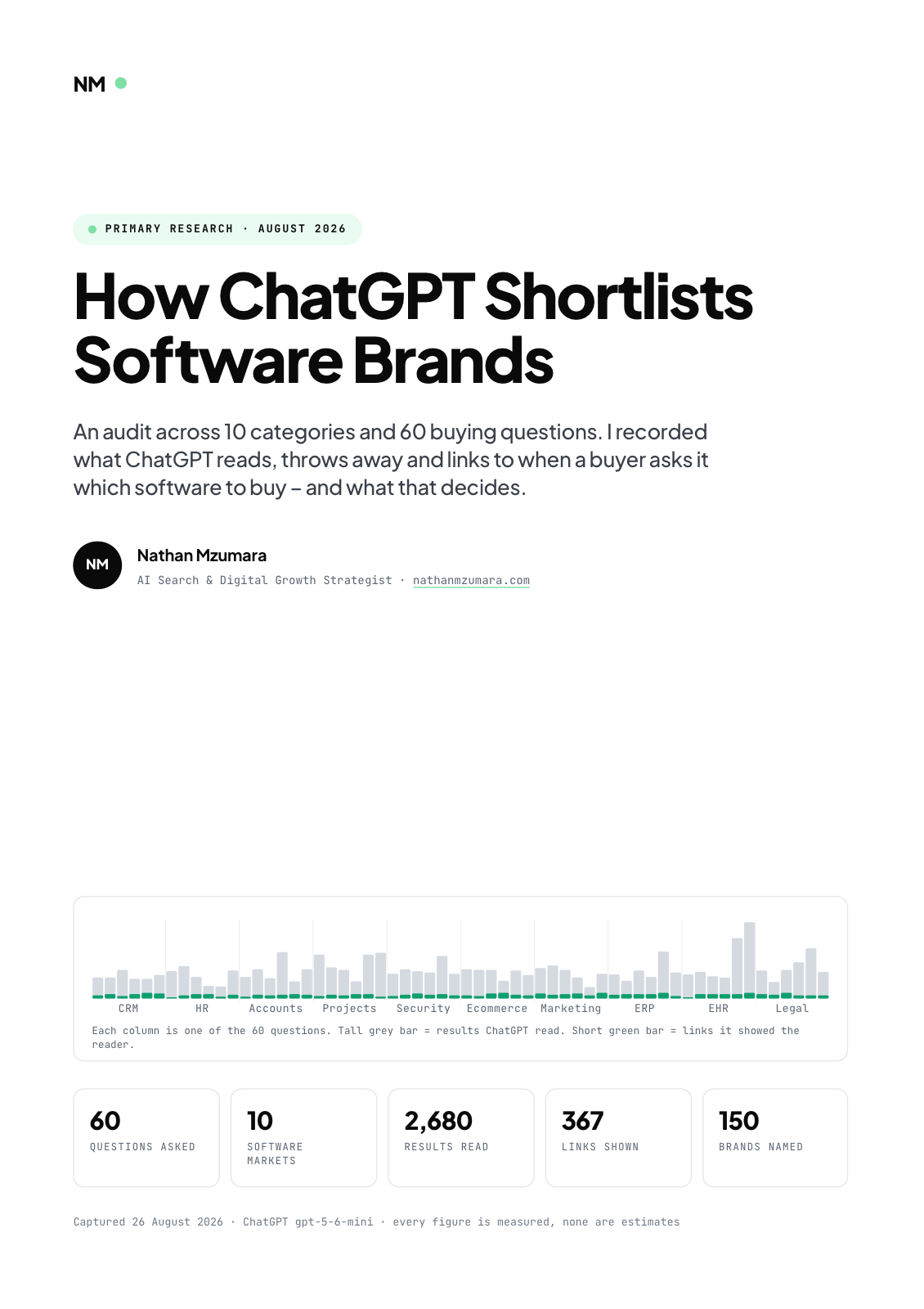
Primary research · August 2026
How ChatGPT Shortlists Software Brands
An audit across 10 categories and 60 buying questions. I recorded what ChatGPT reads, throws away and links to when a buyer asks it which software to buy, and what that decides.
- 60
- Questions asked
- 10
- Software markets
- 2,680
- Results read
- 367
- Links shown
Free download
Get the full report
35 pages · PDF · 536 KB. Enter your details and it downloads straight away.