AI Company
Plaud
Also known as: Plaud AI, Plaud Note, Plaud NotePin
Plaud is a consumer AI hardware brand that makes voice recording devices, such as the card-shaped Plaud Note and the wearable Plaud NotePin, paired with an app that transcribes and summarises what was captured. The devices handle capture, while the companion software applies speech recognition and large language models to produce transcripts, summaries and structured notes. It is one of the better known examples of the AI wearable and AI notetaker category aimed at individuals rather than enterprise IT buyers.
What it is
Plaud sells small recording devices together with a subscription app that turns audio into transcripts, summaries, action points and templated outputs such as meeting notes or interview write-ups. The Plaud Note is a thin recorder designed to sit on the back of a phone, and the NotePin is a smaller wearable that can be clipped or worn. The value sits in the pairing of dedicated hardware with cloud processing rather than in the device alone.
Why it matters
Plaud matters to marketers as a signal of where consumer AI hardware and the wider AI notetaking category are heading, and as a comparison point buyers raise when evaluating software only alternatives. Brands selling meeting or productivity tools are increasingly compared against named hardware products inside AI assistant answers, so being absent from those comparisons costs visibility. It also illustrates how a hardware brand builds discovery through reviews, retail listings and YouTube demonstrations rather than classic keyword pages alone.
How it works
Practitioners study Plaud as a competitor or adjacent product: tracking how it is described in AI answers, which features are cited, and which review sources models lean on. Product teams benchmark transcription accuracy, summary quality and privacy handling against it. Content teams publish honest comparison and alternative pages so their own product appears when someone asks how a tool differs from Plaud.
When it applies
Relevant when you sell or write about recording, transcription, notetaking or AI wearable products, or when your buyers ask how dedicated hardware compares with phone apps and meeting bots.
Examples
- A meeting software brand publishes a factual comparison page covering hardware recorders such as Plaud alongside software notetakers.
- A consultant tests a Plaud device against a laptop notetaker to decide which produces usable client call summaries.
- An analyst tracks how ChatGPT and Perplexity describe Plaud when asked to recommend AI voice recorders.
How it is measured
- Share of AI answers about AI voice recorders that name your brand alongside Plaud
- Traffic and conversions from comparison and alternative pages that mention the category leaders
- Sentiment and feature claims cited by models when describing your product versus named competitors
- Review coverage volume across sources that AI assistants commonly quote
Related terms in AI Company
- Amazon Web ServicesAmazon Web Services is Amazon's cloud computing division, providing compute, storage, databases, networking and machine learning services on a pay as you go basis. It is one of the main cloud platforms used to host websites, data pipelines and AI applications. For AI work it offers services such as Amazon Bedrock, SageMaker, OpenSearch and various vector and database options.
- AnthropicAnthropic is an AI company that builds the Claude family of large language models and positions safety research at the centre of its work. Its products include the Claude apps, a developer API and Claude integrations used inside other tools. For marketers, Anthropic matters because Claude is one of the assistants where buyers now ask questions that used to start in a search engine.
- BroadcomBroadcom is a US semiconductor and infrastructure software company, listed as AVGO, that supplies networking, storage, wireless and custom silicon alongside a large enterprise software portfolio. In AI it is known for data centre networking components and for co-designing custom accelerators with large cloud operators. Its software side expanded significantly with the acquisition of VMware.
- CerebrasCerebras Systems is a US computing company that builds very large wafer-scale processors and systems for training and running AI models. It sells hardware and also offers a hosted inference service that runs open models at high token generation speeds. It matters to search and marketing teams mainly as one of the infrastructure options behind fast AI assistants and agents.
- GoogleGoogle is the search engine and technology company owned by Alphabet, and the operator of Search, YouTube, Chrome, Android, Google Ads and Google Cloud. It develops the Gemini family of AI models and surfaces generated answers in products such as AI Overviews. For most businesses it remains the largest single source of organic and paid search demand.
- Google DeepMindGoogle DeepMind is Google's artificial intelligence research and development unit, formed by combining DeepMind with the Google Brain team in 2023. DeepMind was founded in London in 2010 and acquired by Google in 2014. The unit develops Google's Gemini models alongside longer-running research projects such as AlphaFold.
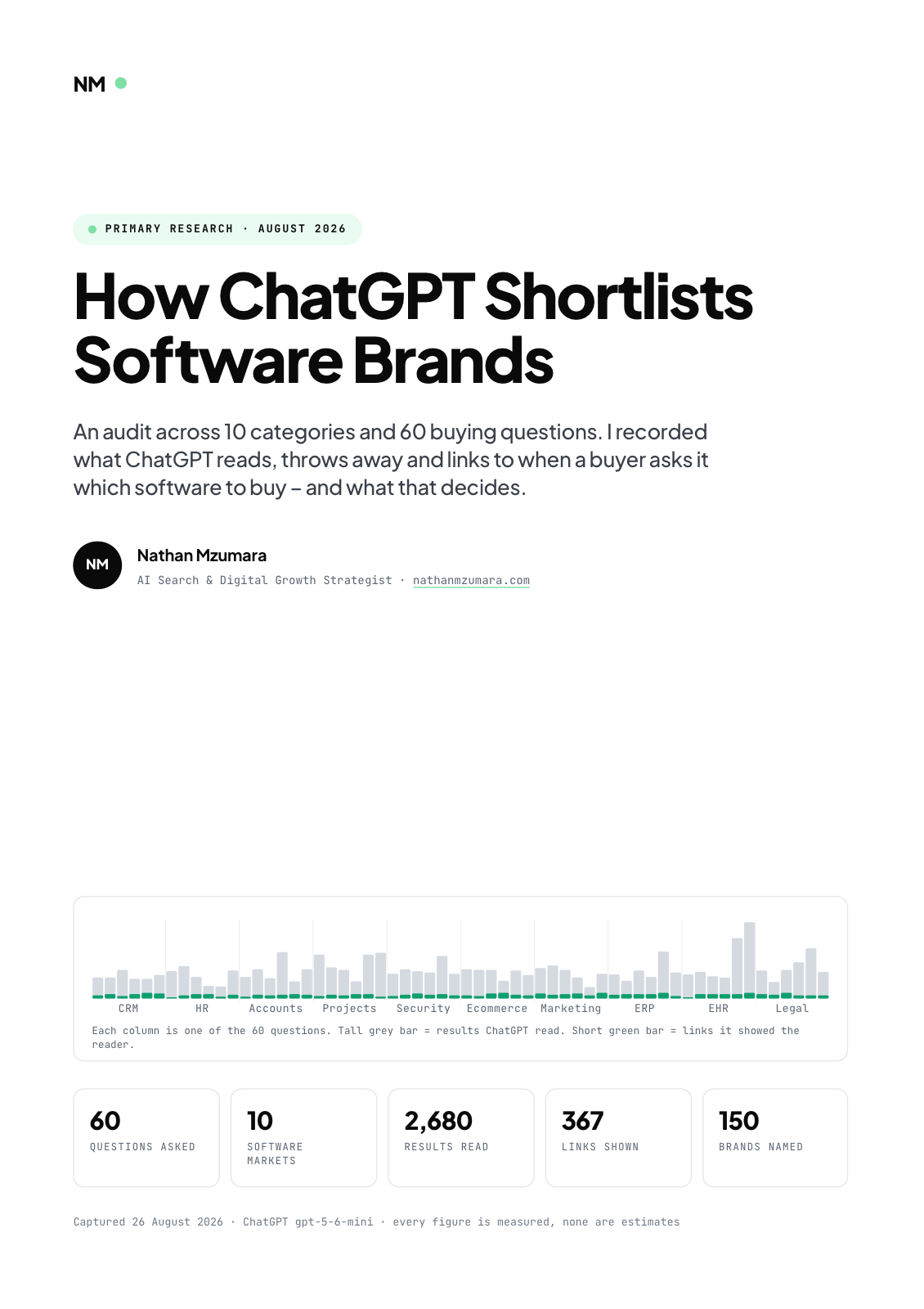
Primary research · August 2026
How ChatGPT Shortlists Software Brands
An audit across 10 categories and 60 buying questions. I recorded what ChatGPT reads, throws away and links to when a buyer asks it which software to buy, and what that decides.
- 60
- Questions asked
- 10
- Software markets
- 2,680
- Results read
- 367
- Links shown
Free download
Get the full report
35 pages · PDF · 536 KB. Enter your details and it downloads straight away.