Search Tactic
Link schemes
Also known as: link spam, paid link schemes
Link schemes are attempts to manipulate a site's rankings by creating, buying or exchanging links that would not exist on merit. Google's spam policies name them explicitly, covering paid links that pass ranking signals, large scale link exchanges, automated link building and links embedded in syndicated articles at scale. Sites involved can be demoted algorithmically or hit with a manual action.
What it is
A link scheme is any pattern of linking designed primarily to influence search rankings rather than to help a reader. Typical forms include buying or selling links that pass PageRank, reciprocal exchanges at scale, low value directory and bookmark submissions, guest posts placed purely for keyword-rich anchors, and links required as a condition of a contract or terms of service. The intent and the pattern matter more than any single link.
Why it matters
Links still carry weight as a signal of prominence, so the incentive to fake them has never gone away, and search engines invest heavily in detecting it. Getting caught can mean a demotion that is hard to diagnose or a manual action that suppresses visibility until the links are cleaned up and a reconsideration request is accepted. In AI-assisted search, where answers draw on sources that engines already consider trustworthy, a compromised link profile weakens the case for citing you at all.
How it works
Practitioners audit referring domains and anchor text for unnatural patterns, check whether paid, affiliate and sponsored placements carry rel="sponsored" or rel="nofollow", and mark user-generated links with rel="ugc". Where problem links cannot be removed, they are disavowed as a last resort, though Google advises most sites never need the disavow tool. The durable alternative is earning links through content, digital PR, product and partnerships that people would reference anyway.
When it applies
The topic applies whenever you buy, sell, exchange or sponsor links, run affiliate or influencer programmes, or inherit a link profile through a site acquisition or agency handover. It also applies during any diagnosis of an unexplained drop in organic visibility.
Examples
- An agency sells a monthly package of 20 guest posts with exact-match anchors on unrelated blogs, all pointing at the same three money pages.
- A SaaS vendor offers customers a discount in exchange for a dofollow link in their site footer, making the link a condition of the deal.
- A publisher runs sponsored reviews for affiliate commission but leaves the outbound links as plain follow links with no rel attribute.
How it is measured
- Share of referring domains judged low quality or irrelevant in a manual link audit
- Anchor text distribution, in particular the percentage of exact-match commercial anchors
- Percentage of paid, sponsored and affiliate outbound links carrying the correct rel attribute
- Manual action status in Google Search Console, including any unnatural links notices
Insights on Link schemes
Related terms in Search Tactic
- Answer Engine OptimisationThe practice of structuring content so it can be lifted directly into AI answers. Close cousin of GEO; emphasises clean, parseable facts and unambiguous attribution.
- Citation-worthy contentContent with the qualities LLMs select for when synthesising an answer: a single, defensible claim per paragraph; named entities; first-hand evidence; and a clear authority signal.
- Content auditA content audit is a structured review of every page or asset in a content set, scored against performance, quality, accuracy and search intent. The output is a decision for each item: keep, improve, consolidate, redirect or remove. It turns a large and uneven content library into a prioritised action plan.
- Crawler policyA crawler policy is the set of rules a site publishes and enforces to decide which automated agents may access its content, how often, and for what purpose. It typically combines robots.txt directives, server side rules and terms of use, and increasingly distinguishes search crawlers from AI training and assistant crawlers. The policy defines both what is allowed and what happens when a bot ignores it.
- Digital discoveryThe full set of channels through which people find brands, products, and answers, search engines, AI assistants, social platforms, marketplaces, and agentic browsers. Replaces the narrower frame of just “SEO”.
- Ecommerce SEOEcommerce SEO is the practice of making an online store's category, product, brand and editorial pages discoverable in organic search. It combines technical work on crawling, indexing and site structure with commercial decisions about which queries each page should serve. The goal is qualified non-paid traffic that converts into orders.
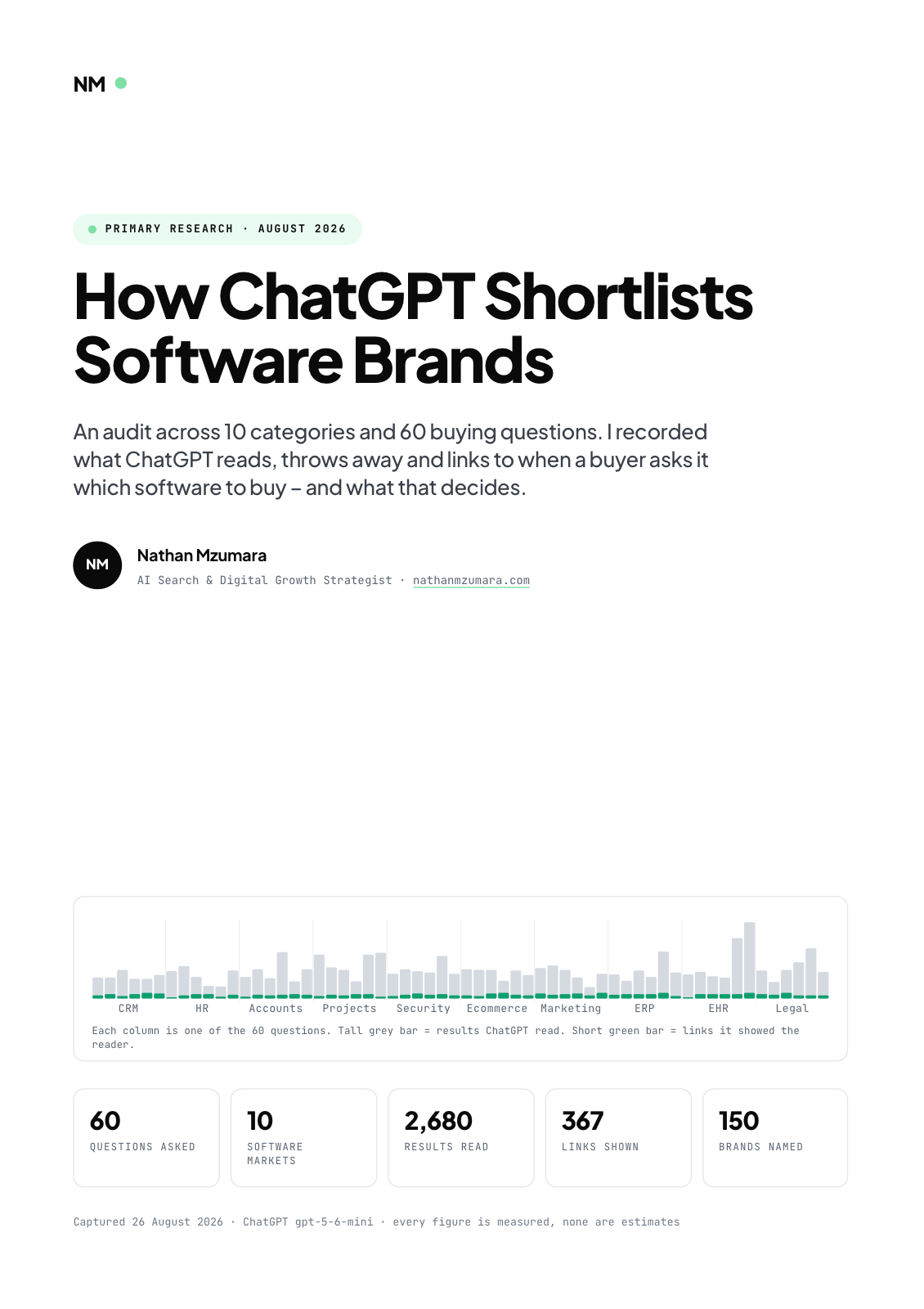
Primary research · August 2026
How ChatGPT Shortlists Software Brands
An audit across 10 categories and 60 buying questions. I recorded what ChatGPT reads, throws away and links to when a buyer asks it which software to buy, and what that decides.
- 60
- Questions asked
- 10
- Software markets
- 2,680
- Results read
- 367
- Links shown
Free download
Get the full report
35 pages · PDF · 536 KB. Enter your details and it downloads straight away.