Enterprise AI
Knowledge management
Also known as: KM, enterprise knowledge management
Knowledge management is the practice of capturing, organising, maintaining and making available the information an organisation relies on to do its work. It covers documentation, policies, product facts, support answers and the tacit knowledge held by staff. In an AI context it also covers how that material is structured so machines, not just people, can retrieve and reuse it accurately.
What it is
Knowledge management combines process, governance and tooling: where knowledge lives, who owns it, how it is reviewed, and how people and systems find it. Traditional KM focused on intranets, wikis and document stores. Modern KM extends to the content layer that feeds retrieval-augmented generation, internal assistants and external AI answer engines.
Why it matters
Generative systems answer from whatever they can retrieve, so poorly maintained knowledge shows up as confident but wrong answers. If your product facts, pricing rules and policies are inconsistent across sources, both internal assistants and external AI search tools will reproduce that inconsistency. Clean, owned, current knowledge is now a discovery asset as much as an operational one.
How it works
Practitioners inventory existing content, remove duplicates and contradictions, assign an owner and review cycle to each asset, then structure pages so that facts are stated plainly and are easy to extract. For AI use cases they chunk and index content, add metadata such as product, region and effective date, and run retrieval evaluations against a set of known questions. Feedback loops from unanswered queries and from support tickets feed the next round of content work.
When it applies
It applies whenever an organisation has more than a handful of people or products, and becomes urgent as soon as any assistant, chatbot or AI search surface is answering on the company's behalf.
Examples
- A software firm consolidates three overlapping help centres into one governed knowledge base, with a named owner and review date on every article.
- A bank tags every policy document with effective dates and regions so its internal assistant stops quoting withdrawn terms.
- A support team logs questions the assistant could not answer each week and turns the top twenty into new articles.
How it is measured
- Content freshness: share of articles reviewed or updated within the agreed cycle
- Retrieval accuracy: percentage of test questions where the correct source document is returned in the top results
- Self-service resolution rate, or tickets deflected per thousand knowledge base sessions
- Duplicate and contradiction count found in periodic content audits
Insights on Knowledge management
Related terms in Enterprise AI
- AI agentsAI agents are software systems that use a language model to plan and carry out multi-step tasks, rather than simply returning a block of text. They can call tools, query APIs, browse websites and write to other systems in pursuit of a goal, with varying degrees of human oversight. The term covers everything from a scripted assistant that books a meeting to a research agent that gathers sources and drafts a report.
- AI chipsAI chips are processors designed or optimised to run machine learning workloads, especially the large matrix operations behind training and inference. The category covers GPUs, tensor and neural processing units, and custom ASICs, usually paired with high-bandwidth memory and fast interconnects. They are also called AI accelerators or AI semiconductors.
- AI drug discoveryAI drug discovery is the use of machine learning and computational models to support the early stages of finding and refining new medicines. Models are applied to tasks such as predicting protein structures, identifying candidate molecules, prioritising targets and estimating properties like toxicity or binding affinity. The aim is to narrow a very large search space before expensive laboratory and clinical work begins.
- AI infrastructureAI infrastructure is the stack of hardware, networking, storage and software needed to train, fine-tune and serve AI models at scale. It spans accelerators such as GPUs, the data centres and power that house them, and the orchestration and serving layers that turn raw compute into working model endpoints. For most marketing teams it is a cost and capacity constraint they consume through APIs rather than something they build.
- AI procurementAI procurement is the process of evaluating, buying and contracting artificial intelligence tools and services, from assistants and content platforms to models accessed through an application programming interface. It covers commercial terms alongside security, data protection, accuracy and integration questions that do not arise with ordinary software. Most organisations run it as a structured review with pilots, stakeholder sign off and defined exit conditions.
- AI securityAI security is the practice of protecting AI systems, their data and the applications built on them from misuse, manipulation and leakage. It covers threats such as prompt injection, data exfiltration through model outputs, unsafe tool use by agents and compromised supply chains. It also covers the controls that keep AI features safe once they are live.
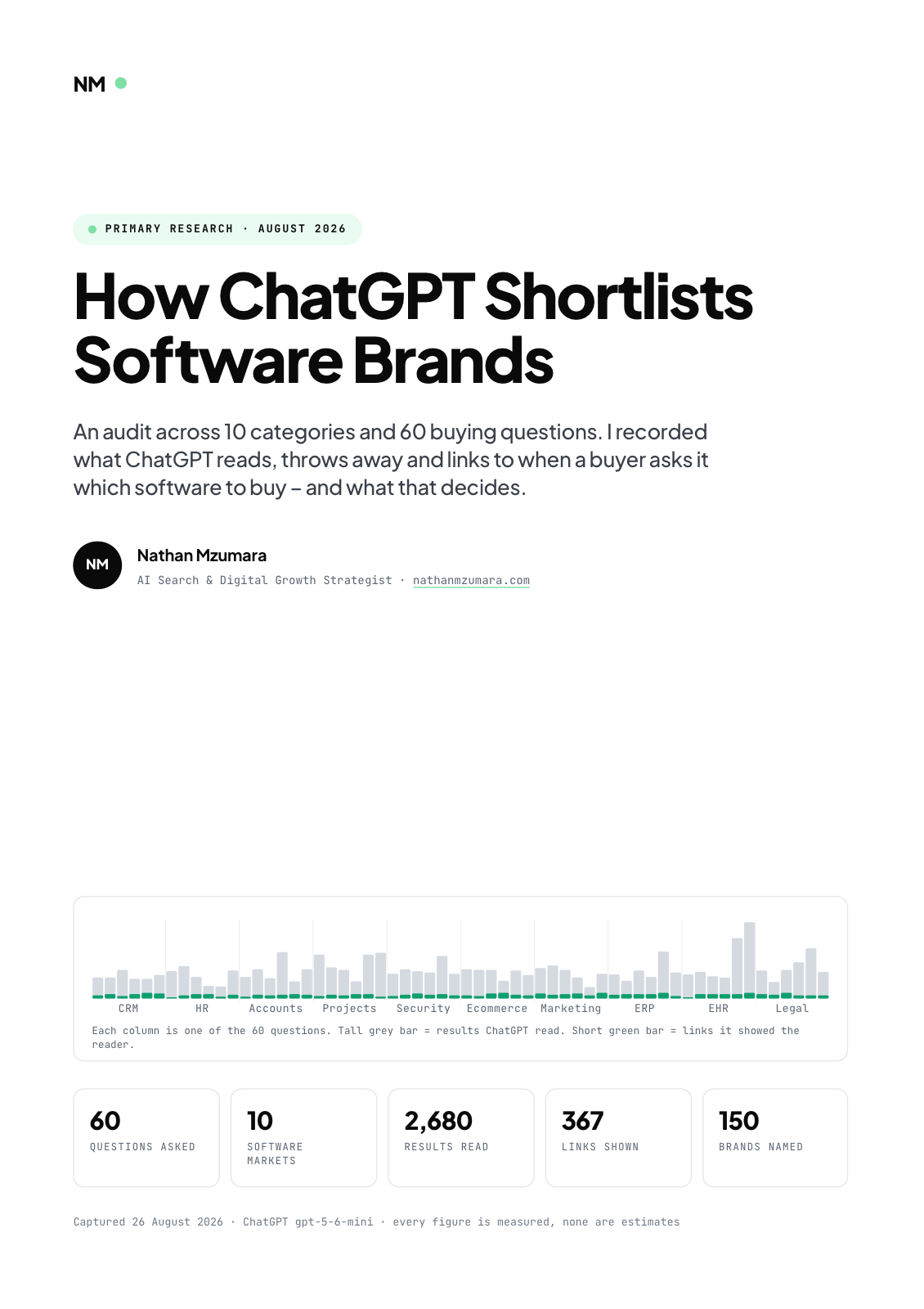
Primary research · August 2026
How ChatGPT Shortlists Software Brands
An audit across 10 categories and 60 buying questions. I recorded what ChatGPT reads, throws away and links to when a buyer asks it which software to buy, and what that decides.
- 60
- Questions asked
- 10
- Software markets
- 2,680
- Results read
- 367
- Links shown
Free download
Get the full report
35 pages · PDF · 536 KB. Enter your details and it downloads straight away.