Search Tactic
Keyword research
Also known as: query research, keyword discovery
Keyword research is the process of finding and prioritising the queries people use when looking for information, products or services in your market. It combines volume, intent, difficulty and business value to decide which topics deserve pages and budget. The output is usually a mapped list of queries, clusters and target URLs.
What it is
Keyword research starts with seed terms and expands them using search tools, autocomplete, site search logs, sales calls and competitor pages. Each query is then classified by intent, grouped into clusters that can be served by one page, and scored on commercial value and difficulty. The result is a working document that tells content, product and paid teams what to build and in what order.
Why it matters
It is how you connect what the business sells to the language customers actually use, which is often not the language used internally. Good research prevents duplicate pages, exposes gaps competitors already cover, and gives a defensible reason for each piece of content. As answer engines and AI summaries reshape clicks, understanding the question behind the query matters more than chasing a single head term.
How it works
Practitioners export volume and difficulty data from a keyword tool, pull real queries from Search Console and internal site search, then cluster by meaning rather than exact string. Clusters are mapped one to one against existing or planned URLs, with a primary query and supporting questions for each. Prioritisation weighs expected traffic against conversion likelihood and the effort required to compete.
When it applies
It applies before writing or restructuring content, when planning a site architecture or migration, and on a recurring basis as new terminology and question formats emerge.
Examples
- A law firm finds that clients search "how long does probate take" far more than "probate services", and builds a question led guide that feeds the service page.
- An ecommerce site clusters 400 queries into 30 category and filter pages, removing 12 thin pages that were competing with each other.
- A SaaS team mines Search Console for question queries already earning impressions, then expands the FAQ blocks that AI assistants tend to quote.
How it is measured
- Number of priority clusters with a single mapped, published URL
- Share of tracked clusters where the site ranks in the top ten, and top three
- Impressions and clicks growth for mapped clusters in Search Console
- Conversion rate and assisted revenue by cluster, to check commercial value not just volume
Related terms in Search Tactic
- Agentic researchAgentic research is the use of an AI system that plans and carries out a multi-step research task on its own, running many searches, opening and reading sources, then writing a synthesised answer or report with citations. It differs from a single search query because the model decides what to look up next based on what it has already found. Vendors often market this capability as deep research.
- Answer Engine OptimisationThe practice of structuring content so it can be lifted directly into AI answers. Close cousin of GEO; emphasises clean, parseable facts and unambiguous attribution.
- Citation-worthy contentContent with the qualities LLMs select for when synthesising an answer: a single, defensible claim per paragraph; named entities; first-hand evidence; and a clear authority signal.
- Content auditA content audit is a structured review of every page or asset in a content set, scored against performance, quality, accuracy and search intent. The output is a decision for each item: keep, improve, consolidate, redirect or remove. It turns a large and uneven content library into a prioritised action plan.
- Crawler policyA crawler policy is the set of rules a site publishes and enforces to decide which automated agents may access its content, how often, and for what purpose. It typically combines robots.txt directives, server side rules and terms of use, and increasingly distinguishes search crawlers from AI training and assistant crawlers. The policy defines both what is allowed and what happens when a bot ignores it.
- Digital discoveryThe full set of channels through which people find brands, products, and answers, search engines, AI assistants, social platforms, marketplaces, and agentic browsers. Replaces the narrower frame of just “SEO”.
Primary research · August 2026
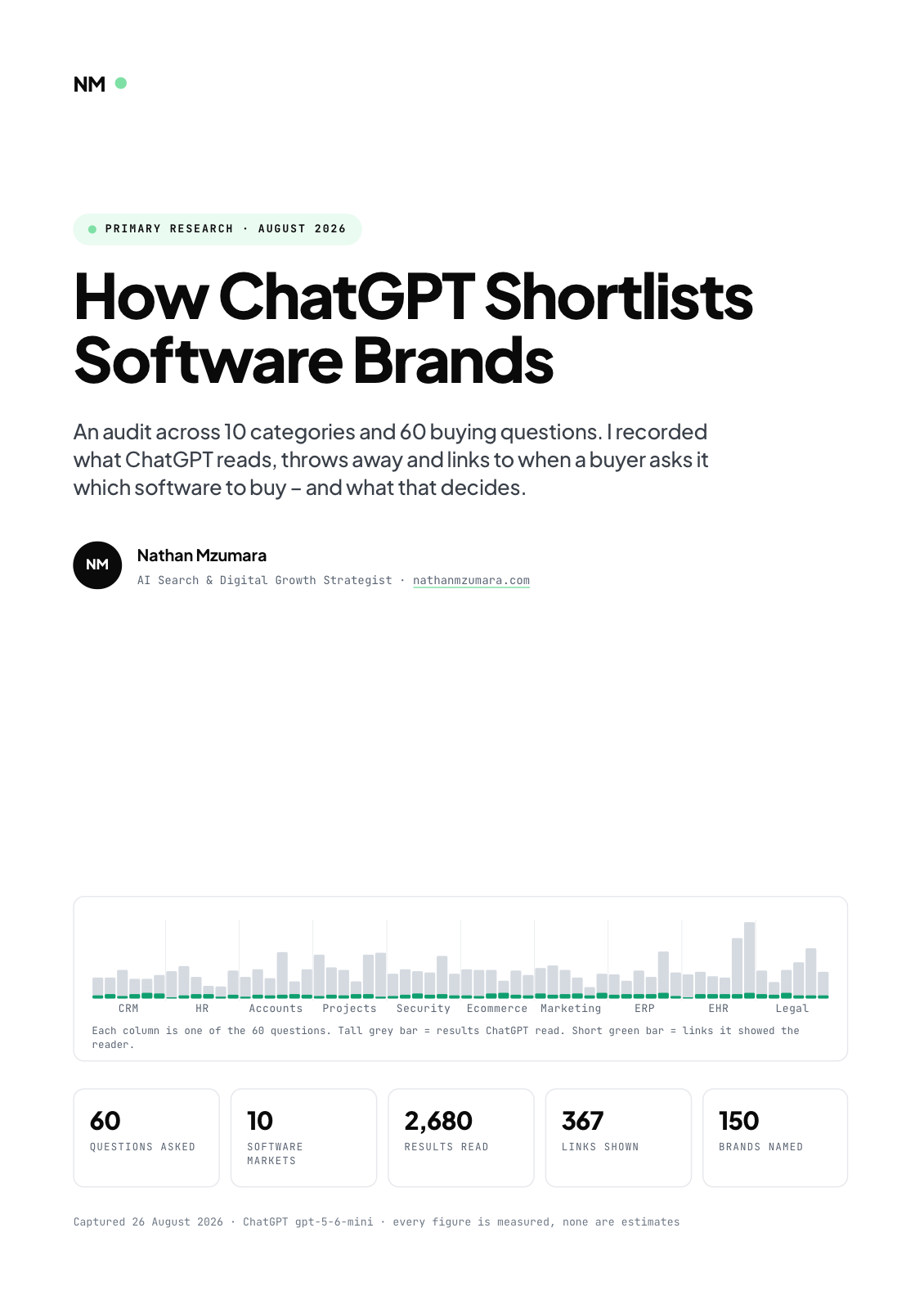
How ChatGPT Shortlists Software Brands
An audit across 10 categories and 60 buying questions. I recorded what ChatGPT reads, throws away and links to when a buyer asks it which software to buy, and what that decides.
- 60
- Questions asked
- 10
- Software markets
- 2,680
- Results read
- 367
- Links shown
Free download
Get the full report
35 pages · PDF · 536 KB. Enter your details and it downloads straight away.