Enterprise AI
Enterprise resource planning
Also known as: ERP, ERP system
Enterprise resource planning, or ERP, is software that runs core business processes such as finance, procurement, inventory, manufacturing, supply chain and often HR on a shared data model. Instead of separate systems for each function, an ERP keeps one record of customers, products, orders and transactions. It is usually the system of record that other tools, including marketing and commerce platforms, read from.
What it is
An ERP is an integrated suite of modules sitting on a single database, so a stock movement, an invoice and a general ledger entry all reference the same underlying records. Deployments range from cloud suites to heavily customised on premise installations. Most large organisations run one or more ERPs alongside a CRM and a commerce or content platform.
Why it matters
For discovery work the ERP often holds the facts that need to be accurate in public: product specifications, pricing, stock availability, branch details and lead times. If feeds to the website, product data and structured data come from the ERP, its data quality becomes a search and AI visibility issue. Poor ERP hygiene shows up as wrong prices in shopping results, out of stock listings and product pages that assistants cannot describe reliably.
How it works
Teams integrate the ERP with front end systems through APIs, middleware or scheduled feeds, so product, price and availability data flows to the site, feeds and structured data. Marketers work with data owners to define which fields are authoritative, how often they sync and who fixes errors at source. Attribute governance matters: consistent product titles, categories, identifiers and units in the ERP reduce cleanup downstream.
When it applies
It is relevant whenever product, price, availability or location data shown to customers originates in an operational system rather than being written by hand in a CMS. It applies most in manufacturing, distribution, multi location retail and B2B commerce.
Examples
- A distributor's product pages pull stock levels and lead times from the ERP every hour, so availability shown in search feeds matches the warehouse.
- A retailer standardises product titles and units in the ERP, cutting disapprovals in its shopping feed caused by mismatched attributes.
- A B2B manufacturer exposes ERP held specification fields as structured data so technical attributes appear in search results and AI summaries.
How it is measured
- Feed error and disapproval rate caused by source data issues
- Percentage of product records with complete required attributes in the ERP
- Sync latency between ERP updates and live site or feed values
- Mismatch rate between published price or stock and the ERP record on spot checks
Insights on Enterprise resource planning
Related terms in Enterprise AI
- AI agentsAI agents are software systems that use a language model to plan and carry out multi-step tasks, rather than simply returning a block of text. They can call tools, query APIs, browse websites and write to other systems in pursuit of a goal, with varying degrees of human oversight. The term covers everything from a scripted assistant that books a meeting to a research agent that gathers sources and drafts a report.
- AI chipsAI chips are processors designed or optimised to run machine learning workloads, especially the large matrix operations behind training and inference. The category covers GPUs, tensor and neural processing units, and custom ASICs, usually paired with high-bandwidth memory and fast interconnects. They are also called AI accelerators or AI semiconductors.
- AI cost managementAI cost management is the practice of tracking, forecasting and controlling what an organisation spends on AI systems, including model API calls, inference compute, vector storage and the tooling around them. It applies familiar financial discipline to usage that is variable, token based and easy to scale without noticing. The goal is predictable spend at an acceptable level of quality and latency, rather than the lowest possible bill.
- AI drug discoveryAI drug discovery is the use of machine learning and computational models to support the early stages of finding and refining new medicines. Models are applied to tasks such as predicting protein structures, identifying candidate molecules, prioritising targets and estimating properties like toxicity or binding affinity. The aim is to narrow a very large search space before expensive laboratory and clinical work begins.
- AI infrastructureAI infrastructure is the stack of hardware, networking, storage and software needed to train, fine-tune and serve AI models at scale. It spans accelerators such as GPUs, the data centres and power that house them, and the orchestration and serving layers that turn raw compute into working model endpoints. For most marketing teams it is a cost and capacity constraint they consume through APIs rather than something they build.
- AI procurementAI procurement is the process of evaluating, buying and contracting artificial intelligence tools and services, from assistants and content platforms to models accessed through an application programming interface. It covers commercial terms alongside security, data protection, accuracy and integration questions that do not arise with ordinary software. Most organisations run it as a structured review with pilots, stakeholder sign off and defined exit conditions.
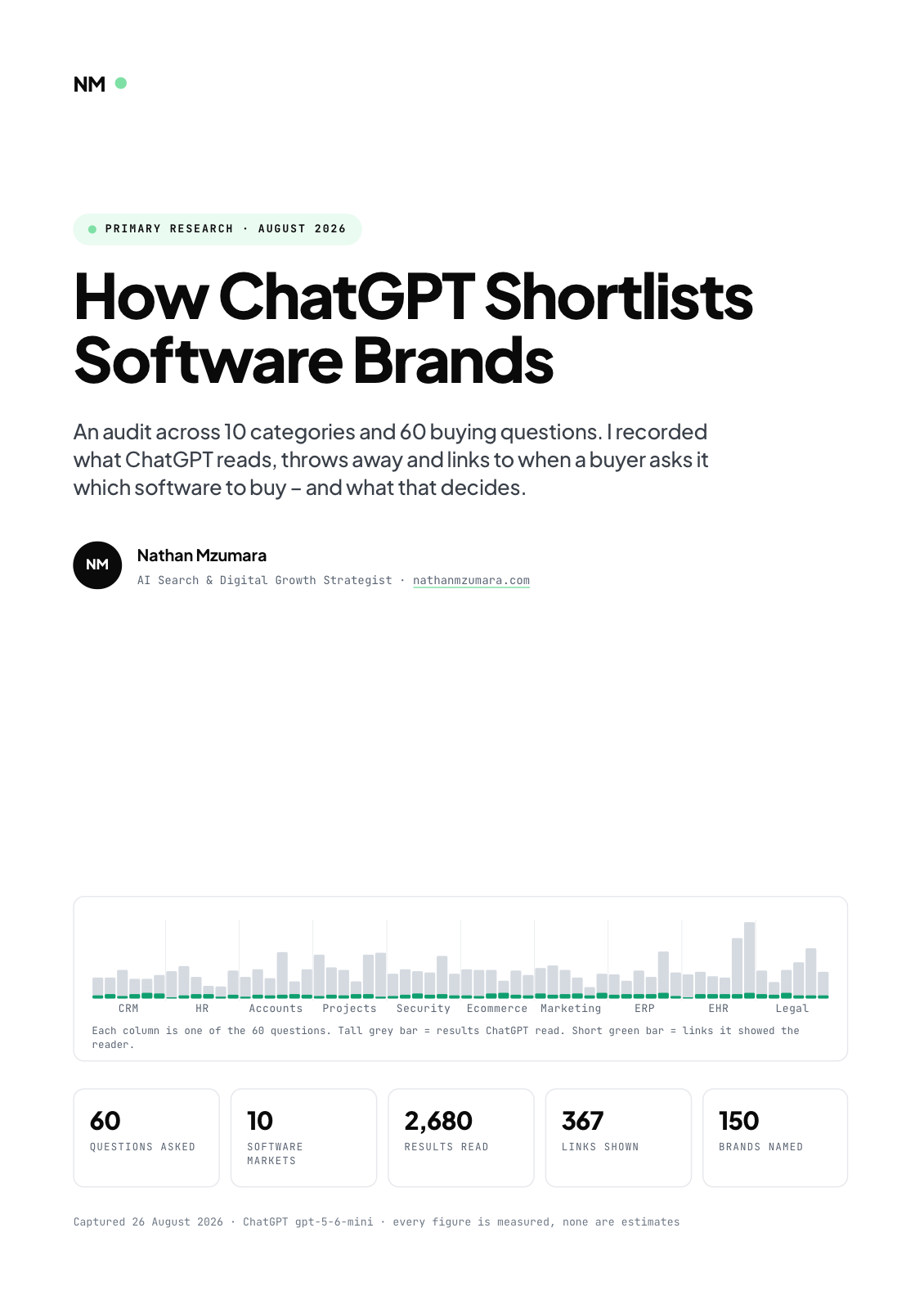
Primary research · August 2026
How ChatGPT Shortlists Software Brands
An audit across 10 categories and 60 buying questions. I recorded what ChatGPT reads, throws away and links to when a buyer asks it which software to buy, and what that decides.
- 60
- Questions asked
- 10
- Software markets
- 2,680
- Results read
- 367
- Links shown
Free download
Get the full report
35 pages · PDF · 536 KB. Enter your details and it downloads straight away.