LLM Platform
Amazon Bedrock
Also known as: Bedrock, AWS Bedrock
Amazon Bedrock is a managed AWS service that gives developers API access to foundation models from several providers, including Anthropic, Meta, Mistral, Cohere, AI21 Labs, Stability AI and Amazon's own models. It handles hosting, scaling and access control, so teams can call models without running their own inference infrastructure. It also bundles supporting features such as retrieval over your own documents, agents, guardrails and model evaluation.
What it is
Bedrock is AWS's front door to large language models and other foundation models, exposed through a single set of APIs and the AWS SDKs. Rather than committing to one model vendor, teams can switch between models by changing a model identifier. It sits alongside the rest of AWS, so identity, logging, networking and billing work the way the rest of an AWS estate does.
Why it matters
For marketing and discovery work, Bedrock is often the platform underneath internal AI features such as site search, product question answering, content drafting tools and support assistants. Those features shape how customers find and evaluate things on your own properties, which is a growing part of the discovery picture alongside public AI assistants. Choosing a platform also decides how easily you can test a new model when a better one appears.
How it works
Practitioners call Bedrock from application code or a workflow tool, usually with a prompt plus context retrieved from their own data. Bedrock Knowledge Bases can connect a document store to a vector index so answers are grounded in your content, Agents can chain tool calls, and Guardrails can filter topics and content the business does not want generated. Teams typically start on on demand pricing, then move high volume workloads to provisioned throughput.
When it applies
It applies when an organisation already runs on AWS and wants model access under existing security, data residency and procurement arrangements. It is less relevant if you only need a chat interface for individuals rather than an API behind a product or internal tool.
Examples
- A retailer builds an on site product adviser using Bedrock Knowledge Bases over its product manuals and returns policy.
- A B2B SaaS team drafts first versions of help centre articles through a Bedrock API call, then routes every draft to a human editor.
- A publisher runs the same prompt set against two Bedrock models to compare answer quality and cost before committing.
How it is measured
- Cost per thousand input and output tokens by model and workload
- Answer groundedness or citation accuracy in retrieval based features, sampled and scored by humans
- Median and p95 response latency for user facing features
- Guardrail intervention rate, split by blocked topic and false positives
Insights on Amazon Bedrock
Related terms in LLM Platform
- Answer engineAn answer engine is a search product that responds to a question with a direct, synthesised answer rather than a ranked list of links. It reads and summarises sources, usually citing some of them, and supports follow-up questions in the same session. ChatGPT search, Perplexity, Google AI Mode and AI Overviews all behave as answer engines.
- ChatGPTOpenAI's consumer assistant, the largest LLM surface by user count. Citation patterns shift materially with major model releases (e.g. GPT-5.5 in May 2026), and persistent memory now carries brand affinity across sessions.
- ClaudeAnthropic's assistant. Strong on long-context analysis, tool use, and structured citation. Increasingly cited inside enterprise workflows where source attribution and reasoning quality matter.
- CopilotMicrosoft's assistant, integrated across Bing, Windows, Office, and Edge. Pulls from the open web with Bing's index; visibility in Copilot is correlated with Bing ranking signals more tightly than other LLMs.
- GeminiGoogle's flagship assistant, integrated across Workspace, Android, and Search (AI Overviews and AI Mode use Gemini-family models). Brands optimising for Gemini reach are simultaneously optimising for AI Overviews.
- GrokxAI's assistant, surfaced primarily inside X (formerly Twitter) and via the standalone Grok app. Distinctive for real-time access to the X firehose, which makes it the fastest LLM surface for current-events and live-trend queries, a different discovery shape from retrieval-grounded competitors.
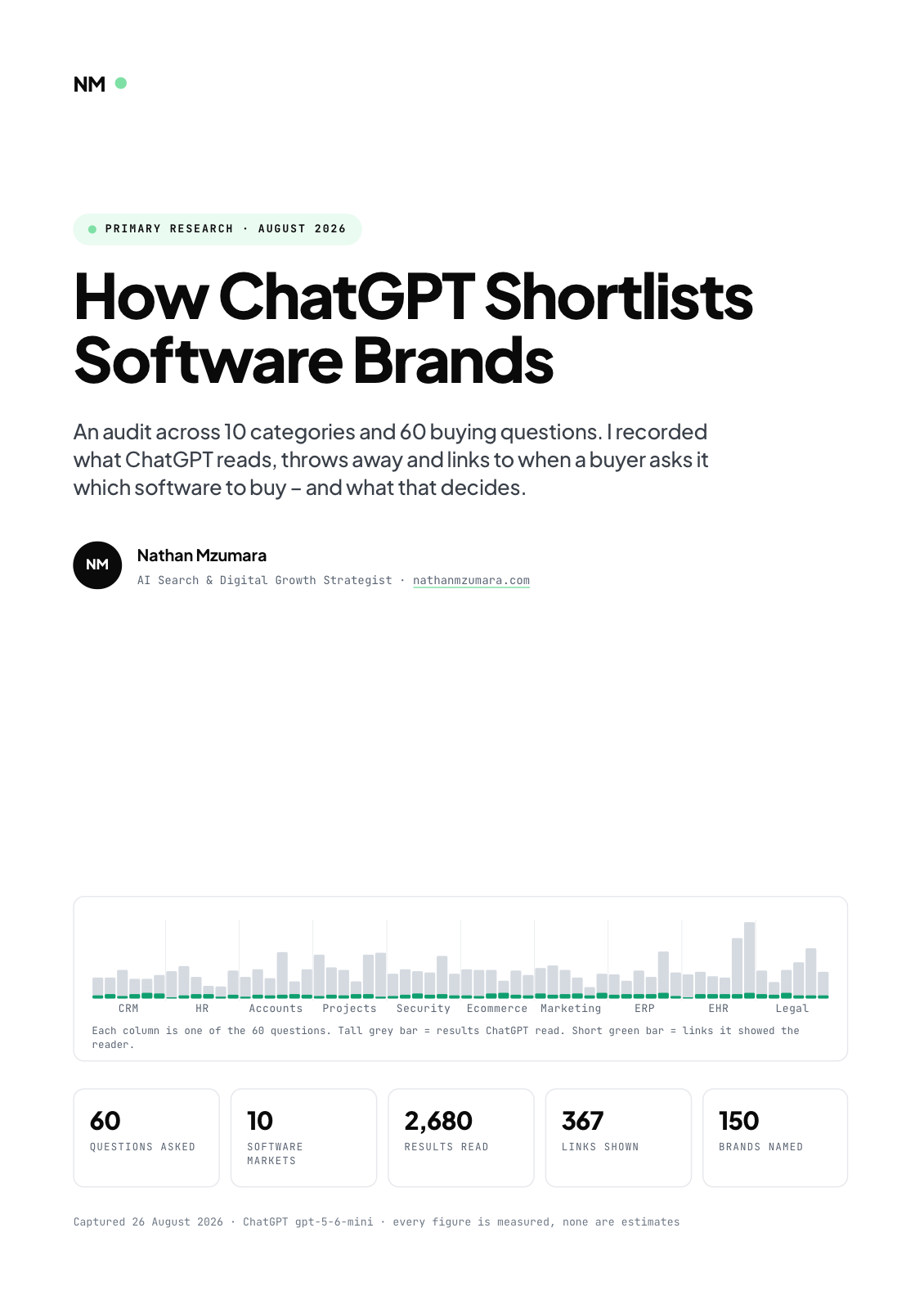
Primary research · August 2026
How ChatGPT Shortlists Software Brands
An audit across 10 categories and 60 buying questions. I recorded what ChatGPT reads, throws away and links to when a buyer asks it which software to buy, and what that decides.
- 60
- Questions asked
- 10
- Software markets
- 2,680
- Results read
- 367
- Links shown
Free download
Get the full report
35 pages · PDF · 536 KB. Enter your details and it downloads straight away.