Analytics & Measurement
AI cost per task
Also known as: cost per task, per-task AI cost, AI unit cost
AI cost per task is the total cost of completing one unit of useful work with an AI system, divided by the number of tasks completed to an acceptable standard. It includes model tokens, tool and retrieval calls, retries, and any human review needed before the output can be used. It is the unit economics measure behind an AI workflow.
What it is
AI cost per task converts scattered spending on models, APIs, vector search and human checking into a single figure per completed job, such as one drafted brief, one enriched record or one resolved support ticket. The denominator matters: only outputs that pass quality review should count. Tracked this way, it exposes workflows that look cheap per call but expensive per finished result.
Why it matters
Teams often budget by subscription or token spend, which hides the real driver of cost, namely retries and human rework. Cost per task makes AI investment comparable with the manual process it replaces and with other channels, so it can be defended in a budget conversation. It also guides where to spend effort: prompt changes, cheaper models, better retrieval or tighter scope.
How it works
Define the task and its acceptance criteria, instrument the workflow to log tokens, tool calls and wall-clock human review time per attempt, then divide total period cost by accepted outputs. Practitioners compare variants by routing a share of tasks to a smaller model or shorter context and watching whether the acceptance rate holds. Caching, retrieval trimming and early failure checks usually move the number more than raw model price.
When it applies
It applies whenever an AI workflow runs at volume and repeatedly, such as content production pipelines, data enrichment, classification, support deflection or internal research, and especially before scaling a pilot.
Examples
- A content team calculates that one published product page costs 1.20 pounds in model calls plus 25 minutes of editor time, and uses that to decide how many pages to commission.
- A support lead compares cost per resolved ticket between an AI first-line assistant and the previous human-only queue.
- An ops team finds that a third of enrichment records fail validation and retry, so the true cost per accepted record is well above the per-call figure.
How it is measured
- Cost per accepted task, with model, tooling and human review costs separated
- Acceptance rate on first attempt, and average retries per completed task
- Human minutes per task, tracked as the workflow matures
- Cost per task versus the manual baseline it replaces, reviewed monthly
Insights on AI cost per task
Related terms in Analytics & Measurement
- A/B testingA/B testing is a controlled experiment that shows two or more versions of a page, email or feature to randomly split groups of users and compares how each performs against a chosen goal. It isolates the effect of a single change so improvement can be attributed rather than assumed. It is also called split testing.
- AttributionAttribution is the practice of assigning credit for a conversion to the marketing touchpoints that preceded it. It covers the models, rules and data joins used to decide which channels, campaigns or content get counted. In AI search, attribution is harder because many assistant-led journeys leave little or no referral data.
- Click-through rateClick-through rate is the proportion of people who saw something and then clicked it, expressed as clicks divided by impressions. It is used to judge search listings, ads, emails and internal links. A higher rate usually means the message matched what the audience was looking for.
- Consent ModeConsent Mode is a Google framework that lets tags adjust their behaviour based on the consent choices a visitor has made. Instead of tags being blocked outright, they receive signals about whether analytics and advertising storage are allowed, and act accordingly. Version 2 added parameters covering the use of personal data for ads and for ad personalisation.
- Conversion trackingConversion tracking is the practice of recording the actions you care about, such as purchases, form submissions or calls, and connecting them back to the channel, campaign or session that led to them. It gives advertising platforms and analytics tools the outcome data they need to report performance and optimise bidding. Accuracy depends on correct tag implementation, consent handling and clear conversion definitions.
- Cross-channel reportingCross-channel reporting is the practice of bringing performance data from search, social, email, paid media, AI assistants and other channels into a single view. It standardises metrics and time periods so channels can be compared fairly rather than judged in isolated platform dashboards. The aim is to show how channels work together to produce enquiries, sales and revenue.
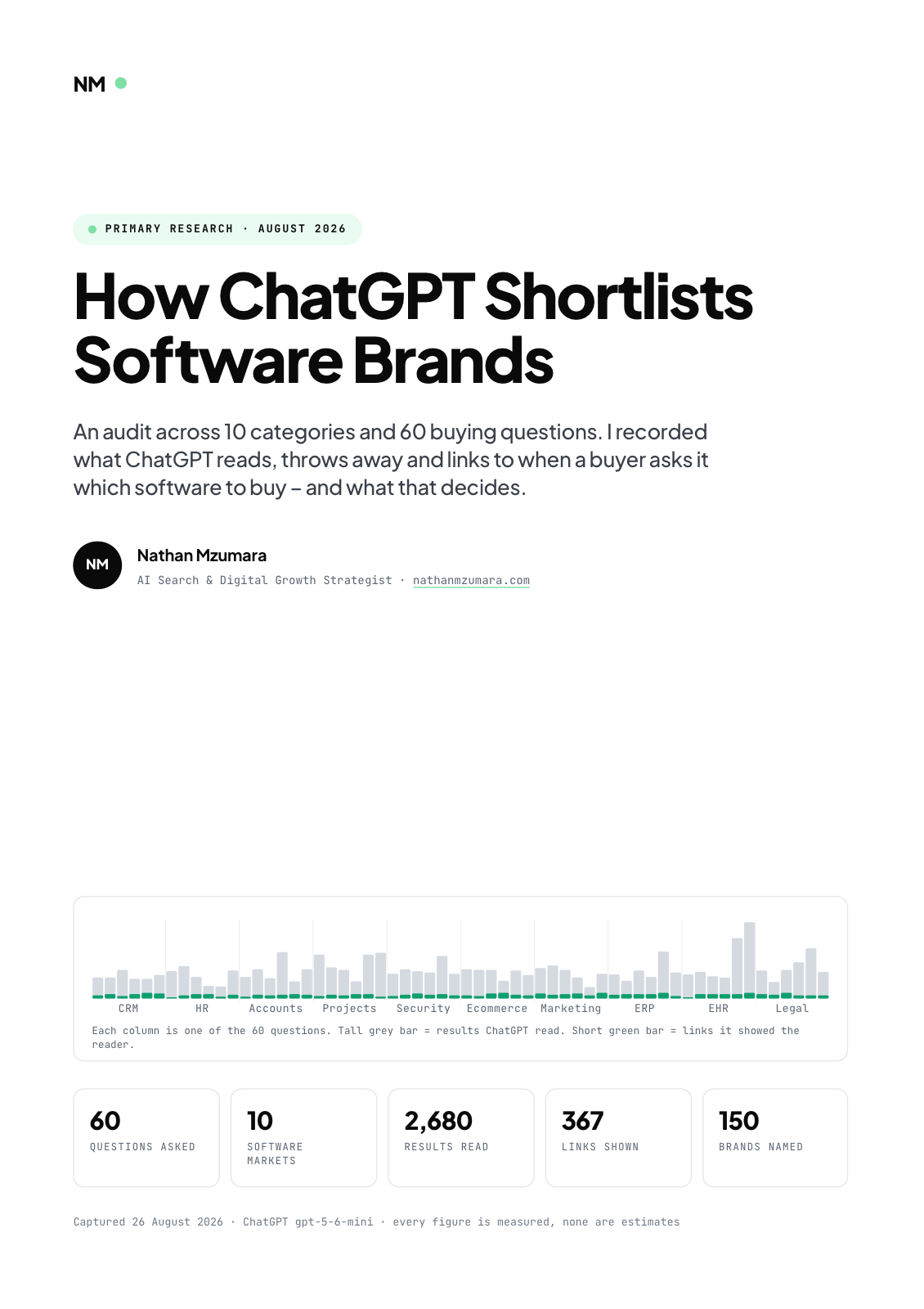
Primary research · August 2026
How ChatGPT Shortlists Software Brands
An audit across 10 categories and 60 buying questions. I recorded what ChatGPT reads, throws away and links to when a buyer asks it which software to buy, and what that decides.
- 60
- Questions asked
- 10
- Software markets
- 2,680
- Results read
- 367
- Links shown
Free download
Get the full report
35 pages · PDF · 536 KB. Enter your details and it downloads straight away.